Once summer arrives, this flower blooms in brilliant colors all over its branches.
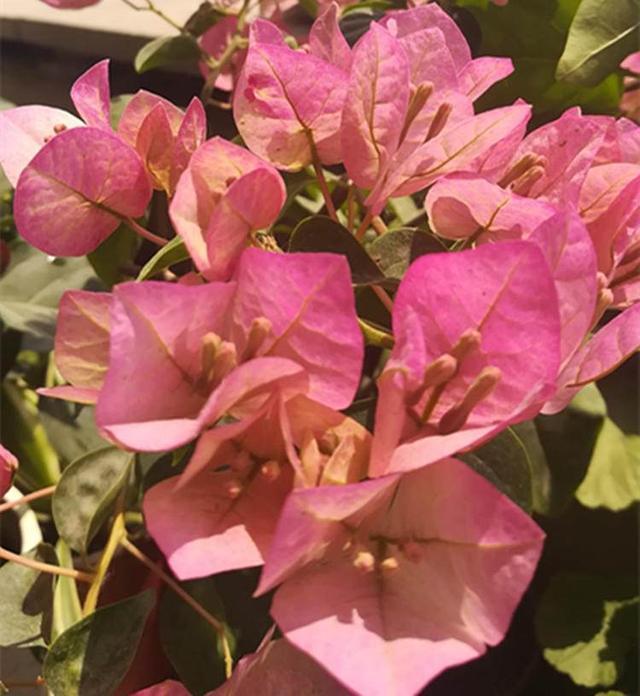
Bougainvillea is a woody climbing flower. Its blooms are brightly colored, large and beautiful, in shades of brick red, purple-red, light purple, creamy white, orange-yellow and more. Because its bracts closely resemble flowers, it is called "bougainvillea." All year round, whenever it blooms, the dazzling "flowers" cover its branches, and even in summer it is not affected by the heat in the slightest.
Bougainvillea prefers a sunny, warm and humid environment. It is fairly heat-tolerant and can still bloom when the temperature reaches 35°C, making it a neutral plant that is completely unafraid of heat. However, bougainvillea is not cold-tolerant, and in areas north of the Yangtze River it can only overwinter indoors in pots. It likes fertile soil with plenty of moisture, tolerates pruning, and does not tolerate shade.
From May to September, in summer, water thoroughly when the potting soil is dry; in summer it needs watering every day. In autumn, control watering; in winter, water once about every 3 days when the soil is dry. Bougainvillea can withstand low temperatures of 7°C. During the flowering period, keep it moderately dry and do not fertilize.
For general bougainvillea cultivation, the potting soil is made by mixing loam, cow manure, leaf mold and sand, piling it up to compost, and adding an appropriate amount of bone meal when using it. During cultivation, pinch out the growing tips regularly to form a bushy, low-growing plant shape. A trellis can also be set up to let it climb upward.
Bougainvillea is a light-loving plant, and whether grown indoors or in the open ground, it should be placed in a spot with plenty of sunlight. With sufficient light, it blooms abundantly; with insufficient light, it has sparse leaves and few flowers, the new shoots grow thin and weak, and the bracts are dull in color or it may even fail to bloom.
When caring for bougainvillea, repot it before it sprouts in spring. During the vigorous growth period, water it thoroughly, and water until it runs through. After flowering, watering should be appropriately reduced. In early October, move it indoors and control watering and room temperature so that the buds do not sprout. In May, move it outdoors for open-ground care, fertilizing once every half month; during the flowering period, increase phosphorus fertilizer, and during the growth period avoid excessive nitrogen fertilizer to prevent leggy growth.
After flowering, shape and prune the plant to adjust its vigor, cutting off dead branches, dense branches, diseased and weak branches and shoot tips, to encourage more sturdy new branches and ensure abundant blooming. About every 5 years, it can be heavily pruned and renewed once. In winter, control watering so the plant goes into full dormancy, and then in the coming spring and summer it will bloom even more profusely and brilliantly.