Effects of Different Cuttings Lengths on the Quality of Own-Rooted Grape Seedlings
Effects of Different Cuttings Lengths on the Quality of Own-Rooted Grape Seedlings
Currently, grape cutting methods in different regions of China are largely similar, but because of the blind pursuit of seedling output, the quality of seedlings is neglected, resulting in uneven seedling quality and seriously affecting the early yield and fruit quality of grapes. With the development of science and technology, grape cultivation has gradually expanded to unsuitable areas such as the arid, semi-arid and cold northwest and the high-temperature, high-humidity south. Because seedling quality affects the stress resistance, growth vigor and yield of grapevines, people are paying more and more attention to seedling quality. Previous studies have shown that the quality of grape cuttings and different cutting densities both affect seedling quality. Therefore, the authors conducted a study on the effects of different cutting lengths on the growth and quality of grape seedlings, hoping to provide a reference for producing high-quality grape seedlings.
1 Materials and Methods
1.1 Test Materials and Treatments
One-year-old dormant branches of three grape cultivars, Christmas Rose, Giant Rose and Summer Black, were used as test materials. During winter pruning in 2015, fully mature, thick, plump-budded, uniform-internode, 0.6-1.0 cm thick, pest- and disease-free one-year-old grape branches were selected from the grape experimental orchard of the Regulation Research Group, Zhengzhou Fruit Research Institute, Chinese Academy of Agricultural Sciences. After cutting, the branches were cut into short cuttings about 60.0 cm long, tied into bundles of 50, marked and stored together in sand for later use.
The experiment was conducted in the spring of 2016 in the grape experimental orchard of the Regulation Research Group, Zhengzhou Fruit Research Institute, Chinese Academy of Agricultural Sciences, with sandy soil. The dormant branches of the three cultivars were taken out of the sand storage pit, rinsed clean with clear water, soaked in clear water for 12-24 hours to fully absorb water until the cut surface was bright green, then removed and drained.
1.2 Experimental Methods
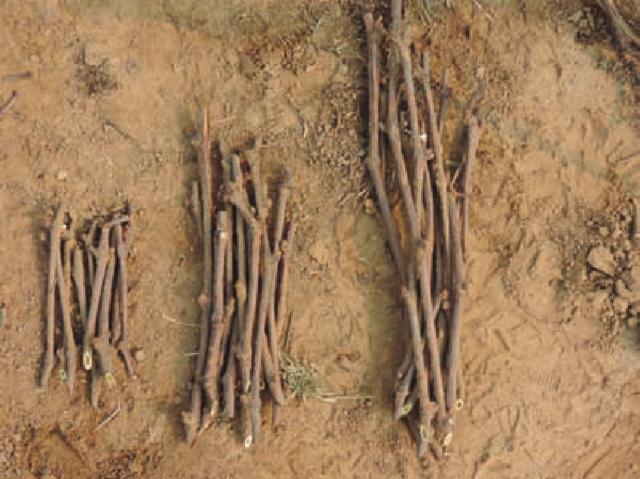
The experiment set up three treatments for grape cutting length: retaining 2 buds (T1), retaining 3 buds (T2), and retaining 4 buds (T3) (Figure 1). The upper end of the cutting was 1.0-1.5 cm from the bud and cut flat; the lower end was cut at an angle. The cuttings were quickly dipped in rooting powder (developed by Zhengzhou Fruit Research Institute, Chinese Academy of Agricultural Sciences) for 5-8 seconds, then inserted at a 45-degree angle to the ground into film-mulched nursery ridges. The ridge width was 60.0 cm, the furrow width was 40.0 cm, and 2 rows were inserted on each ridge (Figure 2). After thorough watering, soil was mounded over the base of the cuttings. After sprouting, 1 main shoot was retained, lateral shoots were pinched to leave 2 leaves, and pests and diseases were managed routinely.
300 cuttings were used as one plot, with three replications. After sprouting, the survival rate and mortality rate were investigated at the appropriate time; at the time of leaving the nursery in autumn, the trunk thickness between the 4th and 5th buds above the root crown was investigated.
Figure 1 Cuttings of the 3 treatments
Figure 2 Cutting ridges
2 Results and Analysis
2.1 Effects of Different Grape Cutting Lengths on Survival Rate
The experimental results showed that for Christmas Rose, the T1 treatment had the highest survival rate, 95% (Table 1) [Jishan Huayao], the T2 survival rate was 93.33%, and the T3 survival rate was 70.00%, significantly lower than treatments T1 and T2, showing a trend that the longer the cutting, the lower the survival rate. For Giant Rose, the seedling survival rates of the three treatments were all greater than 80.00%, among which T1 and T3 had the highest survival rates, both 95.00%, while the T2 survival rate was 86.67%, a difference of 8.33 percentage points from the former two. For Summer Black, the seedling survival rates of the three treatments were all lower than 80.00%, among which T1 had the lowest survival rate of all treatments, 73.33%, while T2 and T3 had the same survival rate, 76.67%.
Table 1 Effects of Different Cutting Lengths on the Quality of Own-Rooted Grape Seedlings
Note: Seedling thickness refers to the trunk thickness between the 4th and 5th buds above the root crown; above 0.8 cm is grade I, 0.6-0.8 cm is grade II, 0.4-0.6 cm is grade III, and less than 0.4 is below grade.
2.2 Effects of Different Cutting Lengths on the Quality of Own-Rooted Grape Seedlings
For Christmas Rose, the T1 treatment had the largest proportion of grade II seedlings (Table 1), with grade I and grade II seedlings accounting for 10.53% and 50.88% respectively, grade III seedlings accounting for 36.84%, and very few below-grade seedlings; the T2 treatment had no grade I seedlings, with grade II and grade III seedlings at 42.11% and 56.14 respectively, accounting for relatively large proportions, and very few below-grade seedlings; the T3 treatment had very small proportions of grade I and below-grade seedlings, with grade II seedlings accounting for 34.09% and grade III seedlings accounting for 50.00%. The statistical data showed that for Christmas Rose grape, the quality of own-rooted seedlings propagated from cuttings retaining 2 buds (T1) was the best.
For Giant Rose, in the T1 treatment the proportion of grade I seedlings was small, only 3.57%, grade II seedlings accounted for 23.21%, grade III accounted for a relatively large 58.93%, and below-grade accounted for 14.29%; treatment T2 had no grade I seedlings, grade III seedlings accounted for the vast majority, as high as 80.77%, and grade II and below-grade seedlings were 7.69% and 11.54% respectively; in the T3 treatment, grade I seedlings accounted for 4.35%, grade II seedlings 30.43%, grade III seedlings 52.17%, and below-grade 13.04%. The analysis results indicated that the growth vigor of Giant Rose grape seedlings cultivated by hardwood cuttings was relatively weak, and among the three treatments the proportion of grade III seedlings was relatively large, with the T2 treatment reaching as high as 80.77%, and seedling quality relatively poor. Under the condition of a relatively high survival rate, the T3 treatment, that is, cuttings retaining 3 buds, produced relatively better seedling quality.
For Summer Black, the T1 treatment had no grade I seedlings, grade II and below-grade seedlings each accounted for 14.29%, and grade III seedlings had the largest proportion of all treatments, accounting for 71.43%, with the poorest seedling quality. In the T2 treatment, grade I seedlings were only 1.75%, the proportions of grade II and grade III seedlings differed little, accounting for 45.61% and 47.37% respectively, and below-grade was 7.02%; the grade I seedlings of the T3 treatment were 10.87%, greater than those of the other 2 treatments, and its grade II and grade III seedling proportions were 36.96% and 43.48% respectively, both lower than those of the T2 treatment, with below-grade seedlings accounting for 8.70%. The results indicated that the seedling quality cultivated from Summer Black cuttings with a length of 3 buds or 4 buds was relatively better.
3 Discussion
Under the same external environment and the same cutting technique level, among the different treatments of the three grape cultivars, the own-rooted grape seedlings obtained that reached the grade I standard were relatively few, with the highest only 10.87% and the lowest zero, mostly grade II or grade III seedlings. Among them, Christmas Rose produced the best quality own-rooted grape seedlings when the cutting length retained 2 buds, and also had the highest survival rate; the growth vigor of Giant Rose grape seedlings cultivated by hardwood cuttings was relatively weak, and among the three treatments the proportion of grade III seedlings was relatively large; under the condition of a relatively high survival rate, the seedling quality cultivated when the cutting retained 3 buds was relatively better; for Summer Black grape, the seedlings cultivated from cuttings with a length of 2 buds were mostly grade III in quality, while the seedlings cultivated from cuttings retaining 3 buds or 4 buds were mostly grade II and grade III seedlings. The experimental results fully demonstrated that the heredity of the grape plant has a great influence on the quality of its vegetatively propagated seedlings, and that the length of grape hardwood cuttings is related to the quality of own-rooted seedlings, with certain differences among different grape cultivars. Moreover, previous studies have shown that the quality of grape cuttings and different cutting densities both affect seedling quality.
Therefore, the quality of own-rooted grape seedlings propagated by cuttings is not only affected by external factors such as the environment and cutting techniques such as cutting density, but is also related to the internal factors of the grape plant itself, such as the grape's own heredity, and the length, thickness and maturity of hardwood cuttings, and the performance varies. In production, suitable cutting length, thickness and cutting density should be selected according to the grape cultivar for cutting propagation, so as to achieve the ideal effect.