Key Techniques for Delaying Leaf Senescence in Protected Delayed Cultivation of Red Globe Grape
Key Techniques for Delaying Leaf Senescence in Protected Delayed Cultivation of "Red Globe" Grape
Delayed cultivation of "Red Globe" grape is a new form of protected grape cultivation with Chinese characteristics. It is exactly the opposite of forcing cultivation. Its purpose is to cover for cold protection in the late growth stage, delay and extend the grape fruit growth period as much as possible, delay the ripening and harvesting period of grapes, and thereby harvest fresh grapes in the depths of winter for market supply. By replacing fresh-keeping storage with delayed harvesting, it forms good economic and social benefits. Zhangye City has a typical continental temperate arid climate, with drought and little rain and abundant "cold resources," making it one of the best regions in China for using greenhouses and other protected facilities to produce delayed Red Globe grape. Since 2007, Zhangye City has introduced Professor Chang Yongyi's research result "Research on Delayed Cultivation Techniques for American Firm-Fleshed Late-Ripening Grapes in Short Accumulated Temperature Regions," fully leveraged the advantages of natural resources, used protected conditions to cultivate "Red Globe" grapes for market listing in deep winter, and continuously summarized and integrated delayed cultivation techniques. Through several years of development, the protected grape industry has become a sunrise industry and a people-benefiting industry for increasing farmers' income and prosperity in the region. From 2009 to 2016, we summarized the core techniques of how to delay ripening, delay leaf fall, and postpone market listing in protected delayed cultivation techniques for "Red Globe" grape, in order to better guide practice and provide technical reference for the healthy development of this industry in the region.
1 Materials and Methods
1.1 Overview of the Experimental Site
The experimental site is located in Nuanquan Village, Xinba Township, Gaotai County, with geographical coordinates of 99°18'-99°56' E and 39°08'-39°42' N. Geologically, it belongs to the corridor transition zone of the Qilian fold system. The terrain slopes from south to north, with an altitude of 2,500 m, and belongs to the alluvial-proluvial plain landform at the northern foot of the Qilian Mountains. The climate belongs to a continental desert arid climate, with sufficient sunshine and abundant heat. Winters are cold and dry, summers are dry and hot, and springs are windy. The average annual temperature is 4.6°C, the frost-free period is 120 d, the annual precipitation is 219.2 mm, the evaporation is about 2,000 mm, and the annual sunshine hours are 2,683 h. Transportation and power are well developed. National Highway 312 and the Lanzhou-Xinjiang Railway double track run across the entire area, and postal and telecommunications services are convenient.
1.2 Tested Variety and Cultivation Conditions
The tested variety was 4-year-old "Red Globe" grape, with a plant-row spacing of 0.8 m × 1.8 m, and the tree form was a single-trunk double-arm trellis form. The protected facility condition was a second-generation pillarless solar greenhouse, built according to the standard of "Zhangye City Grape Solar Greenhouse Construction Technology (Trial)," with a height of 3.8 m, a span of 7.5 m, a length of 50 m, and an area of 373.5 sq m. The soil at the experimental site was sandy loam, with medium fertility, relatively rich organic matter content, and relatively high fertilizer, water, and management levels.
1.3 Test Materials
Amino acid liquid fertilizer produced by Gansu Lvneng Ruiqi Biotechnology Co., Ltd. (amino acids >= 8%, K2O >= 5%); biogas slurry produced in the biogas digesters used by local farmers; gibberellin produced by Jiangsu Fengyuan Bioengineering Co., Ltd.; and "Bihu" manufactured in Germany.
1.4 Experimental Design
(1) Through production practice, several key factors for delayed cultivation of "Red Globe" grape using protected conditions in the Zhangye region were summarized.
(2) On October 15, 2016, leaves in greenhouse No. 32 of the experimental area were sprayed with GA3 and "Bihu." During spraying, the fruit clusters were avoided. After spraying, leaves at the same node position on new shoots under different treatments were collected at 7, 14, and 22 d after treatment, and chlorophyll content was immediately determined by spectrophotometry, with clear water spraying as the control.
(3) On October 10, 2016, a fertilizer injection gun was used in greenhouse No. 31 of the experimental area to apply amino acid active fertilizer and biogas slurry to the grape roots. Leaves at the same node position on new shoots under different treatments were collected at 7, 14, and 22 d after root application, and chlorophyll content was immediately determined by spectrophotometry, with clear water application as the control.
2 Results and Analysis
(1) The key to delayed cultivation of "Red Globe" grape is to delay sprouting, flowering, and ripening as much as possible in the early stage, and to pay attention to heat preservation in the later stage to postpone the harvesting period [Jishan Huayao]. In production practice, the main measure to delay grape sprouting is to cover the greenhouse with straw curtains from after grape harvest in the current year until before grape sprouting in the following year, keeping the grapes in the greenhouse away from sunlight as much as possible so as to delay sprouting. This measure can delay sprouting of "Red Globe" grape by about 30 d. In late March and early April, when the local temperature gradually rises and the temperature inside the greenhouse reaches above 10°C, the method of covering with straw curtains during the day, uncovering the curtains at night, and opening ventilation openings can be adopted to allow cold air into the greenhouse. This measure can delay the sprouting time of "Red Globe" grape by about 10 d.
(2) Temperature regulation is one of the core techniques of protected delayed cultivation of "Red Globe" grape. Before the local early frost arrives, the greenhouse should be covered in a timely manner. Generally, because the extent of autumn temperature decline varies by location, the greenhouse film should be installed when the nighttime temperature drops to 8°C. When there is no frost, both the upper and lower ventilation openings should be opened during the day and at night. The maximum daytime temperature should be controlled at about 30°C, and the nighttime temperature should be maintained at 12-15°C. When the outside air temperature drops to 7-8°C at night, attention should be paid to closing the ventilation openings at night. From the initial stage of covering the greenhouse to mid-October, ventilation may be appropriately provided during the day so that the temperature and humidity in the greenhouse are not too high. By mid-to-late October, as the outside temperature decreases, attention must be paid to cold protection and heat preservation. Generally, during this stage, the daytime temperature inside the greenhouse should be maintained at 20-25°C, the nighttime temperature should be maintained between 7-10°C, and the relative air humidity should be maintained between 70%-80%. From mid-to-late December to January, even greater attention should be paid to strengthening cold protection and heat preservation. The daytime temperature should be maintained at about 20°C, the nighttime temperature at about 8°C, and the minimum should not be lower than 5°C.
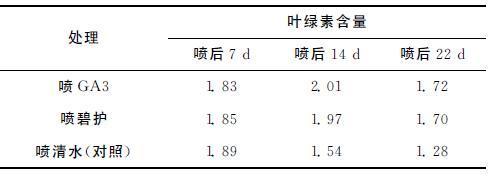
(3) Leaf senescence is mainly reflected in the degradation of chlorophyll, and the same pattern also exists in grape leaves. In delayed cultivation of grapes, as can be seen from Table 1, the chlorophyll content of leaves treated with GA3 and sprayed with Bihu showed a trend of first increasing and then decreasing, while the control leaves showed a decreasing trend. The control leaves showed a decreasing trend. At 22 d after treatment, the decline rate of chlorophyll content in leaves of all treatments was lower than that of the control. Among them, the chlorophyll content of leaves treated with GA3 decreased by 6.01%, and the chlorophyll content of leaves treated with Bihu decreased by 8.10%, while the chlorophyll content of the control decreased by 32.27%, indicating that during delayed cultivation of grapes, spraying GA3 and Bihu on the tree body can effectively control chlorophyll degradation and delay leaf senescence.
Table 1 Effects of Plant Growth Regulators on Chlorophyll Content of Grape
(4) As can be seen from Table 2, the chlorophyll content of grapes with root application of amino acid active fertilizer and root application of biogas slurry showed a trend of first increasing and then decreasing, while the control leaves showed a decreasing trend. At 22 d after treatment, the decline rate of chlorophyll content in leaves of all treatments was lower than that of the control. Among them, the chlorophyll content of leaves with root application of amino acid active fertilizer decreased by 6.25%, and the chlorophyll content of leaves with root application of biogas slurry decreased by 7.10%. The chlorophyll content of the control leaves decreased by 33.52%, indicating that during delayed cultivation of grapes, root application of amino acid active fertilizer and biogas slurry can delay leaf aging to a certain extent and can postpone leaf fall time in delayed cultivation.
Table 2 Effects of Different Root Fertilization Treatments on Chlorophyll Content of Grape
Table 3 Comparison of Growth Stages of "Red Globe" Grape Cultivated Inside and Outside the Greenhouse (Month/Day)
(5) As can be seen from Table 3, through the application of various comprehensive techniques, cultivating "Red Globe" grape in protected facilities can delay the grape sprouting stage by about 30 d and delay the picking period by 90 d.
3 Summary and Discussion
(1) The core techniques for delaying leaf fall in protected delayed cultivation of "Red Globe" grape are delaying sprouting time and postponing leaf fall time.
(2) The main technique for delaying grape sprouting in protected facilities is to cover the greenhouse with straw curtains from after grape harvest in the current year until before grape sprouting in the following year, keeping the grapes in the greenhouse away from sunlight as much as possible. This measure can delay sprouting of Red Globe grape by about 30 d.
(3) Before the local early frost arrives, when the nighttime temperature drops to 8°C, the greenhouse film should be installed in a timely manner to ensure the temperature required for seedling growth.
(4) Temperature and humidity regulation in autumn and winter is one of the core techniques of protected delayed cultivation of grapes. Just after covering the greenhouse, the maximum daytime temperature should be controlled at about 30°C, and the nighttime temperature should be maintained at 12-15°C. When the outside air temperature drops to 7-8°C at night, attention should be paid to closing the ventilation openings at night. From mid-to-late October to early December, the temperature inside the greenhouse should be maintained at 20-25°C during the day, between 7-10°C at night, and the relative air humidity should be maintained between 70%-80%. From mid-to-late December to January, the daytime temperature should be maintained at about 20°C, the nighttime temperature at about 8°C, and the minimum should not be lower than 5°C.
(5) Spraying GA3 and "Bihu" on grape leaves and applying biogas slurry and amino acid active fertilizer to the roots can effectively control chlorophyll degradation and delay leaf senescence, and it is recommended to promote this in production practice.
(6) Through the application of various comprehensive techniques, cultivating "Red Globe" grape in protected facilities can delay the grape sprouting stage by about 30 d and delay the picking period by about 90 d.