What are the daily care methods for Dendrobium crepidatum?
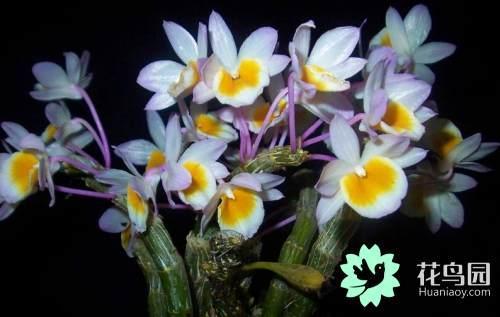
Dendrobium is well known for its medicinal value, yet there is one group of Dendrobium species that people treasure as a guest in the home and a jewel in the palm because of its brilliant colors and fragrance. Its name is Dendrobium crepidatum.
Dendrobium crepidatum is a perennial epiphytic herb in the orchid family, genus Dendrobium, native to parts of Yunnan and Guizhou in China. With beautiful stems and fragrant flowers, it is an epiphytic orchid of great ornamental value. The clump is compact and attractive, with the average whole plant height mostly around 15 cm, making it very suitable for small and medium-sized potted display in the home. Because it has still not been propagated commercially on a large scale, most of what is seen on the market is wild plants collected from the mountains. To protect this precious orchid resource, in addition to expanding commercial propagation, it is also very necessary to improve and popularize home cultivation and propagation techniques.
A mature Dendrobium crepidatum stem is about 1 cm thick, and stem height is mostly around 15 cm, with some individuals exceeding 30 cm. The leaves are semi-leathery, about 8 cm long and about 2 cm wide. There are about 5 to 10 leaves on a stem, and the number of leaves is related to the number of stem nodes and the height of the plant. The node portions wrapped by leaves have striking white longitudinal stripes and are very attractive. Because it is a deciduous type of Dendrobium, the leaves naturally turn yellow and fall in late autumn each year, and the old stems of the following year no longer sprout new leaves, so there are often two kinds of stems in a clump: the ones without leaves are old stems from previous years, and the ones with leaves are new stems that sprouted that year. Plants mostly naturally form clumps of 3 to 5 stems, and vigorous ones can have more than 10 stems per clump.
The flowering period of Dendrobium crepidatum is in spring, with inflorescences borne at the nodes of old stems. More than 10 flowers can be borne on one stem, and 1 to 3 flowers can be borne at each node. The flowering period of the whole plant can reach half a month, while a single flower lasts only a few days. The flower stalk can reach 5 cm, the petals are light pink, and the lip is yellow with a ring of white edging. The pedicel is about 5 cm long and pale purple. The flowers are fragrant, and when many are in bloom the delicate scent is captivating and makes people linger (Figure 2). After artificial pollination, it can set fruit. The fruit is about 5 cm long and about 1 cm thick, containing large amounts of powdery seed.
Planting the plant
Dendrobium crepidatum is an epiphytic orchid and mostly grows on tree bark in its place of origin, so in artificial cultivation, breathable orchid pots should be chosen or it should be mounted directly on a board. When potting, the orchid pot should not be too large, just enough to hold the roots, which helps root drainage and aeration (Figure 4). Granular potting media about 1 cm in diameter such as bark chunks, sphagnum moss, charcoal chunks and gravel can be used alone or mixed. Mounting differs according to the local geographical environment. In southern China, the method of wrapping fern boards with sphagnum moss and tying the plant to the board can mostly be used. Because the climate in the north is relatively dry with little rain, an ordinary lightweight wooden board can be used, with sphagnum moss spread on the surface, and the plant roots tied onto the sphagnum moss. For appearance and durability, it is recommended to use transparent fishing line for tying, and the specific thickness and model can be chosen flexibly according to actual conditions.
If you do not have a breathable orchid pot on hand, you can also use ordinary pots for planting. But the pot should be as small as possible to prevent too much potting medium, which after watering causes moisture to gather at the roots for too long, effectively avoiding root and stem rot. When planting in ordinary pots, the potting medium should be even more loose and breathable. Some friends have also innovatively used pure coconut coir for planting and achieved good results. When using pure coconut coir, special attention must be paid to watering, and water must be given only when the potting medium at the roots is nearly completely dry, to prevent overwatering.
As long as you understand the growing environment and requirements of Dendrobium crepidatum and try to create a suitable environment in daily cultivation, cultivating Dendrobium crepidatum becomes quite easy. The following three points should be especially emphasized in daily cultivation and management, and they are the key to success or failure in cultivation:
1. Leaves and stems should be moist, roots should be dry. The stems and leaves need sufficient air humidity, generally 60% or above is enough. If the air humidity is too low, spray more. But when the weather is relatively hot and there are new tender shoots, try not to spray the new shoots wet, and there must be no standing water on the shoots, to prevent the new shoots from rotting. The roots should not be constantly wet, and there should be a cycle of dry and wet, giving the second watering only after the roots have dried out completely. Generally speaking, roots that are too dry will not quickly cause the plant to die, but roots that are too wet often cause root and stem rot, leading to plant death.
2. Protect from sun in midsummer, give plenty of light in daily care. In the heat of summer, prevent exposure to blazing sun. In other seasons, more light can be given to favor vigorous growth. Except in winter, it is best not to receive direct sunlight, and about 30% shading should be provided.
3. Fertilize in moderation, ensure ventilation and prevent freezing. Because artificial potting media mostly do not have enough nutrients, fertilizer should be replenished in time when planting Dendrobium crepidatum. The number of fertilizer applications should not be too many, and the concentration should be low. Usually in early spring when flower buds are forming, a phosphorus-potassium liquid fertilizer at about 1‰ can be applied once in moderation. In other growing seasons, a liquid nitrogen fertilizer at 1‰ can be applied once a month. Stop fertilizing during the winter dormant period. On ordinary days, place Dendrobium crepidatum in a ventilated environment to favor its growth and shorten the time for root moisture to dry. Dendrobium crepidatum loses its leaves and goes dormant in winter, so this characteristic must be fully considered when planting: let it go fully dormant in a medium-to-low temperature environment where the nighttime minimum temperature is not lower than 5°C and the daytime maximum temperature does not exceed 20°C, which favors more flowering the following spring. Although a certain low temperature must be maintained, the plant must absolutely not be allowed to freeze. Keep the nighttime minimum temperature above 5°C in winter and place it in sunlight during the day, and it can overwinter successfully.
If the above three key points are grasped in daily care, Dendrobium crepidatum will surely bloom with brilliant, fragrant flowers as promised every spring.
Propagation and pest and disease control
Because it does not easily set seed and seed germination has high environmental requirements, it is very difficult to use the sowing method to propagate Dendrobium crepidatum in home cultivation. For small-scale propagation, the division method can be used, cutting and planting large perennial clumps, and each division should have both new stems and old stems with no fewer than 3 stems in total. If you want to propagate in large quantities, the stem-section cutting method must be used. The specific operation is: cut mature, healthy, robust stems that have not yet flowered into small sections, each with 2 to 3 nodes, then plant them directly in sphagnum moss or lay them flat on the surface of sphagnum moss, spray to keep moist, and when the sprouting buds on the nodes grow new roots and new leaves, break them off at the right time and plant them. In daily cultivation, new shoots and seedlings also often naturally sprout from the nodes of old stems, and when the small seedlings have grown leaves and roots of 2 to 3 cm, they can be broken off and planted separately.
Dendrobium crepidatum has strong resistance to pests and diseases, and pests and diseases occur relatively rarely. The occasional diseases are mostly root rot and stem rot caused by bacteria, mainly because the potting medium has poor breathability and moisture remains at the roots for too long. As long as the breathability of the potting medium is specifically improved when planting and the water supply to the roots is well controlled, root and stem rot can be effectively avoided. Pests on Dendrobium crepidatum are not common, and once found they can be removed by hand in time.