How to grow Utricularia sandersonii (white rabbit bladderwort)? Detailed care methods and precautions
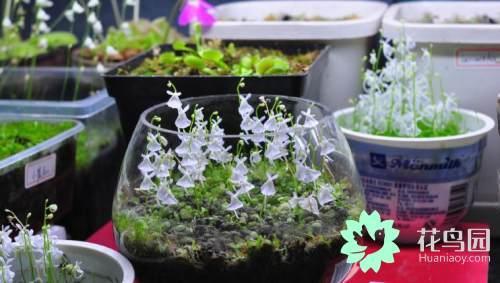
Bladderworts have long creeping stems and tiny traps, and there are many species. My favorite is Utricularia sandersonii, whose flowers are pure white and delicate, with a shape that closely resembles a cute little white rabbit. It also blooms frequently, flowering easily as long as the temperature is suitable.
ContainerUtricularia sandersonii is miniature in size, so a smaller container is recommended. I like to use a watertight yogurt cup, a mini glass tank, and so on. An ordinary small plastic pot for growing flowers with drainage holes also works.
Growing mediumPure sphagnum moss, or peat and perlite; I have also tried aquarium plant soil, with fairly good results. I like pure sphagnum moss best, because it retains water and allows air through.
WaterCarnivorous plants are generally intolerant of salts, so purified water, clean rainwater and air conditioner water are usually used. For a watertight container, add water until it is level with the surface of the growing medium, and add more once no water runs out when it is tilted. For a container with drainage holes, you can find a saucer or small bowl, put some water in it, and set the pot in it; this is the tray method. Note that in especially hot or cold weather, bladderworts grow poorly or stall, so at this time keep them moist but not overly wet, to avoid mold and rot.
FertilizingAlmost no fertilizing; at most bury 1 granule of slow-release Osmocote, since fertilizing easily damages the plant instead.
TemperatureBoth high heat and cold easily cause poor growth or even death of the plant. The optimal temperature, needless to say, is whatever is comfortable for people, since it is comfortable for the plant too. Shanghai has short spring and autumn, and cold winters and hot summers, all of which are hard to endure. I grow Utricularia sandersonii on the bay window in my room. Here the temperature changes less than on the balcony, it is cooler than the balcony in summer, and running the air conditioner when I sleep at night also takes care of it; likewise it is warmer than the balcony in winter.
LightBladderworts need appropriate light, but are afraid of direct sunlight. The bay window only gets a very short period of morning sunlight through the glass, so the light is not considered good, and when the light is too weak, the flowers do not bloom well, so I use T5 tubes for supplemental light. They are actually just ordinary fluorescent lamps. The light is ample yet soft, with the lamps about 20 cm from the plants. The effect of the supplemental light is that after the flowers open, they will not grow crooked due to natural phototropism. A desk lamp with white light also works.
HumidityA certain amount of humidity is very necessary. My bay window opening is at the top, so no wind blows directly on it, and with other plants around it, the local humidity is already sufficient.
PropagationThe periods in spring and autumn when the temperature is suitable are very good for propagation. Utricularia sandersonii spreads and grows in all directions through stolons; even a single leaf with a bit of rhizome placed in new growing medium can gradually grow into a patch. However, to increase the success rate, it is better to use a cluster of leaves with a bit more rhizome, and you can also break the original plant into several pieces and repot them separately. Moreover, to avoid losses caused by high or low temperatures, it is very necessary to keep backups through division.
Utricularia sandersonii propagated by leaf cuttings in autumn can grow into a small patch before winter begins, because Shanghai winters are cold and there is no heating, so winter growth can be ignored. After the temperature rises again in spring, it will start growing vigorously again, blooming in April and reaching full bloom in June.
In the hot summer, especially keep it cool. At this time the leaves become long and narrow, and if it is in good condition it will grow more and more, then usher in an even stronger autumn bloom, by which time the plant has long since matured. The autumn flowers last from September to December, which by this count also makes for half a year of flowering. If the temperature in your area is more suitable, the flowering period will be even longer.
Then comes the next winter. If the container is already full, be especially careful about mold from poor local ventilation. Of course, making many backups or divisions is also a very good approach. I give it a "haircut" before spring arrives, so that it can grow a fresh pot of tender new leaves again.