Hosta blooms in summer, a fresh and beautiful ornamental garden flower
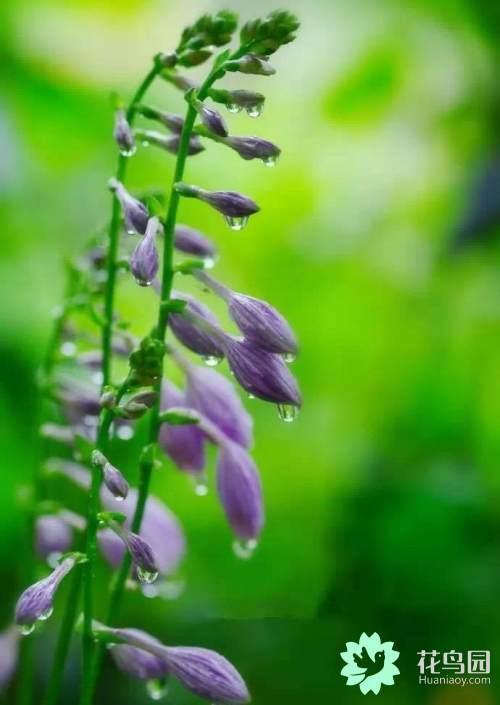
In the Yuan dynasty poem "Ru Meng Ling" by Xu Youren, "The yellow hollyhocks in the corner have all withered. It is the hosta's turn to bloom. This old man knows autumn has come, wind and dew fill the courtyard in the clear night. Unrestrained. Unrestrained. Lying high beneath the green window."
Beneath the window, gentle breezes blow, and the subtle fragrance of hosta drifts over! So beautiful and unrestrained!
Hosta, also known as white calyx or white crane immortal. It is a perennial herbaceous flowering plant of the Liliaceae family. Hosta is mainly grown for its foliage; its ovate heart-shaped leaves are emerald green and glossy. Once hosta is planted in the originally dark and damp understory, the space immediately brightens up.
There are now even more horticultural varieties, with increasingly diverse leaf colors and shapes: narrow-leaved, variegated, curled-leaved, blue-gray-leaved, and even a giant hosta whose every leaf is as large as a palm.
Morphological characteristics
Hosta blooms from June to August, in the hottest part of summer. The flowers are extremely beautiful too. The scape is 40-80 cm tall, erect or slightly curved, bearing several to a dozen or more flowers at the top, tubular funnel-shaped, purple or white, with fragrance spreading all around. The buds of the white-flowered hosta are even more delicate and lustrous as jade, shaped like the hairpins of ancient people, which is also the reason it is called "yu zan" (jade hairpin).
Hosta's flower meaning: free from vulgarity, pure as ice and jade
Growth habits
Hosta prefers shady and moist environments, and dislikes intense direct sunlight. It requires deep soil, well-drained and fertile sandy loam. It is extremely cold-hardy; in northern regions, it needs slight protection in winter.
There is always a particularly damp and shady corner in the yard, under a large tree or by a wall. Most sun-loving plants do not grow well there; even if you do not care whether they bloom, their branches always become leggy and lopsided. So a clump of hosta was planted there. Its emerald green leaves begin to sprout every early spring, growing elegantly green until the cold winter wind howls, and only then do they begin to turn yellow and rest.
Propagation methods
1. Division propagation: Before sprouting in spring or after the leaves turn yellow in autumn, dig out the rhizomes and cut them apart. It is best for each clump to have 2-3 pieces of underground stem, retaining as many roots as possible. It can bloom the following year;
2. Seed propagation: After the seeds mature in autumn, collect and air-dry them, then sow in March-April of the following year. Seedlings grow slowly in the first year and need careful tending; they grow rapidly in the second year and bloom in the third year.
Cultivation notes:
1. It is not drought-tolerant. Pay attention to watering during growth; long-term drought or an overly dry environment easily causes leaves to turn yellow.
2. Avoid waterlogging. If watering is excessive and drainage is poor, the roots easily rot due to lack of oxygen.
3. Hosta has low fertilizer requirements; both water and fertilizer should be applied in moderation.
4. Avoid direct sunlight. It can be grown indoors with bright indirect light.
Ornamental value
Hosta has delicate, lustrous leaves, buds like hairpins, and jade-white color with a pleasant fresh fragrance. It is one of the important flowers in classical Chinese gardens. In modern gardens, it is mostly planted under trees, in grassy areas, in rock gardens, or on the shady side of buildings, exactly as in the line "The hosta's fragrance is wonderful, a few branches blooming by the wall." It can also be dotted in the garden in clumps of two or three. Because the flowers open at night and are richly fragrant, it is an indispensable flower in a night garden, and it can also be grown in pots for indoor and corridor display.
Medicinal effects
The entire hosta plant can be used medicinally. The flowers used as medicine have the effects of promoting diuresis and regulating menstruation and stopping leukorrhea; the roots used as medicine have the effects of clearing heat, reducing swelling, detoxifying and relieving pain; the leaves can detoxify and reduce swelling. For pharyngitis: 8-10 dried hosta flowers, brewed with boiling water, drunk frequently as tea. The effect is quite good~
The ancients were extremely fond of hosta, especially in the courtyards of Jiangnan, most of which had tall enclosing walls. The courtyards were often narrow and dim, and a plantain was often planted in the corner, with its tall leaves reaching beyond the wall, while stones were arranged below and several clumps of hosta planted, elegant and graceful. On summer nights, hosta blooms fragrance-filled, its subtle scent assailing the senses.