City life is forcing birds to get smarter
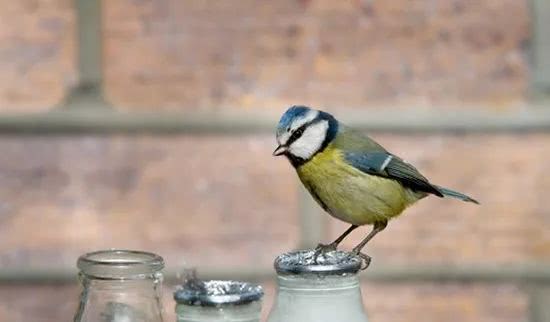
Picture a European town a hundred years ago: a milkman in overalls, on a bright morning, with birdsong in the air, sets two glass bottles of milk on a household's front steps. The moment he turns his back, a group of tits, ready and waiting, will zip their heads straight into the milk bottles...
European blue tits and milk... Image: Steve Magennis
In 1949, an article in British Birds about tits stealing milk fully exposed how humans were being defeated by their avian rivals. The article was based on hundreds of surveys by ornithologists Hinder and Fisher of British birdwatchers, milkmen, milk customers and others.
Allbirds cannot digest milk, and tits are no exception. Birds lack the enzyme that breaks down lactose. But thecream floating on top of old-fashioned milk contains almost no lactose, and that fat was important to birds short of food in winter. In the late 19th and early 20th centuries, milkmen were still in the habit of leaving open milk bottles at people's doorsteps in the early morning, and at the time tits across Britain and Europe would rush in ahead of other animals, diving headfirst into the bottle opening to eat a few centimeters of the cream layer.
To protect the milk, people and tits fought several rounds of attack and defense. At first, people could only dash to the door the instant the milk cart arrived, while the undaunted tits would be waiting at the door on time every day at milk delivery hour. At some point in the 20th century, milk suppliers began sealing the bottles withwaxed cardboard. That did not stop things for long. In 1921, tits in Southampton, England, began pecking and peeling the board away layer by layer until the lid could be pierced by their sharp beaks. Switching toaluminum capsdid not help for long either. By 1930, tits in 10 towns in England had learned to openmetal bottle caps. To deal with metal caps, they first drilled a small hole in the surface, then pulled out the foil inside. A tit might drag the whole cap out, grip it in one claw and fly off with it, then peck at the cream on the inside of the cap once it reached a safe place. If you can find the tree the birds favor most, you can clear a pile of caps out from under it.
A blue tit that has already stolen quite a lot of cream. Image: pinterest
Although some tits did drown in milk bottles while stealing a drink, the human rivals were clearly the ones losing ground. In Hinder and Fisher's survey of tit cap-opening techniques and human defenses, people indignantly described how fast the tits rushed to the milk bottles, usually within a few minutes of the milk being set on the steps - as if they were waiting for it! (Perhaps the birds really were waiting. One milkman complained that some tits did not even wait for him to deliver the milk to the door, but insteadattacked his milk cartwhile he was setting the bottles on the household's steps! By the time he got back to the cart, the birds would fly toward the freshly delivered milk bottles.) In the worst case, a group of tits opened 57 of a school's 300 bottles of milk before the principal arrived. In some areas, people would give milkmen heavy metal caps, stones or cloth to cover the delivered milk. But without exception, these titslearned to remove the obstacles。
In recent decades, tits finally seem to have been defeated by their human rivals in the milk-drinking contest. First, skimmed, homogenized milk without a cream layer became more popular. For a time, tits learned to choose which targets to surround by distinguishing the colors of old-style milk bottle caps. But afterward, other materials replaced aluminum-capped glass bottles, milkmen disappeared, and supermarkets became favored. Today, almost no one remembers the fury of having milk stolen by birds.
Are city birds smarter?
City tits that lost the cream layer will not go hungry all winter either; urban food is plentiful - the problem is thatmaking use of these resources is not easy。
Looking down on the city. Image: ZeroOne/Flickr
Cities are the newest ecosystem on the planet, and over the past tens of millions of years tits have never encountered an environment like this. In natural ecosystems,resources are relatively dispersed,and individual density is not high, with predators constantly circling nearby, so the good strategy is to observe patiently and wait, and only appear once safety is confirmed, which to us looks shy, conservative and timid. However,cities have concentrated resources,and dense populations, with new things emerging endlessly. Being shy means being squeezed out of living space, being too conservative means resources are not fully used, and being timid means how could you survive in the face of dense populations, man-made machines, and the noise and light of modern society? Therefore, city birds need to evolve more active survival strategies. They must bebolder、more open to new things, and better at exploiting their human neighbors, whom they cannot escape and who also hold vast resources.
We have already seen the boldness of European tits in the milk wars; they are quite good at discovering resources and solving problems (removing cardboard lids, metal caps and bottle coverings). In fact, city birds not only consider taking human property for themselves, but alsouse humans to solve old problems。
This is exactly what Japanese crows (Corvus corone) did, as observed by scholar Yoshimichi Nihei of Tohoku University in Japan in the 1990s. This crow is a scavenger and also eats fruit, seeds, insects and so on, and is especially fond of walnuts. But Japanese walnuts are small and hard, and crows cannot possibly pry the shells open with their beaks. They use one method: carrying the walnut up to 10 m high and dropping it, repeating this until the hard shell breaks. The problem is that flying up and down is tiring, and not every walnut can be cracked. In 1992, Nihei observed an alternative method used by crows in Sendai to open walnuts -placing them on the road to let cars crush them. Over 21 months, he recorded 43 cases in total. Most of the recorded crows would place a walnut on a section of road where vehicles were about to pass; more than a quarter of the crows would choose an intersection with traffic lights, so that they could precisely place the walnut under the wheels of cars waiting at the light; he also observed two crows placing walnuts on road sections where cars were unlikely to pass, which may have been failed imitation of other crows. These behaviors appeared at eight road sections in Sendai, and Nihei believed that crows using cars to crush walnutswent through invention, learning, spread and improvement,and was systematic intentional behavior。
A crow moving a walnut to an ideal position. Image: Yoshimichi Nihei
City birds are bolder and better at solving problems
Here a question arises: are city birds really smarter and better at solving problems, or do we simply lack observations and records of the clever behavior of rural birds?
Tests of the two groups of birds in laboratory settings show that city birds may indeed be better at solving problems. In 2016, scholars at McGill University in Canada studied the Barbados bullfinch (Loxigilla barbadensis) in urban and rural Barbados and found that in laboratory settings,city birds could open drawers to get food faster than birds from the countryside. In 2017, research at the University of Arizona showed that house finches (Haemorhous mexicanus) captured from cities and the countryside performed similarly in an undisturbed lid-opening foraging test, while city birds had a slightly higher success rate; but under human disturbance, the rural group was completely wiped out. These studies suggest that city life may have trained birds' problem-solving ability and also accustomed them to human presence.
Whether it is human wheels or humans themselves, nothing seems able to stop city birds from expanding their resource use. Even in 2016, Polish zoologists found that some city birds are not only unafraid of strange human inventions, but even become interested in new things. At 160 feeding stations in a city and the surrounding countryside, they placed something the birdshad never seen before- a bright green children's toy about the size of a lemon, with a tuft of hair on top. The study found that without the toy, similar numbers of great tits fed at feeding stations in the city and the countryside; after the toy was placed on the bird feeder, the number of birds coming to feed in the countryside was almost halved, while even more great tits came to feed in the city. The researchers believe they may do this out of a need to always be ready to exploit new resources.
The green toy looks like this. Image: Tryjanowski et al.
There is a price to pay for getting smarter
Seen this way, wouldn't the relentlessly pressing city birds be defying the heavens? Almost every year, there are news reports of birds snatching sandwiches, ice cream and the like from people's hands, leaving terrified passersby behind. Since city birds are so deft, they should be living very comfortably in cities. But in fact, some comparative studies of the survival conditions of urban and rural birds have reached the opposite conclusion -city birds face greater stress。
Indeed, urbanization provides animals, including birds, with benefits such as food handouts, safe nest boxes, and warm winter environments. But these animals also endure intraspecific and interspecific competition, as well as pollution from human light, noise, diet and so on, and these pollutants have been shown to be associated with inflammatory responses.
French scholars studied the heavy metal zinc content in the feathers of Paris pigeons. Andlong-term exposure to heavy metal environments will damage birds' fertility. In 2009, theoretical ecologist Marion Chatelain of Pierre and Marie Curie University and colleagues caught 97 pigeons from the streets of Paris and kept them in captivity for one year. After a year of captivity, the average zinc content in the same feather parts of these pigeons had fallen to one third of the original level.
We might think that continuous heavy metal intake by city pigeons is a single condition, and we cannot determine what overall effect the urban environment has on birds. However, the results of a rural-urban nestling exchange study at Lund University in Sweden are enough to move anyone to tears.
In 2013, four biology researchers at Lund University conducted an exchange-rearing experiment using great tit (Parus major) nestlings from urban and rural areas in southern Sweden. After 15 days, they took blood samples to measure the length of the nestlings' chromosome telomeres and found that birds raised in the city (including half-broods originally born in the city and half-broods moved in from the countryside) hadchromosome telomeres more than 10% shorterthan their other half-siblings raised in the countryside. Chromosome telomeres are located at the ends of chromosomes, like the plastic tips on the ends of shoelaces, maintaining the structural stability of genetic material. For humans,age and stress- especially stress in early life - will cause telomere attrition, thereby affecting gene function. For animals, chromosome telomere length is likewise related to lifespan. The experimental results show that the urban environment may have accelerated the aging of great tits and shortened their life expectancy, although the specific factors and mechanisms are still not very clear.
What the environment did to the birds: in the Lund University experiment, a city bird raised in the countryside (left) and a countryside bird raised in the city (right). Image: P. Salmon
Even the city's greatest advantage - more food - cannot let city birds live more at ease. Researchers at Virginia Tech found that although cities have more abundant food, urban male song sparrows (Melospiza melodia)are more aggressivethan their rural counterparts. This may stem from valuing and guarding territory and food, and they are not sure whether this is an offensive strategy or a defensive strategy.
Finally, perhaps it can be said thatcity life really does make birds smarter,but being smarter does not mean it is easier。
Compiled by: vicko238
Original author: Menno Schilthuizen
Extra
Just this past night, the Species Calendar Everyone Chat came toTsinghua Universitycampus,Guokr.com lead writer and Species Calendar author @Entchatted with everyone about evolution and shared what "survival of the fittest" means.
The red arrow is pointing at Ent~ Did you see it?
Next Sunday, Calendar Girl will as usual organize the on-site highlights to share with everyone, so don't miss it!
Below, we announce the winners in the on-site raffle. Congratulations@Li Yunfeifor winning the same style as Ent"Darwin's Finches" Guokr Teeone piece:
Congratulations@Angry Brickfor winning the Ent-translatedLife Ascendingone copy.