Recommended succulents that are easy to grow and beautiful in summer
A Town with an Ocean View
Relaxing? Piano ~ Studio Ghibli Collection
Hiroko Makiko
00:00/04:42
BGM: A Town with an Ocean View
In recent years, succulents have quickly taken the world by storm with their peculiar looks, but the hot summers of the south are an insurmountable threshold for succulents, which drop dead at the drop of a hat, leaving you both angry and heartbroken. Today we are going to introduce a succulent that performs beautifully even in summer.
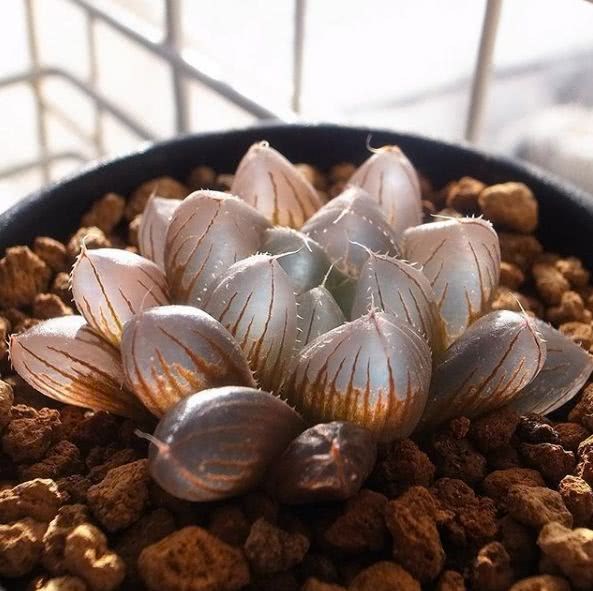
There is one beauty that fears no midsummer heat, and she is - Haworthia cooperi.
Purple-skinned Haworthia cooperi
Compared with other succulents, Haworthia cooperi is less likely to die in summer and has very low light requirements; just a corner with diffused light is enough for it to shine.
Even the big internet celebrity on Weibo - the magazine Natural History - urged everyone on its secondary account to go and grow Haworthia cooperi right away.
Natural History is a popular science magazine with a huge following on Weibo
(Haworthia is another name for the genus Haworthia)
So delicate you could pop it with a breath, crystal clear, bouncy and springy,
Haworthia cooperi is just such a versatile beauty.
- Introduction to Haworthia cooperi -
First, let's look at the beauty's profile~
Haworthia cooperi is a "soft-leaf" variety among the succulents of the genus Haworthia in the family Asphodelaceae. The plant starts out solitary and gradually forms clusters. The fleshy leaves are arranged in a rosette, rounded and convex on both sides, with jade-green leaf color and a transparent or semi-transparent tip, commonly known as the "window," with dark longitudinal lines on the surface and fine filamentous whiskers at the tip.
- Advantages -
Easy to care for, easy to get through summer, low light requirements, especially beautiful
- Disadvantages -
Slow growth. Look at the comparison photo - in 3 months it has only grown this much.
- Members of the Haworthia cooperi family -
There are many varieties of Haworthia cooperi, and some are not easy to tell apart, but there is no helping it - they are just too beautiful. Let's take a look at the members of the Haworthia cooperi family~
Shaking Haworthia cooperi
Syringe Haworthia cooperi
Giant Red Line
Hime Haworthia cooperi
Black-skinned Haworthia cooperi
Purple-skinned Haworthia cooperi
Pan's Ice Lantern Haworthia cooperi
Large-window Hime Haworthia cooperi
Cherry Crystal
Glutinous Haworthia cooperi
After admiring the beauty, we must learn how to maintain her good looks!
- Care -
Succulents of the genus Haworthia have a special feature - taproots.
First, let's look at the comparison photo.
The taproot of Haworthia cooperi (photo from the internet)
The slender root system of Crassulaceae succulents
Isn't it especially obvious?
Even the newly grown small roots are plump and watery - don't they look just like the root tendrils of a radish!
The advantage of this kind of root system is its extremely strong water storage capacity, always keeping a rich reserve for emergencies. Next, let's discuss care issues centered on the root system!
1-Watering
In spring and autumn, it is recommended to slowly water and soak the soil when the substrate is half dry. Too much watering will cause leggy growth, and the whole plant shape will spread out and cannot recover; you can only wait for the leggy leaves to be used up.
You can mist it when you have nothing to do, and it will actually look even better!
A leggy Haworthia cooperi
In summer, avoid watering thoroughly in high temperatures; just give water slowly. A friend of mine did not water at all, only misting morning and evening, and still grew her Haworthia cooperi plump and translucent with gratifying growth. If you want to grow them, use this method as appropriate~
These are all the Haworthia cooperi she grows, and they are all plump and beautiful.
2-Enclosed growing
What is enclosed growing? In spring and autumn, cover the Haworthia cooperi with a transparent plastic bag or cup and let it breathe every 2~3 days.
A sign of successful enclosed growing: dew drops appear on the cup wall
In an enclosed growing state, the humidity is high, so Haworthia cooperi grows especially plump and the windows become more translucent.
But never place it in the sun, otherwise the dew drops on the cup wall will form a mirror reflection and cause sunburn. A spot with diffused light is enough.
Note! Enclosed growing is not possible in summer; the temperature is too high, and going too far is as bad as not going far enough.
3-Soil mix
A 7:3 ratio, 7 parts soft granules, 3 parts peat soil, then mix in a little rice husk carbon to sterilize.
Why use soft granules?
For example, would it be more comfortable for a fat person to sit on a soft sofa or on hard wooden boards while eating? In order to make the granular soil breathable, water-retaining and well-draining without cutting its root system, soft granules stand out!
Soft granules: akadama soil and kanuma soil are first choice; a size of 1~3mm is enough, as too large is instead not good for the root system's water absorption.
4-Sunlight
Haworthia cooperi avoids strong light (the color will turn gray). Diffused light or placement behind a window is quite suitable. With an appropriate amount of light, the color of Haworthia cooperi becomes richer.
The light in southern summers cannot be directly exposed to the sun; outdoor growing requires shading, otherwise it will shrivel from sun exposure - personal experience.
5-Suitable temperature
The suitable growing temperature is 18°C~22°C. It can also grow at 30°C. Below 5°C or above 40°C, or in a constant-temperature environment, it may go dormant, but indoors this generally does not happen, so it is quite suitable for growing Haworthia cooperi.
6-Repotting
If you get Haworthia cooperi in summer, it is recommended to buy one shipped with its pot and not repot it, because repotting will definitely damage the roots. For beginners, it still takes time to grow a good root system, so wait until autumn when the temperature is suitable to repot.
Choice of pot: a Banzou pot is best. The root system of Haworthia cooperi is deep, and a length of 10~15cm is more suitable.Use a pot sized to the Haworthia cooperi; avoid putting a small succulent in a large pot, as improper watering can easily cause root rot.
A Banzou pot
Detailed steps for repotting
1. Remove the soil and shake the soil off the roots.
2. Trim the roots: cut off roots that do not grow small root tendrils, because they no longer absorb water.
3. Pot it up and choose a suitable position.
4. Place it in a cool, ventilated spot and wait for it to settle in, which takes about 1~2 weeks; mist lightly during this period.
Signs of settling in: the leaf center begins to turn green and grow new leaves.
7-Flowering
Haworthia cooperi flowers 2~3 times a year. The flowers are relatively small. If you are not planning to keep seeds, for the sake of appearance it is better to pull out the flower stalk roots and all.
- Problem roundup -
Q1: What should I do if Haworthia cooperi does not settle in for a long time?
A1: If it is still shriveled after several months, then it has not grown roots. Dig out the Haworthia cooperi, cut off the rotten roots, place it in a cool spot to dry the wounds, then pot it again to grow roots.
Q2: What should I do if Haworthia cooperi has root rot?
A2: Control your urge to mist and water! Quickly trim the roots and repot the Haworthia cooperi!
When Haworthia cooperi has root rot, the roots will change color
Q3: What should I do if Haworthia cooperi is sunburned or shriveled?
A3: Move it away quickly, place it in diffused light to recover, and wait patiently.
Q4: What should I do about water stains from misting with hard water in the north?
A4: 1. Use weakly acidic water for misting; 2. Stop using tap water and use mineral water or rainwater.
Let me quietly tell you a little trick: photographing Haworthia cooperi against the light makes it look like a moving crystal, especially beautiful, while with the light it looks gray and dull. Mist it a little more, and its appearance is simply off the charts!
Palace Lantern Haworthia cooperi without misting
After misting
END
Friends who already have Haworthia cooperi at home
Share your care experience!
- Recommended from the previous issue -