The Dragon Boat Festival is approaching: these 4 kinds of leaves can be used to wrap zongzi, and the third is the easiest to use yet often overlooked
Friendly reminder
Hemu Report aims to share and popularize information about various plants and their uses, for reference only. If medicinal use is needed, it is recommended to consult a professional physician to avoid problems!
There is about one week left until the Dragon Boat Festival. The Dragon Boat Festival is not only a traditional festival in our country, but also a festival eagerly awaited by many food lovers. Because when the Dragon Boat Festival arrives, it means there are delicious zongzi to eat. Every year during the Dragon Boat Festival, netizens start a "war of words" over sweet and savory zongzi. Northerners love sweet zongzi, while southerners love savory pork zongzi, each occupying half of the zongzi world, and they argue endlessly over this.
In fact, the differences between the north and south are not only in taste. In the leaves used to wrap zongzi, the choices of northerners and southerners are also different, so zongzi wrapped in different leaves can often be seen. Today let's talk about 4 kinds of leaves that can be used to wrap zongzi!
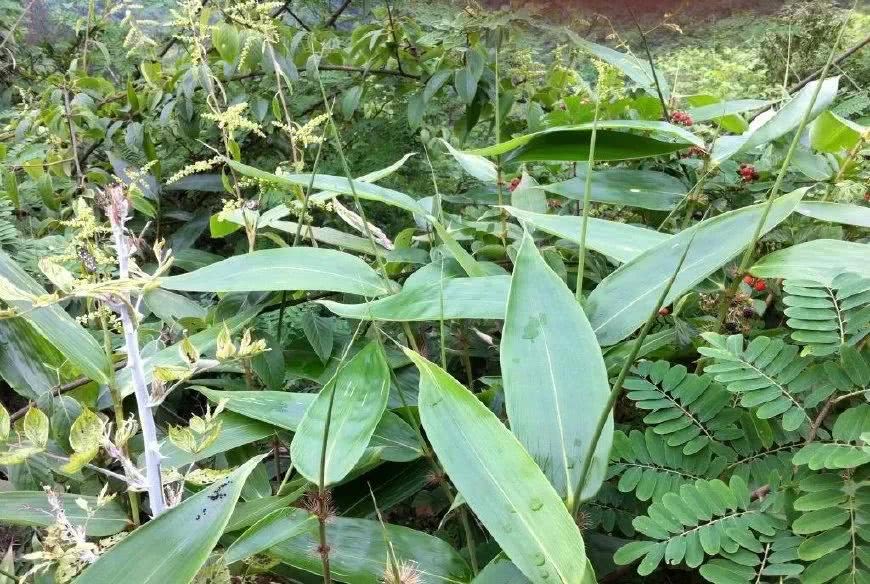
The first kind of leaf: indocalamus leaf
Indocalamus is a common shrub south of the Yangtze River in China. Its leaves are long and broad, with strong flexibility, making them very suitable for wrapping zongzi. People in Shanghai and Guangzhou relatively prefer to use indocalamus to wrap zongzi. Especially some rather particular older Shanghai residents only use indocalamus leaves picked from Huangshan, Anhui every year, and do not want those from other places. This is because this kind of indocalamus leaf does not break after long boiling and contains the fresh fragrance of bamboo, making it very good for cutting the greasiness when used to wrap meat zongzi, so it is very popular.
Since the main use of indocalamus leaves is to wrap zongzi, people also call them "zongzi leaf" in folk custom. In the past, people collected wild indocalamus leaves. Later, as the demand for zongzi leaves increased, some quick-witted farmers also began to cultivate indocalamus, specifically supplying large cities.
The second kind of leaf: reed leaf
Northerners often use reed leaves to wrap zongzi, mainly because they use local materials and it is convenient. Indocalamus is relatively rare in the north, while reeds are common instead. Reed leaves are narrower than indocalamus leaves, making wrapping a bit more difficult, but the advantage is that they are long enough. Since the Ming Dynasty in China, people have had the custom of using reed leaves to wrap zongzi. In the ancient medical book Wang Jiu Yao Jie, reed leaves were greatly praised, believing they could "clear the lungs and quench thirst, promote urination and treat strangury." Moreover, zongzi boiled with reed leaves are soft, glutinous, and fragrant. Old Beijingers love to use reed leaves to wrap zongzi. The most famous reed leaf producing area in the north is Baiyangdian in the North China Plain, with excellent quality.
The third kind of leaf: corn husk
Corn husk refers to the layer upon layer of husk outside the corn cob. This can be said to be the most convenient and easiest to use. This is because almost every household in rural areas grows corn cobs, making it very convenient to obtain materials, and it is also easy to buy in cities. Any vegetable market sells corn cobs with the husk still on. When you buy them, keep the husk and do not throw it away; it is a great thing for wrapping zongzi. The flexibility of corn husk should be considered the best among zongzi leaves, and after cooking it has a faint fresh corn fragrance, and can also dye glutinous rice light yellow, which is very beautiful.
Corn husk has its own sweet fragrance, making it especially suitable for wrapping sweet zongzi. People in Sichuan like to use it to wrap zongzi, and locally it is called "baogu ba," with a delicate texture.
The fourth kind of leaf: lotus leaf
An ancient poem says: "The lotus leaves stretching to the horizon are endlessly green, and the lotus flowers reflected in the sun are especially red." The biggest advantage of lotus leaves is that the leaves are large enough, so when wrapping zongzi, you can make them as large as you want. Since ancient times, lotus leaves have been a good ingredient for cooking. For example, "beggar's chicken" is made by wrapping it in lotus leaves. Lotus leaves have a strong fresh fragrance and also have the effect of calming the heart and reducing internal heat. Now is the season when lotus leaves grow rapidly, so using them to wrap zongzi is quite good.
Dear readers, have you ever used these leaves to wrap zongzi? Especially the third one, which is often overlooked. The Dragon Boat Festival is almost here, so if you are interested, you can give it a try!
Text/Hemu Report, images/Internet
If you like Hemu's articles, you are welcome to follow