Orchid Beginner Essentials: Lotus Petal Form Teaching and Analysis
From ancient times to the present, in the course of continuous development and evolution, Chinese orchids have gradually established a theoretical system that takes orchid petal form, flower color, leaf shape, and leaf color as the main appreciation standards. This theory is an established convention rather than a standard verified by botanists. It is a custom, a custom integrated into Chinese culture. This set of petal appreciation standards summarized by earlier orchid growers has been widely recognized by everyone and has formed a nationally unified standard. This has also provided an important reference basis for the breeding and selection of Chinese orchids and has had a profound influence on later orchid cultivation.
We often use the petal form of orchid flowers to measure whether an orchid is good or not, and this is also basic knowledge that orchid enthusiasts must master when getting started. According to the petals of orchids, they can be divided into three major categories: standard-form petal flowers, strange-petal flowers, and colored flowers. Standard-form petal flowers, as the name suggests, are flowers with upright, proper, and non-irregular petal forms. Among them, standard-form petal flowers are further divided into: plum petals, lotus petals, and narcissus petals; strange flowers are divided into: butterfly flowers, peony, chrysanthemum petals, tree form, lion head, and crystal; colored flowers are divided into: plain heart, white, green, red, orange, yellow, black, etc. These 3 divisions of standard-form flowers were first applied to spring and cymbidium orchids in Jiangsu and Zhejiang, and then gradually developed nationwide. In addition, there are also folk terms such as super petals and round petals. Today we will only talk about plum petals among standard-form flowers. The other petal forms will be gradually explained to everyone in later lessons, so remember to keep following!
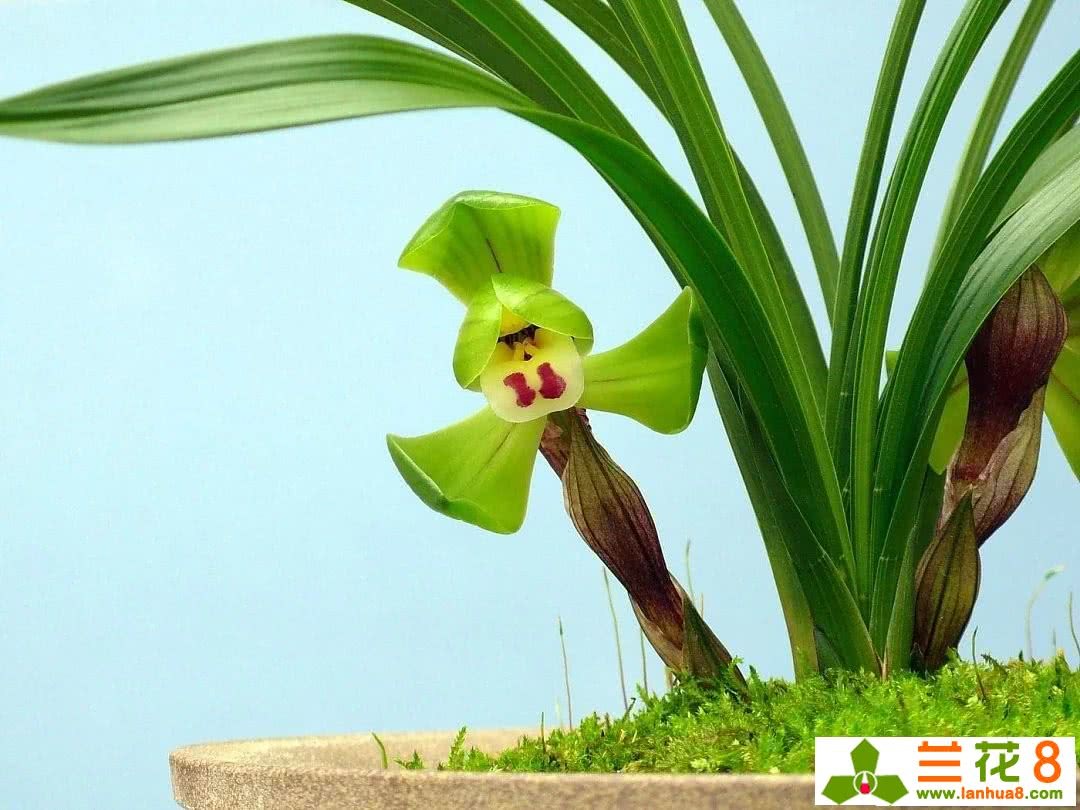
Generally speaking, an orchid flower is composed of 3 outer petals, that is, what are called sepals in botany, 2 petals, and 1 lip. The flower shape of an orchid lotus-petal flower is like a just-opened lotus flower. Its ideal standard can be summed up in one sentence: the three outer petals are short and broad, with a contracted base and released corners; the petals are short and broad without a pouch; the lip is broad, large, round, and upright. The details are as follows:
1. The three outer petals are short and broad (the length-to-width ratio is generally less than 2:1); those exceeding 3:1 can only be called lotus-shaped. The base is contracted, and the upper two sides of the petal show an obvious obtuse angle, also called released corners. This point is very important. Without released corners, it cannot be called a lotus petal;
2. The petals do not have a pouch, are short and broad, and are in an inward embracing state, with no thickening and no white head. It is best if they can cover the column;
3. The lip is round and upright. It is best when it spreads out and does not curl; sometimes it is slightly curled;
Those that fully meet the above standards are called true standard lotus-petal flowers, and those that basically meet them are ordinary lotus-petal flowers. There is not much mystery to this, and it is easy to understand. It is worth noting that many orchids can be called standard lotus-petal flowers when they first open, but after several days of blooming, the outer petals elongate, the petals open, and the tongue curls backward, so that there is not even a trace of a lotus-petal flower left. Orchid enthusiasts jokingly call this "one-day lotus." Only those that remain unchanged after a long time can be counted as true lotus petals. Those with a uniform tongue color are called plain lotus, and according to petal color they can be divided into yellow lotus, red lotus, etc. In the previous lecture we talked about lotus-shaped narcissus, so I will not go on about it here! Author: Mei Fei (founder of Orchid Bar), written on June 8, 2018. Welcome to repost, and please indicate the source when reposting! I publish orchid knowledge and pictures every day, taking you to understand orchids in depth and teaching you to grow orchids easily. If you have anything you do not understand about orchids, you can ask me at any time or leave a message below. If my knowledge has helped you, I hope you can give me a like or repost it to help more people!