How to buy succulents online? A veteran teaches you how to buy reliable succulents
After browsing countless succulents online, how can you tell the real from the fake at a glance?
With so many similar varieties, which one is really your dream plant?
Bargain-hunting requires caution, so how do you quickly develop a sharp eye?
In this episode, a veteran succulent grower + Photoshop whiz takes you to find truly good succulents.
Unreliable glamour shot 1
For friends just getting into succulents, buying online is indeed more affordable than going to a physical store, and the variety selection is more complete. But since you have little experience and no real-life reference, it's hard to avoid falling for some of the little scams.
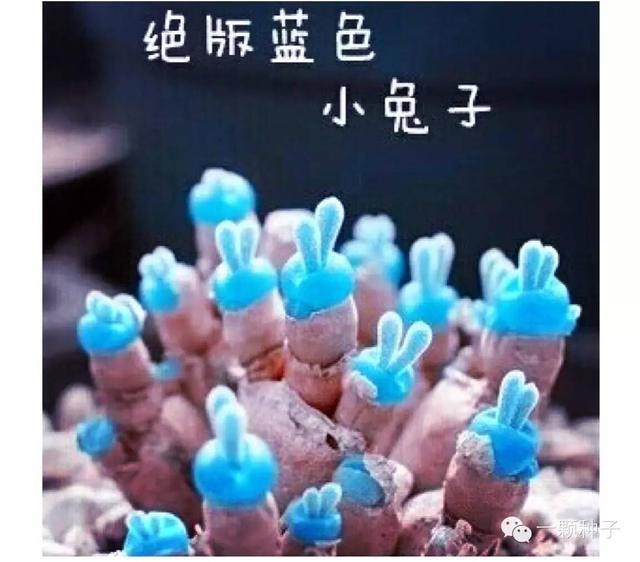
Take glamour shots like these - once you see them, don't even bother looking at the shop; they're all unreliable.
Succulents are plants too, and plants need chlorophyll to sustain growth - that's the most basic fact. So most plants are green or greenish. Under special conditions their color changes, and the combined effect of lutein, carotene and so on in the leaves produces many vivid colors.
As for ones this blue that they're actually glowing - are you from Mercury or something!
Unreliable glamour shot 2
And this kind too - they're actually all made with simple Photoshop editing, no skill involved, and they easily mislead beginners who've never grown plants.
Agave is grayish-green with a faint hint of blue-green. This one has been adjusted far too blue - so blue that even the top-dressing gravel in the background turned blue...
Unreliable glamour shot 3
Butterwort 'Ace'
Not a succulent, but a carnivorous plant. After being edited, it's widely used on certain succulent online shops - you've definitely seen it~
Telling real from fake
Actually, shop owners all like their goods to look vivid and eye-catching, so it's understandable that they adjust their photos somewhat. But editing that strays too far from reality is unacceptable. For beginners, who may not know much about plants, it's very common to see a beautiful photo, believe it and buy, then be greatly disappointed when the real plant arrives.
To tell real from fake, here are a few tricks for you:
1. If the color is too vivid and bizarre - like peach pink, bright purple, fluorescent green and the like - completely departing from the characteristics a plant leaf should have, choose carefully.
2. Observe the background. Generally these Photoshop jobs are fairly crude, and the background may reveal the color bias. For example, if the leaves are adjusted toward blue, the background will also faintly turn blue-gray.
3. Know your plant - be clear about the variety and name of the succulent you want to buy, so you can easily find its true appearance for reference. Succulents generally look their best in spring and autumn when light is strong and temperature differences are large; when buying, don't let a momentary flush of color go to your head.
These photos have only had slight adjustments made to the originals - not only are the images beautiful, but they don't depart from reality and mislead consumers.
Echeveria 'Perle von Nurnberg'
Be careful and guard against it
There are so many succulent varieties, and similar ones are easily confused. Plenty of shops pass one thing off as another, so be extra careful.
Can you tell these apart?
Sedum 'Yatsuyo'
Sedum rubrotinctum 'Aurora'
Sedum rubrotinctum
Sedum pachyphyllum
Online, plenty of shops sell Sedum pachyphyllum under the name 'Yatsuyo'. What exactly is the difference between a 5-yuan Sedum pachyphyllum and a 'Yatsuyo' at around 20 yuan?
1. Color: Sedum pachyphyllum is grass-green in summer with a slight white bloom; in spring and autumn once it colors up, it turns red starting from the leaf tips, and the stem is grass-green. 'Yatsuyo' leaves are yellow-green and won't turn red, and the stem has a light wood-colored outer skin and is very straight.
2. Form: Sedum pachyphyllum leaves are somewhat teardrop-shaped, narrow at the base and broader near the tip, and most leaves curve upward. 'Yatsuyo' leaves are straight and rarely curve, resembling fingers.
Distinguish carefully
Is it easy to tell apart? Look at these two.
Echeveria agavoides 'Carola'
Echeveria 'Chihuahuaensis'
When Echeveria 'Chihuahuaensis' colors up, the leaf tips are very red but the leaves themselves barely change; Echeveria agavoides 'Carola' turns red at the leaf tips and on the undersides too.
Echeveria 'Chihuahuaensis' leaves are relatively thin and flat, while Echeveria agavoides 'Carola' leaves are slightly thicker and the form is more compact.
But when they haven't colored up, the two really are hard to tell apart.
So identifying succulent varieties is an important prerequisite for buying the right plant. Read more educational posts in your spare time and learn.
About old stems
Beautiful succulents are all terribly expensive, and deals where you get a hundred-fold return for every penny are hard to find.
Is your old-stem plant really an old-stem plant?
Old stem describes a succulent that has grown for many years and developed tree-like branches and trunk. Rarity drives up value - the older, the more valuable - and beautiful large clustered old-stem plants often fetch a high price.
But the concept of an old stem is vague. How long a stem counts as an old stem? How many years of growing qualifies as an old stem? It's hard to say. And a succulent with a very long stem isn't necessarily old.
For example, the two Echeveria glauca old-stem plants above.
The stem in photo one is very long, but that's because it previously lacked light and the plant grew leggy; afterward, stronger light was given to develop the shape. A plant just over a year old was grown to look like a three-year-old old stem.
Photo two really is an old stem. The key to telling is looking at the scars left on the stem where leaves have dropped off. Although the stem in photo two isn't tall, the leaf scars on it are very dense and numerous, showing at least two years of growth.
Different succulent varieties grow taller at different rates, so they can't be compared together. For the same variety, different care environments produce big differences in stem length. So knowing the growth rate of some varieties is an effective way to identify old stems.
Potential winners
Is your succulent a potential winner?
In the vast ocean of succulents, there are plenty of shallow spots, but the deep places are bottomless too. Five hundred yuan can fill a whole balcony, or it might not even buy a single pot. The important thing is: the expensive plant you buy now is 500 a pot - will it still be 500 a pot in the future?
Dudleya farinosa 'Primrose'
This photo is absolutely stunning, which led to imported 'Primrose' old-stem plants selling for one or two thousand.
This year prices dropped a bit, but it's still hard to accept. At the same time, more and more domestic shops are starting to sell seed-grown seedlings, and the seedlings on offer are getting bigger and bigger. They cost only around forty or fifty yuan, so is it really necessary to buy this old-stem plant?
Echeveria laui is no longer a rare succulent, but it's still an expensive one. After a slow decline, the price has become relatively stable.
In the past two years, seed-grown seedlings 4 cm in diameter go for around 50-70 yuan. Large plants cost several hundred and aren't easy to find. It really does grow slowly, and both propagation and cultivation require a long cycle, so there's still some room in the market.
Echeveria 'Pink Bluebird' is itself a rare variety, basically relying on imports, so naturally it sells at a high price. Be careful of ordinary Echeveria 'Bluebird' being passed off as it.
It's down to luck
Whether you get great value for money comes down to luck~
Fasciation is a phenomenon that often appears in succulent growing. Out of a batch of several hundred leaf-propagation seedlings, a few may turn out fasciated.
A fasciated plant of a good variety is bound to be more expensive, and its form is also very interesting.
The probability of a plant developing variegation is much lower than fasciation, and it's not stable enough. If you grow a variegated variety, be sure to cultivate it well.
There are actually many paths to buying good succulents. Once you have more experience, you'll naturally find more shortcuts, and your purchases will be more precise!