Lin Ailong / How should the ProFisher Sustainable Seafood Label design its scoring system? | Creating a Sustainable Seafood Label for Taiwan 03
By Lin Ailong (CEO of the Sea Dragon King Loves the Earth Association, PhD candidate in Law at Pennsylvania State University)
(Continued from the previous article) Regarding the scoring design of [ProFisher], many people's first reaction is: "Why do the first two major categories, which are crucial to marine ecology, account for only 30 points, while fisheries management accounts for 70 points?" The answer is simple: three parts are destiny, seven parts are hard work. Only the best-managed fisheries will produce environmentally friendly seafood.
A single rod and line is indeed very environmentally friendly, but if tens of thousands of fishing boats all install dozens of electric fishing rods and fish day and night, the ocean, no matter how abundant, will be fished out. Therefore, no matter how environmentally friendly a fishing method is, it requires good monitoring and management.
Three parts destiny, seven parts hard work
We and marine experts have done trial calculations: if the ecological weighting were even slightly raised to 40%, Taiwan would likely never have any fishery that could pass. They would not even reach the edge of a total score of 50. Then the label, established at the cost of so much brainpower, money, and manpower, would lose its meaning. Just think: even the currently most progressive mackerel industry, after five years of exhaustive effort, let alone sustainable seafood, if it could not even obtain a label for the progressive stage, would fishers still be willing to accept management? This part is no longer within the realm of science; it is something political decision-making must bear.
Therefore, the Sea Dragon King Association assigns [Ecological Health and Fishing Methods], where scores are very hard to raise, only 30% of the ProFisher scoring design. The remaining 70% depends on the joint efforts of the entire fisheries industry chain. Only by striving hard can the ocean have a future. Below is a brief introduction to ProFisher's scoring items.
◎ Only with fish can there be a fishery
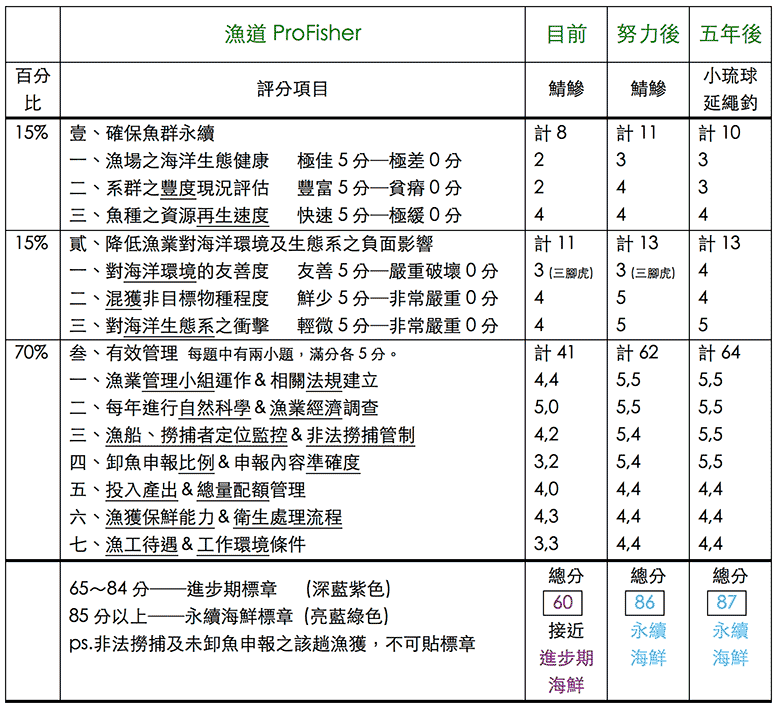
Category One: Ensuring the sustainability of fish stocks 15 points
- The marine ecological health status of the fishing ground: Excellent 5 points -- Very poor 0 points
- Assessment of the current abundance of the stock: Abundant 5 points -- Barren 0 points
- The resource regeneration rate of the fish species: Fast 5 points -- Extremely slow 0 points
From the perspective of marine ecologists (as distinct from fisheries scientists), only a healthy marine ecosystem and a complete food chain can ensure "fish every year." These three scoring items greatly test a country's marine scientific research capacity. No one can ever precisely calculate how many fish there are in the sea, but there are estimates that are more accurate or more absurd.
If we take the "Great Barrier Reef of Australia and Taiping Island of the Nansha Islands" as the standard for a full score of 5 points in marine ecology, then Taiwan's main island and offshore islands after industrial development would probably all be below 2 points. Of course, detailed assessment should be left to marine scientists for on-site evaluation.
The abundance of fish stocks is also a complex question. Online articles from time to time question MSC and MEL Japan, arguing that they issue labels too freely. For example, Bering Sea walleye pollock and Pacific hake have both seen obvious declines in resource abundance, yet have obtained MSC certification?!
◎ The ocean belongs to everyone, not just fishers
Category Two: Reducing negative impacts on the marine environment and ecosystem 15 points
- Friendliness of fishing methods and gear to the marine environment: Friendly 5 points -- Severely destructive 0 points
- Degree of bycatch of non-target species: Rare 5 points -- Very severe 0 points
- Impact on the service functions of the marine ecosystem after harvesting: Slight 5 points -- Very severe 0 points
The conservation goals of this major category are precisely the points of greatest public concern in marine conservation -- for example, opposing trawling that destroys the seabed, and opposing trawling that catches large numbers of juvenile fish; some groups are committed to preventing the bycatch of sea turtles, seabirds, dolphins, and so on. Therefore, nearshore bottom trawling receives 0 points in Category Two, in line with international conservation trends and social perceptions.
The third item is something marine scientists at the Sea Dragon King Association especially insist on, while the fisheries sector has often neglected it in the past: after harvesting, what impact is caused to the ocean's service functions? For example, "whitebait" in certain months bycatches too many babies of other fish species, which may cause the collapse of the upper biological chain. The "spearfishing" controversy also lies here. Compared with trawling and gillnetting, spearfishing can receive 4-5 points for being friendly to the marine environment, and it absolutely will not bycatch non-target species. If you want to shoot a humphead wrasse, it is the one! 5 points.
The problem is that coral reef fish have always been "diverse but few in number," and the larger the female fish, the far greater its egg production compared with young mother fish. Removing large fish may have a fatal impact on the ecology of that sea area. Unless there is a complete scientific survey every year to know which fish are in that area and in what quantities, following Australia's strict limits on catch numbers and body length, and this is the third goal of the ProFisher label: "effective management."
◎ Control our harvesting pressure
Category Three: Effective management
Each item has two sub-items worth 5 points each. Excellent model 5 points -- Everything awaiting reconstruction 0 points
- Operation of fisheries management groups & establishment of related regulations
- Annual natural science & fisheries economics surveys
- Positioning and monitoring of fishing boats and harvesters & control of illegal harvesting
- Ratio of landing declarations & auditing of the accuracy of declaration content
- Input-output & total allowable catch quota management
- Catch preservation capacity & hygiene handling procedures
- Treatment of fishing workers & working environment conditions
Effective management is actually very arduous! First, bringing all potential harvesters together for a meeting is not an easy task. Let alone reaching consensus. When NGOs hold meetings, it often happens that 10 groups have 12 positions, and in the end there are still two groups that did not attend the meeting and afterwards say they do not agree.
In terms of research capacity, the fisheries in Taiwan that currently conduct long-term scientific surveys are all funded by the Fisheries Agency, but the Fisheries Agency is very short of funds, and most fisheries have no tracking assessment, such as Penghu Spanish mackerel. "Fisheries economics" data are therefore lacking. But for the sustainable development of the industry and marine ecology, collecting and deeply analyzing economic data from harvesting costs, processing, and sales to related peripheral industries is of great significance.
The third and fourth items, from grasping "fishing boat movements" to implementing "landing declarations" and auditing "the accuracy of declaration content," all have a key and major impact on the accuracy of scientific research and the formulation of fisheries management policy. Only on the basis of the third and fourth items can we truly establish the regulations needed to prevent overharvesting, such as setting closed seasons, closed areas, and limits on the total number of fishing boats, and so on.
"Total and individual quotas" are a more ideal level. After two meetings, the Mackerel and Scad Fisheries Advisory Group still has not reached consensus on the tonnage for "total catch control." The fundamental reason is that fishers' landing declaration work still needs much more effort. Western Australia's lobster fishery took nine years to achieve individual quotas. Individual quotas can avoid the "fishing Olympics" produced by total catch control -- everyone races to catch all the fish within a short open harvesting period (such as the current situation with Penghu sea urchins), and can also avoid the unequal competition and survival pressure that "large fishing operations" with advanced fish finders worth several million yuan place on "small fishing operations" that rely on feeling to find fish schools.
The sixth item, preservation of catch, involves food preservation and food safety. If we can effectively reduce waste from spoilage, we can catch far fewer fish while still maintaining good prices, which is good for both the ocean and fishers. If the Fisheries Agency can encourage small boats to install live fish tanks, or build ultra-low-temperature freezers at fishing ports, this concept can be implemented.
In fact, the sub-item on catch preservation capacity is a major category for an entire industry chain. From the "operational compartment design" of the vessel and the configuration and maintenance of "refrigeration and freezing equipment" on board, to the freezing plants and processing plants after landing, all are involved. At present, Taiwan's mackerel industry has only one freezer vessel; the rest use refrigeration. The hygiene handling process includes hygiene education for onboard personnel, the water quality of ice, cleaning of work areas, avoiding leaving catch piled on deck for too long, and so on, all as links in the chain. It is suggested that the EU's hygiene assessment standards and related professional discussions could be adopted as scoring standards.
Finally, the seventh item concerns the wages, treatment, and working environment of fishing workers. Although it is not directly related to marine conservation, it is the practice of universal human rights values. In terms of treatment, if fishing workers are given unequal contracts, intermediaries are allowed to deduct wages arbitrarily, labor and health insurance are not provided, wages are not paid on time, and leave is less than the statutory number of days; in terms of environment, if workers are often injured on the job, employers often use verbal violence, workers can always only sleep on the boat, and no prayer space is provided, then no matter how environmentally friendly the seafood is, it is bleak and should be heavily penalized.
ProFisher's math time
After saying so much, take a pen and let us do some trial calculations together!
First, let us calculate the mackerel and scad fishery. Due to the lack of precise data (such as the labor and health insurance status of fishing workers), assume that conditions are generally not very bad and use the median for calculation. The preliminary trial calculation gives 60 points! Very close to the standard for the "progressive stage." It is believed that with one year of preparation, including increasing fisheries economics surveys and implementing landing declarations, it may be possible to affix the label; after another three years of effort, reaching "sustainable seafood" can be expected.
Now let us do a trial calculation for Xiaoliuqiu, which has already implemented the "three-nautical-mile net ban." Xiaoliuqiu has many sea turtles, but the number of fish and coral reef organisms is insufficient, and whether it can have a "renaissance" depends on fate. After the net ban, Xiaoliuqiu has small-scale longline fishing for black throat, white belt fish, red-eye mullet, and so on. Xiaoliuqiu's advantage is that it has experience convening local residents for meetings in order to designate no-take zones and the three-nautical-mile net ban. In addition, the Liuqiu Fishermen's Association has its own patrol boat and patrol team, and association cadre Li Yili is diligent in taking boats out to patrol and diving to inspect. In controlling illegal harvesting, it should be able to score very high.
After trial calculation, assume Xiaoliuqiu is given five years to improve effective fisheries management, including organizing a local fisheries management group, making landing declarations, subsidizing scientific and economic research surveys, and enhancing fishers' capacity to handle catches. In time, it has the potential to meet the "sustainable seafood" standard!
Conclusion
Although environmental labels are not a panacea -- energy-saving light bulbs, recycled paper, and organic fruits and vegetables cannot guarantee 100% salvation of the Earth's ecology; seafood labels will not necessarily win back the heart of the ocean either, but with effort there is brightness. If citizens have the opportunity to enjoy food that takes more responsibility for the environment, that is also a blessing. We hope that through the sustainable seafood label and the consumer market, we can help the mother ocean restore vitality with her own energy. Formosa's ocean must ultimately take this step itself.