The styling of cascade bonsai emphasizes seizing the momentum by overhanging into space
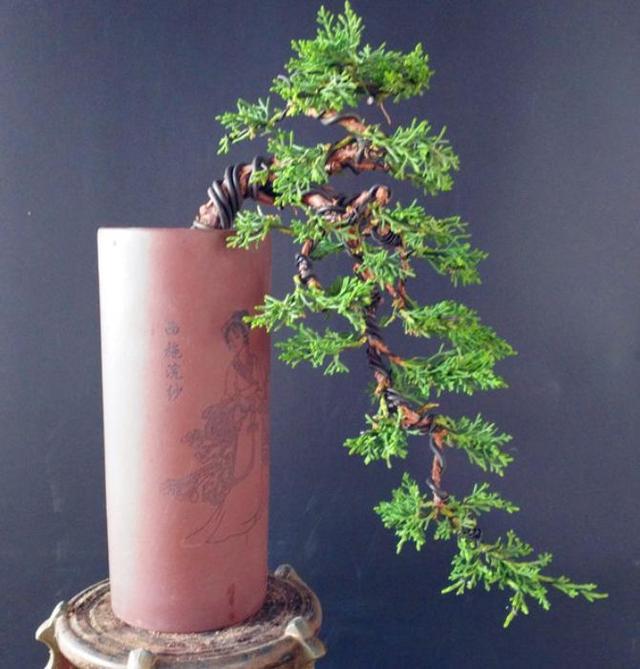
Cascade bonsai that seize the momentum by overhanging into space
Cascade bonsai generally include semi-cascade, full-cascade and inverted-hanging styles, etc.
(1) Semi-cascade bonsai: the entire tree extends beyond the pot, but the tree body does not drop below the pot surface, either the trunk extends horizontally, or because the trunk is relatively short while the first branch is thicker and longer, thus seizing the momentum by overhanging into space.
(2) Full-cascade bonsai: the entire tree extends beyond the pot, and pours downward in a cascading manner with branches extending horizontally. As shown in the picture, it is a full-cascade cascade bonsai.
(3) Inverted-hanging bonsai: the entire tree extends beyond the pot, the exposed trunk hangs vertically downward, and the branches still extend horizontally.
The making of cascade bonsai mainly lies in the selection of material. The base of the material's trunk has a certain curved arc, and the trunk or large branches can extend horizontally or droop accordingly. In the past, tall cylindrical flower pots were often used to plant cascade bonsai, in order to set off the momentum of the tree falling from high to low. Now semi-tall square pots or mesh pots are used instead, and then tall stands are used to create the cascade momentum.
In the styling of cascade tree-stump bonsai, the branch pads beneath the trunk body are generally not kept, but are instead expressed in the shaping of the crown pads, because in terms of its form, this can make the tree's form more complete. Therefore, the curvature changes of the trunk's lower baseline are required to be clear, to prevent shaded branches from appearing on the lower trunk and the tree's vigor becoming unbalanced. All kinds of styling of stump bonsai require branches to emerge on all four sides of the trunk body, but only the cascade style requires branches on only three sides of the trunk body. The treatment of the lower branches is achieved through the outward growth and curvature changes of the front branches and back branches of the trunk body, so that the branch pads have enough space to grow and shaded branches will not occur.
Cascade bonsai are divided into large cascade bonsai and small cascade bonsai. Cascade bonsai generally use cylindrical pots. In large cascade bonsai (Figure 2), the drooping crown extends beyond the bottom of the cylindrical pot, while in small cascade bonsai the drooping crown does not extend beyond the pot bottom. Small cascade bonsai are generally not less than 3/4 of the cylindrical pot. When making it, select a tree species with a length of not less than 25cm from the base of the root to the first side branch, make longitudinal and transverse cross-shaped cuts on it, and wrap it well with adhesive tape, then wind it well with thick iron wire at 45 degrees. Fix it firmly and make it bend and droop. The tree head may also tilt slightly upward, and the side branches should change according to the changes of the drooping main hand. The selected material should have side roots, and the trunk's segments should be rugged and orderly, elegant and full of momentum.
Figure 2
In order to make the peculiar styling of cascade bonsai and achieve an overall sense of beauty, the following points should be noted during making [Jishan Huayao].
(1) The base of the cascade tree-stump bonsai is generally vertical, starting to incline to one side from the middle-lower part, with the trunk going downward, while near the tip it curls back upward, showing the momentum of a coiled dragon walking backward, giving people a feeling of vigorous vitality.
(2) Cascade tree-stump bonsai emphasize raising the roots. Raising the roots can both show its aged tree form and somewhat ease the dynamic momentum of the bonsai, creating visual balance. If relying only on root styling cannot satisfy the balance requirements of the bonsai, stones can be used to achieve the goal.
(3) Cascade tree-stump bonsai should use medium-deep pots and should be placed on high-footed stands, so that the elegance of the stump bonsai can be shown even more.
The main tree species for making cascade bonsai include: five-needle pine, black pine, orange jasmine, Chinese elm, Japanese bush cherry, littleleaf box, etc.