Fisheries Agency inspects distant-water fishing vessels; 30% suspected of withholding foreign crew wages or excessive working hours
In response to reports in recent months of abuse of foreign crew and wage withholding, the Fisheries Agency held a press conference today (the 7th) to outline its current concrete measures. Fisheries Agency Director-General Huang Hung-yen stated directly that since the implementation of the three distant-water fishing laws last year up to now, 65 distant-water fishing vessels and 133 crew members have been inspected, and about 30% of these are suspected of violations, mainly excessive working hours or wage withholding, and further investigation will be conducted on a case-by-case basis. The Fisheries Agency also imposed a fine of 250,000 yuan in May and June on vessels illegally hiring crew, and suspended their licenses for two months.
Inspections of distant-water fishing vessels: 30% suspected of violations
The Fisheries Agency estimates that by the end of this year it will inspect 80 distant-water fishing vessels and more than 450 foreign crew members, and will evaluate more than half of the intermediary agencies. Huang Hung-yen stated that most of the complaint cases received so far involve wage withholding under various pretexts. "What we believe should not be deducted must be returned." To date, 8,340 USD in owed wages and 1,596 USD in security deposits have been recovered.
Wang Mao-cheng, deputy director of the Fisheries Agency's Distant Water Fisheries Division, explained that inspection results since the end of last year show 30% suspected violations, but because language barriers in the questionnaire design may have distorted the results, further in-depth investigation will be conducted on individual cases. "The actual number of violation cases may be even lower."
Are there cases of crew not receiving wages? Huang Hung-yen stated directly that if they did not receive wages, the crew would have gone on strike long ago. Ninety percent of crew on distant-water fishing vessels are foreign crew members, and they can join forces to prevent the vessel from operating, which would cause the vessel owner huge losses. "Vessel owners are afraid of crew strikes, so most still follow the rules." Are there cases of crew being abused? "Such situations are very rare; it is just that one or two cases have been infinitely amplified." Only then did the outside world come to think it seemed foreign crew were commonly abused. "But that logic is not correct."
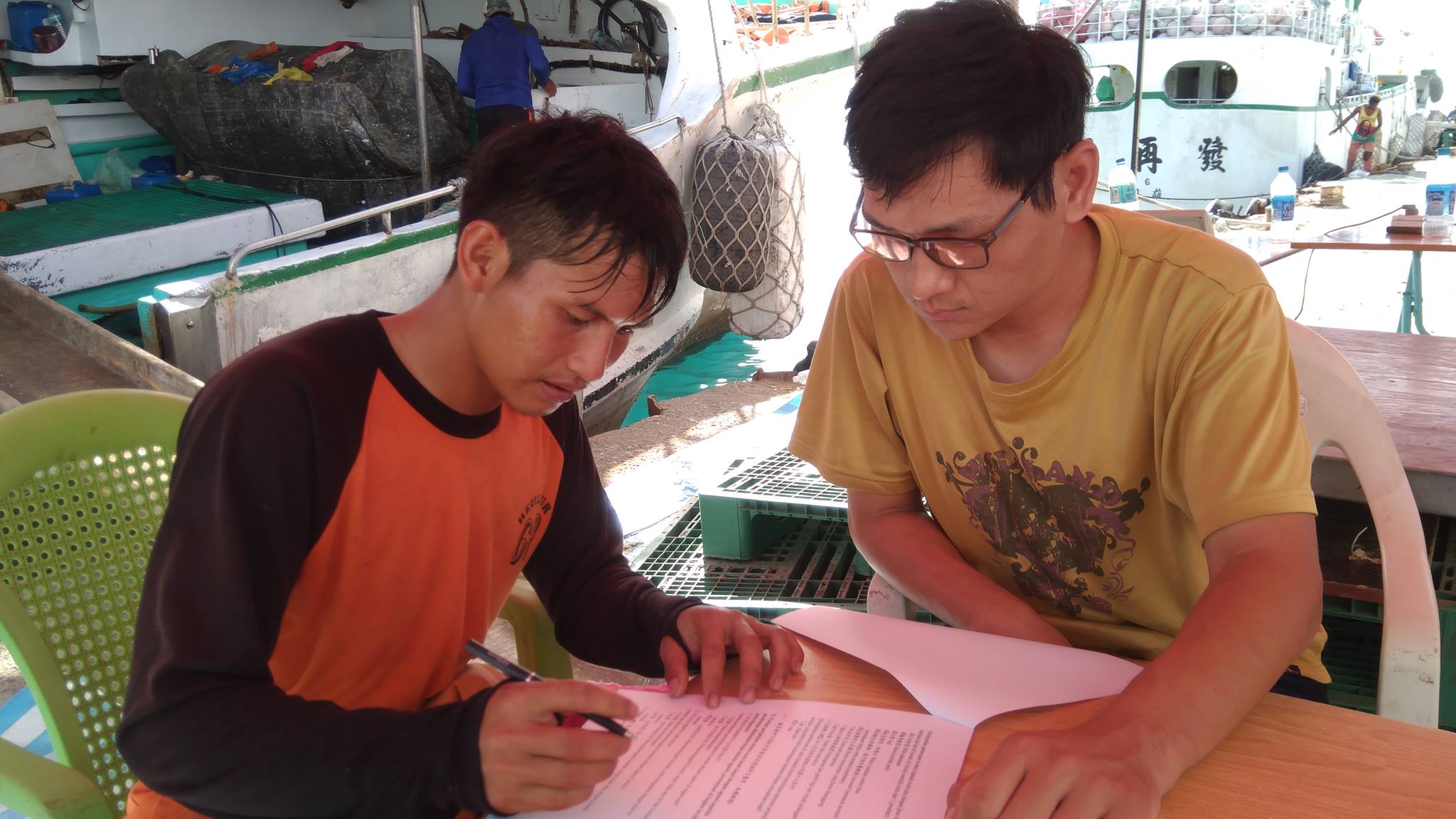
Fisheries Agency: Intermediary evaluation to be implemented; poor intermediaries will be penalized
According to the "Regulations Governing the Permission and Management of Employing Non-R.O.C. Crew Members Overseas," implemented on January 20 last year, the monthly wage of foreign crew members shall not be lower than 450 USD; wages are paid directly to the crew to avoid pre-deducted compensation or security deposit fees; death insurance shall not be lower than 1 million yuan; the minimum daily rest time is 10 hours, and the minimum weekly rest time is 84 hours.
Regarding the intermediary system, a licensing system for intermediary agencies is adopted, and foreign crew members may only be hired through those on the Fisheries Agency's whitelist; an intermediary security deposit system is adopted, ranging from 1.5 million to 2 million yuan; and an intermediary evaluation mechanism has begun to be implemented, under which those evaluated as poor may be ordered to suspend business.
Regarding intermediary evaluation, Wang Mao-cheng further pointed out that evaluations began this year to let intermediaries know which points they should pay attention to and make corresponding improvements, and next year they will actually be included in the assessment, with the Fisheries Agency penalizing poor intermediaries.
However, the evaluation assesses only the Fisheries Agency's intermediary whitelist. How then can illegal intermediaries not on the list be prevented? Huang Hung-yen stated that if they are not on the list, they cannot conduct intermediary business. Even if there are illegal intermediaries, many shipping companies would not dare hire these crew members because approval could not be obtained, and the fishing vessel companies would then be unable to operate.
Wang Mao-cheng explained that hiring foreign crew members overseas must be reported to the competent authority for approval within 15 days. If, when a specialist conducts an inspection at a foreign port, it is found that a group of crew members is not included in the approved materials, a fine will be issued.
Civil society questions whether crew can tell the truth during public inspections
To strengthen inspection capacity at domestic and foreign ports, the Fisheries Agency also hired eight additional foreign crew inspectors and assigned six additional overseas fisheries specialists in June this year. Wang Mao-cheng further explained that there are now 17 fish unloading inspectors who can conduct crew inspections at the same time as inspecting fish unloading at ports. This is mainly done abroad, and if some fishing vessels happen to enter domestic ports, inspections will also be conducted there.
However, the inspection method involves inspectors going aboard vessels to give questionnaires to crew members. Chiu Shao-chi, Taiwan ocean project director of the UK Environmental Justice Foundation, questioned that without an enclosed space, and with the vessel owner possibly nearby, crew members cannot answer about their actual conditions. Crew members must be assured they will not be reported and be in a safe environment before they can speak about problems. "At the start of our interviews, many crew members also said there were no problems with the work, but after ten or twenty minutes, they slowly spoke about many problem points." Wang Mao-cheng, however, stated that these inspection techniques will be improved so that crew members can speak about the real situation without concerns.
Will foreign crew be included under the Labor Standards Act? Chen Chi-chung: Under internal study and drafting
As to whether overseas foreign crew members may be included under the management of the Labor Standards Act, Huang stated that this is a long-term path to take in the future and that they want to move in that direction, but the system must first keep up and there must be good communication with the industry. Huang further declared that in the future he hopes to raise foreign crew wages to 610 USD per month. Chen Chi-chung pointed out that whether to bring foreign crew under the Labor Standards Act, comply with the International Labour Organization's Work in Fishing Convention (ILO188), or enact a separate law is currently under internal study and drafting, and will be completed and announced to the public as soon as possible.
Chiu Shao-chi stated that Council of Agriculture Deputy Minister Chen Chi-chung has invited civic groups to hold discussions and intends to cooperate more actively with these groups. "This is a good start, but we hope information can truly be fully disclosed and policies can be actually implemented."