Rangoon creeper vines fill the garden with blooms in summer, fragrance drifting for a mile
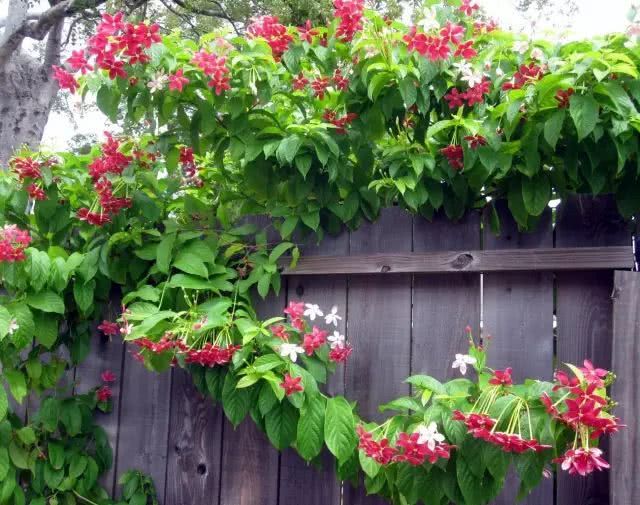
If in the more southern regions you spot from afar a large expanse of star-shaped climbing flowers mixing red and white, whose fresh fragrance you can smell from far away, that is the Rangoon creeper (Combretum indicum). It is a deciduous climbing flowering plant, blooming brilliantly in summer, with very good ornamental value and climbing effect, and it is very popular in warm regions.
Once you have seen what the Rangoon creeper looks like, it is hard to forget. It has strings of five-star-shaped blooms gathered together, hanging down slightly, a truly moving sight. Its flowers can be seen from late spring to autumn, so its flowering period can be said to be very long.
The Rangoon creeper appears to produce two kinds of flowers, white and red, but actually this is because they open at different times. The newly opened flowers are all white, and as time goes on, the flowers turn red. It also has some double-flowered cultivars, but they are very rare.
What also leaves a deep impression is its ever-changing stem. Its climbing effect is very good, and the stem gradually becomes woody. Because it is a deciduous flowering plant, the places where leaf stalks first grew slowly develop some sharp protrusions, and its stems all curve upward.
After the Rangoon creeper's flowers fade, it can produce fruit somewhat like a balcony, which turns dark brown when ripe. It is a fruit that can be used in medicine, but it must not be eaten by mistake.
To grow the Rangoon creeper, it is best to choose cutting or air-layering propagation. Generally in spring and autumn, use 2 to 3-year-old branches as cuttings, give them slightly moist sandy soil, and keep the growing temperature at around 22°C; they root and sprout very easily.
Give the growing environment plenty of light, and if the planting spot has a trellis or wall to climb, it will grow into a very attractive flower arbor.
Before planting, give it an appropriate amount of slow-release organic fertilizer, and during the later growth period add more light fertilizer, and it will bloom more.
In winter it will drop its leaves, so water should be controlled and fertilization stopped; at this time you can properly prune some messy branches.