Detailed Explanation of the Standardized Cultivation Model for Dwarfing (Double-Dwarf) Apples in Fengxiang County
Standardized Cultivation Model for Dwarfing (Double-Dwarf) Apples in Fengxiang County
1 Dwarfing (Double-Dwarf) Apple Cultivation
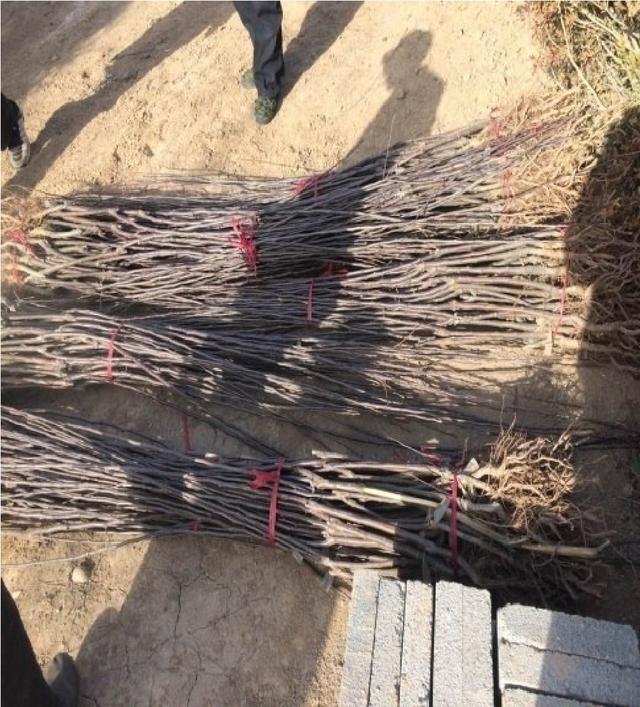
The types of nursery stock currently used in dwarfing apple cultivation in China include four forms: dwarfing own-rootstock nursery stock, dwarfing interstock nursery stock, spur-type nursery stock, and double-dwarf nursery stock (Figure 1), among which dwarfing interstock nursery stock is the most commonly used in production. In Fengxiang County, double-dwarf cultivation covers a relatively large planting area, accounting for more than 80%. Double-dwarf nursery stock refers to seedling stock propagated from seed, onto which a dwarfing interstock is grafted, and then a spur-type cultivar is grafted onto the dwarfing interstock. Orchard establishment in areas with irrigation conditions focuses on double-dwarf cultivation. This helps accelerate the pace of dwarfing apple development in Fengxiang County, so as to achieve the goals of improving land utilization, shortening the time to bearing, reducing production costs, improving management techniques, and enhancing fruit quality.
Figure 1 Dwarfing (Double-Dwarf) Apple Nursery Stock
2 Cultivation Standards for Dwarfing (Double-Dwarf) Apples
2.1 Planting Large Nursery Stock
Practice has proven that planting large nursery stock (with multiple branches) can produce fruit in the same year of planting. Moreover, the more branches the large nursery stock has, the higher the yield in the second and third years; planting nursery stock with no branches or with too small a trunk diameter means fruit will not begin to set until the fourth or fifth year, let alone achieve a high yield. The diameter of nursery stock for establishing a dwarfing (double-dwarf) apple orchard must not be less than 16 mm; 10-15 branches, and at minimum no fewer than 5 branches. It is recommended not to use single-trunk nursery stock for orchard establishment.
2.2 Standardized Orchard Establishment
At present, dwarfing apple nursery stock in production is mainly dwarfing interstock nursery stock. To establish a double-dwarf apple orchard, nursery stock must be reserved in advance or top-grafted by oneself. When establishing an orchard, one should choose a site with superior site conditions, a large day-night temperature difference, an altitude of 750-1300 m, abundant sunlight, a suitable climate, deep soil, fertile soil, gentle terrain, sheltered from wind and facing the sun, close to a water source, pure water quality, and convenient transportation (Figure 2). Following the principle of "adapting to local conditions and planting suitable varieties in suitable sites," and based on market demand and ecological conditions, in the dry belt above 820 m altitude, mid-to-late-maturing varieties should dominate, mainly planting spur-type Fuji varieties such as Yanfu No. 6, Liquan Short Fuji, Huimin Short Fuji, Miyazaki Short Fuji, and Aomori Short Fuji, or well-colored Fuji strains; in the river-plain irrigation district at 760-800 m altitude, focus on developing excellent early-to-mid-maturing varieties such as Ligala, Shangan No. 3, Honggailu, Qinyang, and American No. 8, Zhongqiuwang, Huashuo, Shinano Red, Yuhua Fuji, and Early Fuji King. After planting apple nursery stock, technical measures such as plastic film mulching, covering the trunk with plastic film bags, and setting up supports should be adopted to ensure seedling survival and upright growth.
Figure 2 Standardized Orchard Establishment
2.3 Planting Density
On flat land with irrigation conditions, double-dwarf nursery stock using M26 and M9 as dwarfing interstocks should be selected. Spacing should be (1.5-2.0) m x (3.5-4.0) m, with 95-83 trees per mu. Without irrigation conditions, dwarfing interstock nursery stock of ordinary varieties using M26 and M9 as dwarfing interstocks should be selected.
2.4 Planting Depth of Dwarfing (Double-Dwarf) Nursery Stock
The planting depth of the dwarfing rootstock is a key factor in successful orchard establishment. For dwarfing interstock nursery stock using M26 as an example of the dwarfing interstock, the length of the dwarfing rootstock should preferably be 25-30 cm; in the semi-arid fields of the Fengxiang area, M26 should preferably be exposed above ground by 3-5 cm, and in fields with better water and fertilizer conditions, M26 should preferably be exposed above ground by 12-15 cm (Figure 3); for double-dwarf apple nursery stock using M26 as an example of the dwarfing interstock, the length of the dwarfing rootstock should preferably be 25-30 cm, and in fields with better water and fertilizer conditions, M26 should preferably be exposed above ground by 5-8 cm. If the dwarfing interstock is exposed above ground too much, the tree body will be too small, affecting high yield and efficiency; if the dwarfing rootstock is exposed above ground too little, the tree body will be too tall, even resembling a standard tree, and cannot normally exert the high-quality and high-efficiency performance of dwarfing apple trees.
Figure 3 Planting Depth of Double-Dwarf Apple Nursery Stock
2.5 Arranging Reasonable Pollinator Trees
Generally, 20% pollinator trees are arranged.
2.6 Adopting the Tall Spindle Tree Shape
Training objectives: for mature trees, 70,000-80,000 branches per mu, ratio of long, medium, and short branches 1:3:6, leaf area index 2.5-3.0, branch-to-fruit ratio about 3:1, leaf-to-fruit ratio 25-30:1, ratio of flower buds to leaf buds 1:3, 14,000-15,000 flowers per mu, orchard coverage rate about 70%.
Tree structure: tree height 3-3.2 m, trunk height 0.8-1 m, ratio of the central leader diameter to the diameter of main branches at the same position 5-6:1, 25-30 small main branches arranged on the trunk, length not exceeding half the row spacing, the lower ones may be appropriately longer and the upper ones shorter. Main branch angle 110°-120°, with bearing branches growing on them, bearing fruit at the primary level, with no medium or large bearing branch groups retained; the whole tree is spindle-shaped (Figure 4). After maturity, the canopy is small, branch volume is abundant, bearing capacity is strong, there are no large main branches, light is sufficient, and light energy utilization is high.
Figure 4 Tall Spindle Tree Shape
2.7 Planting Grass and Mulching Grass in the Orchard
Through many years of our experimental demonstrations, adopting orchard grass planting (Figure 5) and orchard mulching gradually increases soil organic matter content and activates soil nutrients; by fully applying organic fertilizer and applying more biogas fertilizer, soil nutrients are increased; by precisely applying chemical fertilizer and topdressing compound fertilizer containing multiple trace elements, soil nutrition is increased; by foliar topdressing, tree nutrients are supplemented. This can greatly improve soil fertility and guarantee the soil nutrient demand for fruit tree growth. In particular, orchard grass planting and straw mulching can effectively increase soil organic matter content, accelerate the decomposition and transformation of minerals, and combine farming with soil nourishment. According to experimental measurements, after 5 years of planting white clover, the soil organic matter content of the orchard increased from the original 0.87% to 1.72%, and after 7 years the soil organic matter content increased to 1.98%. After 3-5 years of grass mulching, the organic matter content in the 5-10 cm soil layer can increase by one percentage point.
Figure 5 Orchard Grass Planting
2.8 Biological Control
Adopt comprehensive technical measures, reduce the amount of chemical pesticides and fertilizers, reduce pollution, fully give play to the advantages of biological control measures, comprehensively control diseases and insect pests, and produce green food. Choose and use low-residue chemical pesticides, so as to effectively control diseases and insect pests below the threshold that causes production harm, while not polluting the environment and keeping fruit residues within standards. It mainly includes the following aspects:
(1) Agricultural control. It mainly includes methods such as fertilization and irrigation, winter pruning and summer pruning (four-season pruning), orchard plowing, inter-row grass growing, fruit bagging, bark scraping, using insect-attracting belts for control, sticky insect boards for control (Figure 6), manual capture and killing, trunk whitewashing, and winter orchard cleaning.
Figure 6 Sticky Insect Boards for Pest Control
(2) Physical control. Use pests' tropism toward light, sugar-vinegar solution, sex pheromones, etc. for monitoring and control. It mainly includes methods such as frequency-vibration insect-killing lamp trapping, sugar-vinegar solution trapping, sex attractant trapping, and mating disruption twist ties.
(3) Biological control. Measures for biological control of diseases and insect pests mainly use natural enemy insects to control pests, use fungi to control pests and diseases, use beneficial birds to control pests, and use microbial pesticides to control diseases and insect pests.
(4) Chemical control. Implement the plant protection policy of "prevention first, comprehensive control." In years when diseases and insect pests occur in large numbers, in order to effectively, quickly, and stably eliminate diseases and insect pests, it is still necessary at present to combine the application of high-efficiency and low-toxicity chemical agents to achieve the goals of high quality, high yield, and high efficiency in fruit trees.
3 Precautions for Dwarfing (Double-Dwarf) Apple Cultivation
Orchard establishment with double-dwarf nursery stock must have irrigation conditions; orchard establishment with dwarfing interstock nursery stock is better with irrigation conditions, and if there are no irrigation conditions, water must be applied and film mulching must be done during orchard establishment (Figure 7).
Figure 7 Mulching with Plastic Film After Planting Double-Dwarf Apple Nursery Stock