What to Do About Fruit Cracking in Dahongrong Apples? A Detailed Guide to Prevention and Control Methods
What to Do About Fruit Cracking in Dahongrong Apples?
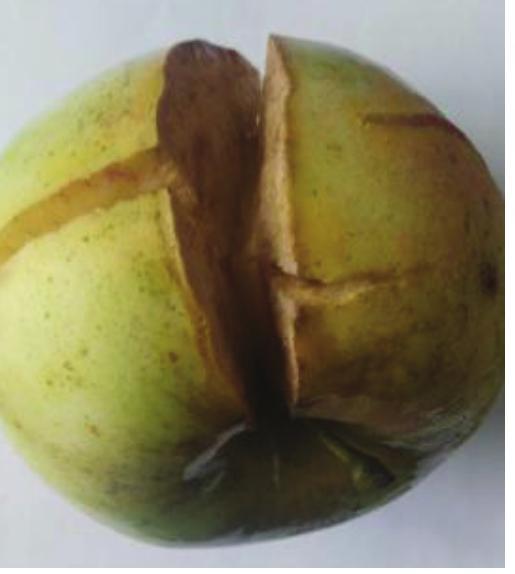
On August 29, 2017, Hou Laosan from Taoyuan Subdistrict Office in Pingyuan County brought four Dahongrong apples in for consultation. The apples were found to have severe fruit cracking. An on-site investigation in the orchard showed a cracking rate of 60%-70%, and it was still increasing. On one individual fruiting branch, 6 of 7 apples had cracked. The cracking on Dahongrong apples appeared in various forms: longitudinal cracks (Figure 1), transverse cracks, and a cross type combining longitudinal and transverse cracks (Figure 2). Transverse cracks generally occur in the middle along the length of the fruit, with cracks reaching more than 1 cm deep; in severe cases the fruit nearly splits open (Figure 3). Longitudinal cracks are mainly irregular and net-like, varying in depth, with red pigment deposited on the sun-exposed cracked surface (Figure 4). Even bagged fruit developed cracks (Figure 5) [Jishan Huayao].
Figure 1 Longitudinal crack
Figure 2 Interwoven longitudinal and transverse cracks
Figure 3 Longitudinal crack nearly splitting the fruit open
Figure 4 Longitudinal section of a cracked fruit
Figure 5 Cracking even with bagging
There are several theories about the causes of fruit cracking: First, the theory of uncoordinated growth. As we know, different types of fruit trees have different fruit growth periods, and the extent of fruit volume increase differs among species, forming different growth curves. The apple enlargement pattern belongs to the S type; fruit size depends on the number of cells and cell size. The fruit cell meristem belongs to apical meristem and has no cambium. When the initial cells divide, the fruit's longitudinal axis grows rapidly, and the ratio of longitudinal diameter to transverse diameter is relatively large; later, as cells enlarge, the transverse diameter surpasses the longitudinal diameter. When the flesh expands faster than the skin, fruit growth becomes unbalanced, and when the flesh volume expansion exceeds the limits of skin expansion, the skin ruptures. Second, the theory of improper water management. If the soil is dry during the early stage of fruit growth, the skin grows slowly, the intercellular spaces inside the fruit are small, and cell density and fruit firmness increase. When rain or irrigation suddenly occurs, soil moisture increases sharply, roots rapidly absorb large amounts of water and transport it upward to the fruit, the flesh absorbs water and swells rapidly, and the skin cannot withstand the expansion of the flesh and cracks, resulting in fruit cracking. Third, the theory of injury. Sites damaged by pesticide injury, diseases, or pests often cause the skin to stop growing; the stopped-growth area and the actively growing area press, tear, and separate from each other, and this becomes the starting point of cracking. In addition, fruit exposed to sunlight on the lit side, with large day-night temperature differences or rain, is prone to cracking, and the cracks are often on the sunny side. Fruit with sunscald scars is prone to cracking; when rain occurs, cracks form along the sunscald scar points and then extend to other parts. Fourth, the theory of pressure. The higher the sugar content of the fruit, the greater the osmotic pressure, and the more easily the fruit absorbs water from the outside. If water is absorbed too quickly, the flesh swells rapidly, bursting the skin and causing cracking. Fifth, the theory of nitrogen-calcium imbalance. Studies have shown that when nitrogen content is relatively high, it affects calcium absorption. Calcium is an element that stabilizes the structure of fruit cell membranes; when calcium is deficient, the cell structure is unstable, and cracking is likely to occur at this time.
Traditional solutions for fruit cracking include water control methods, calcium supplementation methods, bagging methods, and strengthened management methods. Severe cracking makes the fruit unsellable, prevents it from forming a marketable product, and causes it to lose cultivation value. According to surveys, Dahongrong apples generally mature in early September in Pingyuan, and the early stage of fruit maturity coincides with the local rainy season. Hou Laosan introduced Dahongrong apples in 2012, and it has already been 6 years; calcium fertilizer was applied every year, and bagging was also used, but fruit cracking still occurred every year after fruiting, which indicates that cracking is caused by the innate incompatibility of Dahong apples with the local soil and climate. Hou Laosan asked what to do next in orchard management. There is only one suggestion: replace the variety and carry out top grafting to change the canopy, grafting onto a variety with good market prospects that does not crack.