How to prevent and control peach tree gummosis? Understanding the causes is key
Causes and control measures of peach tree gummosis
1 Symptoms
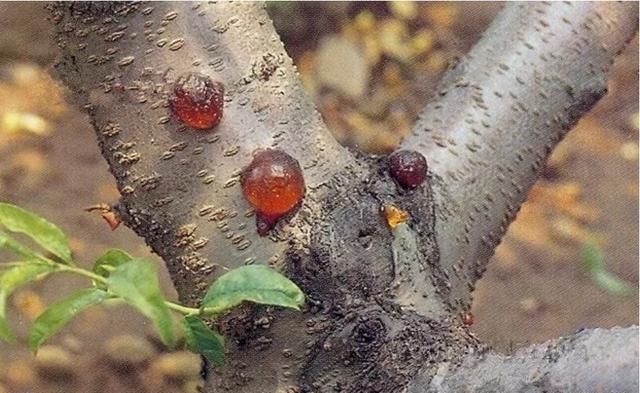
Gummosis mainly occurs on the root crown, trunk, and main branches, with the trunk being the most prominently affected. The trunk is affected more severely than the branches, and small branches and fruit can also be affected. In the early stage of the disease, the affected part swells and continuously exudes translucent yellow gum, especially after rain when gum flow is more severe. After the exuded gum contacts the air, it gradually turns brown and becomes a crystal-clear, soft jelly-like mass, which after drying becomes a brown hard gum mass (Figure 1).
Figure 1 After gum flow, it becomes a brown hard gum mass
3 to 4 gum beads connect together to form irregular round gummosis lesions 3 to 10 mm in diameter, appearing jelly-like, and after drying becoming red-brown hard gum masses. The bark at the gum flow site swells and becomes rough, with cracking, and the wound is difficult to heal. The cortex and xylem gradually turn brown and rot, and are also easily infected by saprophytic fungi. As the disease develops, the gum flow points continuously increase and enlarge. In severe cases, the trunk exudes gum all over. When the lesions surround the trunk and main branches, the tree vigor declines, leaves turn yellow, shoot tips wither, and even branches or the whole plant die.
As the disease progresses, affected fruit exude yellow gum from inside the stone, which overflows onto the fruit surface. The diseased part hardens, and in severe cases cracking appears. Diseased fruit cannot grow and develop and have no edible value.
2 Conditions for disease occurrence
Peach tree gummosis lasts for a relatively long period and can occur from April to October, with the most severe damage from May to September. The occurrence of peach gummosis is closely related to tree age, tree vigor, cultivation and management level, temperature and humidity, and other conditions. Older trees are more severely affected, while young trees are less affected. The activity of latent pathogens in the branches and trunk is related to temperature. In early spring when sap flow is vigorous, that is, when the temperature is around 15°C, the diseased part can exude gum. As the temperature rises, at around 25°C and with more rain, the number of gum flow points on the tree increases, and the disease gradually becomes more severe (Figure 2).
Figure 2 The first disease peak
There are two disease peaks in a year, respectively from late May to late June and from early August to mid-September (Figure 3). After winter begins, gum flow stops. Orchards with clay loam, poor and barren soil, and soil that is too extreme in acidity or alkalinity are prone to gummosis. Peach orchards with low comprehensive management levels or severe pest and disease problems are more severely affected.
Figure 3 The second disease peak
3 Causes of the disease
Gummosis is divided into non-infectious gummosis and infectious gummosis, but it is mainly caused by fungal invasion. After the pathogen invades the trunk and branches (Figure 4), it passes through winter steadily, and in the following year at the early flowering stage of peach blossoms produces a large number of spores. The spores spread by wind and invade wounds on the trunks of other peach trees, infecting the next peach tree.
Figure 4 The wound of gummosis is invaded
4 Scientific control
4.1 Select excellent rootstocks and varieties
Using wild peach as a rootstock has stronger stress resistance than using dwarf peach as a rootstock. Avoid continuous cropping in peach orchards.
4.2 Strengthen peach orchard management and enhance tree vigor
Apply more organic fertilizer, improve soil aggregate structure, and increase soil aeration. Apply 3 to 5 tons of chicken manure per mu; pay attention to drainage in low-lying waterlogged land, and appropriately apply lime or superphosphate in acidic or alkaline soil. Improve the soil, and pay attention to salt removal in saline-alkali land.
4.3 Do a good job of orchard cleaning
Clean the orchard before winter or after the beginning of spring, and burn the affected twigs and fallen leaves in a centralized manner; scrape off hard gum masses and rotting tissue to eliminate sources of inoculum. Use 60 to 100 times diluted Kuifuling solution for whole-orchard spraying. Soil application of boron or foliar spraying of boron during the growing season has a relatively good effect on controlling gummosis.
4.4 Adjust pruning time
Prune reasonably to reduce wounds on branches and trunk. Pruning by heading back and thinning branches during the peach tree growing season creates artificial wounds, and under moderate temperature and high humidity, wounds are prone to gum flow. By adjusting the pruning period, adopt light pruning during the growing season and promptly pinch and thin out some overly dense branches. The main thinning, heading back, and renewal pruning should be adjusted to after leaf fall in winter.
4.5 Whitewash the trunk
Whitewash the main trunk twice in winter and summer. The first whitewashing is done after the peach tree loses its leaves, using 5 degrees Baume lime-sulfur mixture + fresh cow dung + fresh lime, or 20% to 25% lime milk to brush the main trunk to sterilize and disinfect, prevent freezing injury and sunscald, eliminate overwintering pests and diseases on the trunk, reduce pest and disease infection and radiant heat damage, and effectively reduce the occurrence of gummosis.
4.6 Cover the whole orchard with grass in summer
In orchards where green manure is not planted, covering the whole orchard with 10 cm thick weeds or rice straw during the high-temperature and dry seasons of summer and autumn can not only increase the soil water content of the orchard, favor the growth of fruit tree roots, and strengthen the tree body, but also very effectively prevent sunscald caused by ground radiant heat, thereby preventing the occurrence of gummosis.
4.7 Apply protective agents
Use 60 to 100 times diluted Kuifuling solution for whole-orchard spraying, and spray once with 500 times diluted Liangguoan solution before flowering (at the pink bud stage). For trees that have already developed gummosis, small branches can be pruned off, and gum flow on the branches and trunk should be scraped off cleanly. At the wound, apply 10 to 50 times diluted Liangguoan solution (note that the application area should be 1 to 2 times larger than the diseased area). In severe cases, applying again at an interval of 7 to 10 days gives a more noticeable effect. The optimal time for application is when sap begins to flow, that is, at the end of March, when gum flow is just beginning, with few affected trees and a small gum flow range, making control easier and reducing nutrient consumption of the tree. After that, apply whenever found and control accordingly.
4.8 Timely control of insect pests
From April to May, timely control longhorn beetles, jewel beetles, and other pests to avoid damage to the root crown, trunk, branches and twigs; control peach fruit borer larvae, leaf roller larvae, oriental fruit moth, lygus bugs, and others to avoid damage to fruit that leads to gummosis (Figure 5).
Figure 5 Timely control pests that damage fruit
4.9 Chemical control
If the gum flow is caused by a bacterial pathogen, use agricultural streptomycin or Yeqingshuang, etc., for spraying and brushing the main trunk. If the gum flow is caused by a fungal pathogen, use antibacterial agent 401, carbendazim, thiophanate-methyl, iprodione, etc., for spraying or brushing the main trunk. The concentration for brushing the main trunk can be relatively increased compared with the concentration for spraying the canopy. Before brushing the main trunk, use a bamboo strip to scrape off the gum-like material at the gum flow site cleanly, then brush with the medicinal solution, or cut clean used cotton cloth into strips, soak them thoroughly with the medicinal solution, and wrap them around the affected area, then bind with 10 cm wide plastic film, which has a relatively good control effect. For chemical control, 50% thiophanate-methyl ultra-micro wettable powder 1000 times solution or 50% carbendazim wettable powder 800 times solution, or 50% iprodione wettable powder 1500 times solution can be used, with relatively good control effect. From late March to mid-April is the period when infectious gummosis releases conidia, and in combination with the control of other diseases, spray 600 to 800 times diluted Liangguoan solution for prevention. Early May to early June and early August to early September are the two disease peaks of infectious gummosis. Before each peak period, spray 600 to 800 times diluted Liangguoan solution once every 7 to 10 days, for 2 to 3 consecutive sprays, depending on the specific condition of the disease.