New Technology for Controlling the Apple Tortrix Moth
New Technology for Controlling the Apple Tortrix Moth
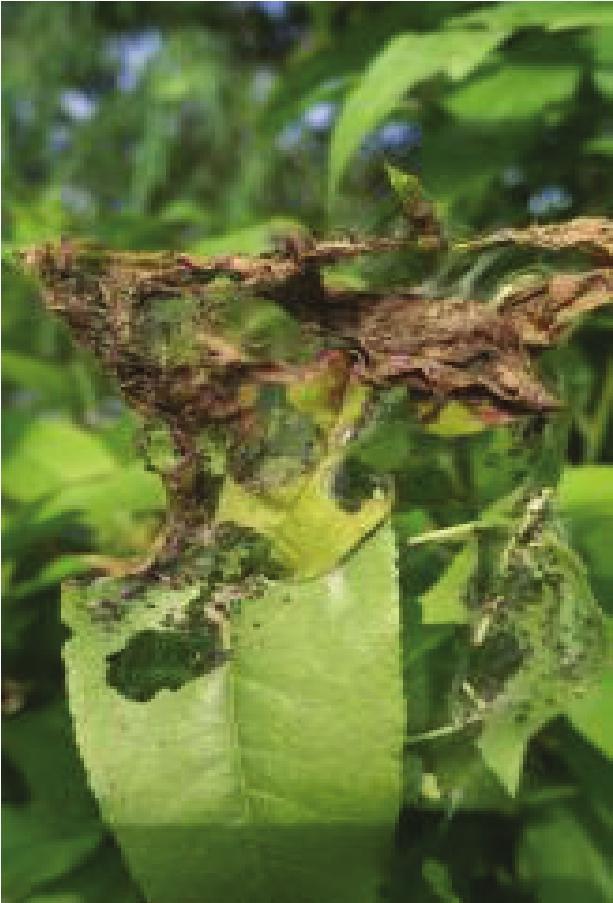
In August, the tower-shaped ornamental peach is in its new shoot growth period. On the tower-shaped ornamental peach in the landscaping belt of Pingyuan County, 30% of the peach tree new shoots were damaged by the apple tortrix moth (Figure 1). The apple tortrix moth spins silk to web together the leaves of peach shoots, feeding among them, eating the leaves into notches or a net-like pattern, and depositing excrement within the webbed leaves (Figure 2) [Jishan Huayao].
Figure 1 Damaged peach shoots
Figure 2 Peach shoots with insect webbing
The apple tortrix moth, also known as the apple leaf roller, yellow small leaf roller, and bark-sliding insect, is a pest of the family Tortricidae, order Lepidoptera. The adult is 6-8 mm long, yellow-brown in color, with two dark brown diagonal stripes on the forewing running from the costal margin to the inner margin and outer margin, one of which widens noticeably when it reaches the middle of the wing from the costal margin to the inner margin. There is a small brown marking at the shoulder angle of the inner margin and near the apex of the costal margin of the forewing. The eggs are flat and oval, pale yellow and semi-transparent, with dozens arranged in fish-scale-like egg masses. The larva has an elongated body with a relatively small, pale yellow head; young larvae are yellow-green, while mature larvae are emerald green. The pupa is yellow-brown, with two rows of spines on the dorsal side of each abdominal segment, the lower row being smaller and denser, and 8 hooked bristles at the tail end.
The apple tortrix moth is one of the major pests in peach orchards. It produces 3 generations per year in the plains, overwintering as larvae in bark crevices of branches and trunks, pruning and saw cuts, and other locations. When peach trees and other fruit trees bud in spring, it emerges from overwintering and damages new buds, tender leaves, and flower buds. After fruit set, it gnaws the peel at the point where two fruits are close together, forming scars and indentations that affect fruit quality. Adults are active at night and hide during the day, are phototactic, and are strongly attracted to sugar-acetic acid liquid; Trichogramma wasps are their natural enemies. Main damage symptoms: larvae spin silk to bind leaf edges and hide within the bound leaves to feed (Figure 3), with new leaves suffering the most severe damage. When the fruit is slightly larger, they often bind leaves onto the fruit, gnawing the peel and flesh, forming cull fruit. The larvae (Figure 4) have the habit of moving between fruits to cause damage; a single larva can damage 6-8 peaches.
The safe control measures for the apple tortrix moth are as follows: First, scraping: before fruit trees bud, scrape off the coarse bark and lifted bark on the trunk, at pruning and saw cuts, and other locations to eliminate overwintering larvae. Second, eradication: before fruit trees bud, spray the whole orchard once with 3-5 degrees Baumé lime sulfur mixture or 45% lime sulfur crystal at 40-60 times dilution to kill remaining overwintering larvae. Third, pruning: combined with the damage characteristics, during summer pruning, promptly cut off the apple tortrix moth leaf nests to eliminate the pests within. Fourth, trapping: using their taxis, prepare sugar-acetic acid liquid (V sugar : V white liquor : V vinegar : V water = 5:5:20:80), place it in tin cans or small basins from June onward, hang them within the tree canopy, with 1-2 per mu, to attract adult apple tortrix moths. Fifth, release: Trichogramma wasps are natural enemies of the apple tortrix moth; release Trichogramma 3-4 days after the peak of egg-laying by the overwintering generation adults, releasing once every 5 days for 4 consecutive releases, which can achieve no damage for the entire year. Sixth, treatment: seize the periods after petal fall and at the peak hatching of the first-generation eggs, and select biological agents or biorational pesticides and other safe agents for control; spray 25% diflubenzuron at 1,500-2,000 times dilution, or 0.5% toosendanin emulsifiable concentrate at 500-1,000 times dilution, or Beauveria bassiana at 100 million spores/mL, etc.
Figure 3 Leaf-binding appearance on peach
Figure 4 Apple tortrix moth larva