New technology for the prevention and control of Armillaria root rot in peach trees
New technology for the prevention and control of Armillaria root rot in peach trees
1 Symptoms of Armillaria root rot damage in peach trees
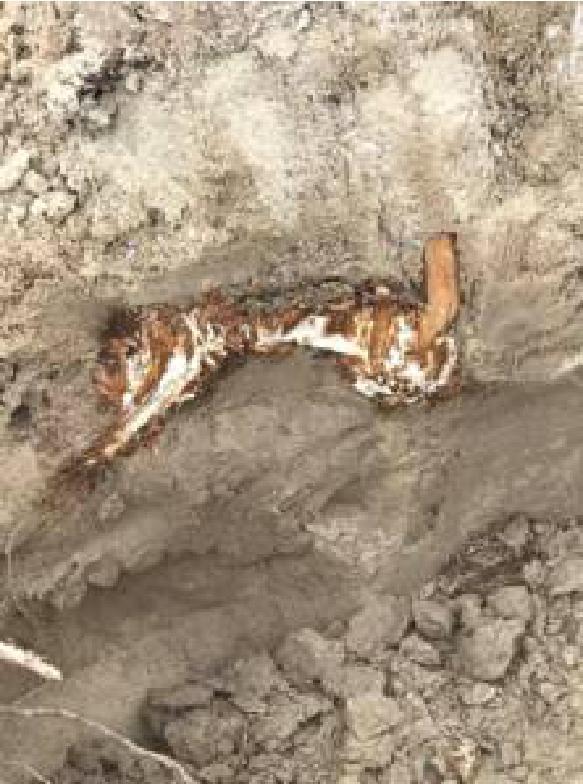
The main symptom of Armillaria root rot is that the space between the cortex and the xylem is filled with a white to pale yellow mycelial layer, with the mycelium spreading outward in a fan shape; the fresh mycelial layer shows blue-green fluorescence in the dark, and the diseased roots have a strong mushroom odor (Figure 1) [Jishan Huayao]. In the later stage of the disease, the cortex of the diseased part rots and the xylem decays; in the rainy season or in a humid environment, clusters of cream-yellow mushroom-like fruiting bodies may form on the diseased parts or at broken roots. On lightly diseased trees, the leaves are small and yellow, and new shoot growth is limited (Figure 2); on severely diseased trees, the leaves drop early, the branches die back, and even the whole tree dies (Figure 3).
Figure 1 Armillaria root rot lesions on peach trees
Figure 2 A peach tree with Armillaria root rot
Figure 3 A dead peach tree killed by Armillaria root rot
2 The pathogen of Armillaria root rot in peach trees
2.1 The pathogen of Armillaria root rot in peach trees
The pathogen of Armillaria root rot in peach trees is the luminescent false honey fungus Armillaria tabescens, a basidiomycete, which is a fungus with a very wide host range. It mainly damages the root crown of fruit trees, such as peach and apple, causing decay of the root cortex. The initial site of infection is not fixed, but no matter where it starts, it rapidly spreads to the root crown, and then spreads from the root crown to the surrounding areas.
2.2 Transmission routes and conditions for disease occurrence
The pathogen mainly overwinters as mycelium on diseased plants and diseased residues in the field, and the pathogen dies after the diseased residues rot and decompose. Contact between diseased and healthy roots and the movement of diseased residues are the main ways the disease spreads. When diseased roots contact healthy roots or healthy roots contact diseased residues, the pathogen can directly invade through wounds and rapidly spread and cause damage. Armillaria root rot mostly occurs in orchards converted from old forest land or riverbank land; orchards where trees have never been planted before rarely develop the disease.
3 Traditional control methods
3.1 Agricultural control
When building a new orchard, avoid old forest land, riverbank land with many trees, ancient grave sites, and similar locations. If an orchard must be built on such plots, first thoroughly remove diseased residues such as tree stumps, residual roots, and rotten bark; second, irrigate, plow, and sun-dry the soil to promote the rotting and decomposition of remaining diseased residues; if conditions permit, the soil can also be covered with plastic film over the summer to use solar heat to kill the pathogen; a 200-fold formalin solution can also be poured onto the soil for fumigation and sterilization, and seedlings should be planted only after the formalin has fully dissipated. After diseased trees are found, dig around the root crown to locate the affected areas, and according to the location of the lesions, find the affected areas on the main, lateral, and branch roots (Figure 4); according to the severity of the disease, thoroughly scrape off or saw off the diseased tissue, and completely remove the diseased residues. To avoid spread and expansion, a trench can be dug around the diseased tree as a barrier, generally 50-60 cm deep and 30-40 cm wide.
Figure 4 Examining the root crown of a peach tree
3.2 Chemical control
Apply medicine to wounds for protection, with effective agents such as Bordeaux mixture, 1%-2% copper sulfate solution, 2-3 degrees Baume lime sulfur mixture, etc.; cover the roots with disease-free soil or medicated soil. For lightly diseased trees or trees where the affected areas are difficult to find completely, direct drenching with medicine can also be used for treatment.
The above two types of methods have poor operability, unsatisfactory control effects, and high control costs. Therefore, after extensive searching, a simple, practical, effective, and low-cost method was finally found - the biological bacterial organic fertilizer control method.
4 Method for controlling Armillaria root rot in peach trees with biological bacterial organic fertilizer
The biological bacterial organic fertilizer is provided by Xinji City Fangsheng Agricultural Technology Company. This bacterial fertilizer contains 10 kinds of probiotics, with a probiotic count of 400 million/g, and has both medicinal and fertilizer effects. Among them, the probiotics that act on pathogens include Bacillus megaterium, Bacillus subtilis, and Bacillus amyloliquefaciens. These three bacteria all have a good inhibitory effect on the pathogen of Armillaria root rot in peach trees. In particular, Bacillus amyloliquefaciens is present in huge numbers and has a strong effect. It can induce plants to develop disease resistance and can produce various physiologically active substances and amino acid substances such as gibberellin, indoleacetic acid, and cytokinin, promoting the growth of the peach tree root system and the plant, and helping diseased trees recover to health.
In the peach orchard of Dongliuzhuang, Qianying Township, Xinji City, with an area of 20 mu, involving 4 fruit-growing households, planted in 2010, the varieties include Late Jinghong and yellow peach. They began bearing fruit in the 3rd year, and from the 4th year onward, six or seven trees died every year. In June 2017, problems were found again in many trees: some were completely wilted, and some had a large main branch dried up. After digging around the root crown, the diseased parts were found to be decayed, with obvious white pathogen tissue. Fifteen years earlier, this orchard had been planted with peach trees of the honey peach variety. After the peach orchard declined, the trees were dug out and mainly goji berry was planted.
The peach trees grew well during the young tree stage, and no Armillaria root rot or other root diseases were found. After entering the fruiting stage, the disease occurred continuously, and the trees even died.
On the afternoon of June 14, diseased trees were dug open and the lesions were found (as shown in Figure 1). The lesions were not treated, and the biological bacterial organic fertilizer (Figure 5) was applied directly to the lesion sites at a rate of about 2 kg, then covered with soil and watered. On the 29th, observation showed that the leaves of the treated trees had turned from yellow to green, while the untreated trees were more dried up but had not yet died. On July 5, observation showed that all leaves of the treated trees had turned green, and new shoots had grown again, while the untreated trees had dried up and died (Figure 6). At the end of July, a survey showed that more than 10 treated trees had recovered to health and were growing normally (Figure 7).
Figure 5 Biological bacterial organic fertilizer undergoing fermentation
Figure 6 Treated trees and control trees 20 days after treatment
Figure 7 Peach trees that have recovered after treatment