The Symbolism of Traditional Chinese Plant Painting: Flowers and Trees Have Feelings Too
If in the garden, this man-made museum of nature, stones symbolize death and water symbolizes void, then the plants placed alongside them symbolize life everywhere.
Human beings exist within an overlapping symphony of life and death, and even feelingless plants and trees are endowed with the countless desires and realizations of life.
Our ancestors did not crudely classify plants into the category of "lower organisms"; instead, they regarded them as one station in the cycle of rebirth. Branches, leaves, and flower stamens, like waists, hair, skin, and faces, are all vessels of the spirit of all things, appearances of dreamlike illusions. Plants and trees bathed openly between heaven and earth even possess more wisdom and compassion than ordinary people in the mortal world.
Section One: The Useless Tree of the Oak Shrine
"Craftsman Shi went to Qi, and when he came to Quyuan, he saw the oak tree of the earth shrine... It is a tree of no use." - Zhuangzi, "In the World of Men"
Craftsman Shi found in Quyuan of the state of Qi an oak tree regarded by the locals as a shrine tree. This oak shrine tree had a circumference of a hundred arm-spans, and its treetop rose above the mountain summit, yet he regarded this giant tree, large enough to build more than ten great ships, with disdain. Because in Craftsman Shi's view, this was a useless tree: its timber would sink if used to build boats, would break easily if made into vessels, would seep resin and fail to fit tightly if made into doors, and would certainly be attacked by insects if used as beams and pillars.
Qing Dynasty, Giuseppe Castiglione, "Auspicious Fungus and Sacred Bird Presented from Mount Song," ink and color on silk, 242.3 x 157.1 cm, now in the Palace Museum, Beijing
Only because the oak shrine tree was a "useless tree" of no value to craftsmen could it flourish and live long to this day.
Zhuangzi in fact used the image of the oak shrine tree to develop Laozi's way of uselessness. Laozi once said: "When people are alive, they are soft and weak; when they die, they become stiff and strong. When all things, plants, and trees are alive, they are soft and fragile; when they die, they become withered and hard. Therefore the stiff and strong are companions of death, and the soft and weak are companions of life. Thus when weapons are strong they do not prevail, and when trees are strong they are broken. Therefore the strong and great occupy the lower place, and the soft and weak occupy the upper place."
(When a person is alive, muscles and bones are soft; after death, they become rigid. When all things, plants, and trees grow, they are soft and fragile; when dead, they become dry and hard. Therefore stiff and strong things belong to the category of death, and soft and weak things belong to the category of vitality. Thus, relying on strength in battle cannot bring victory, just as a tree in full luxuriance will be cut down. Whatever is strong instead occupies a disadvantageous position; whatever is soft and weak instead occupies the upper position.)
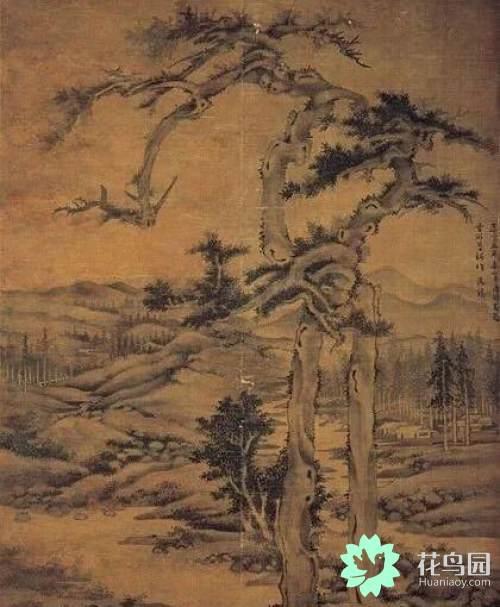
Yuan Dynasty, Wu Zhen, "Hanging Scroll of Twin Pines," ink on silk, 111.4 x 180 cm, now in the National Palace Museum, Taipei, China
The Dao follows nature, and the empty way of "the use of the useless" from Laozi and Zhuangzi seeped into the marrow of ancient literati.
Loyalty, righteousness, merit, and fame were the universal bright pursuit, yet the shade of the useless oak shrine tree also followed like a shadow.
Section Two: The Secret Song of the Mountain Spirit
"I gather the three blossoms in the mountains, where rocks are piled high and kudzu vines spread and twine." - Chu Ci, "Nine Songs"
The ancient character for "Chu" means a country amid dense forests and marshes, and the Chu Ci is precisely a song flickering and walking among dark plants.
Ming Dynasty, Lu Ji, "Peonies and Golden Pheasant," ink and color on silk, 184.3 x 100 cm, now in the National Art Museum of China
In the romantic beliefs of the Chu region, primitive plant worship carried a strong color of sorcery. In the "Nine Songs," the vigorous vitality of plants symbolizes their abundant life force; they are the medium of mutual affection, or else the very glue and lacquer in an inseparable bond. Many plants recorded in the texts indeed had the effect of arousing desire and enhancing fertility, closely linked to survival and reproduction.
"Gathering the life-extending lingzhi in the mountains, with rocks piled high and kudzu vines spreading and twining."
Qing Dynasty, anonymous, "One of the Twelve Beauties of Yongzheng: Standing Holding a Ruyi Scepter," ink and color on silk, now in the Palace Museum, Beijing
The plant in the mountain spirit's hand is a mysterious elixir of youth and also a sacred spring of joy. Plants are the spokespersons or incarnations of the gods.
Southern Song Dynasty, Ma Lin, "Portrait of the Corn Poppy," ink and color on silk
After the Chu Ci, Qu Yuan listed dozens of plants in "Li Sao." He used flowers and grasses as clothing, and when longing and weeping, he also used various orchids, fragrant herbs, and fresh flowers to wipe away his tears. Qu Yuan's image in "Li Sao" gradually began to merge with plants, and the gulf between humans and plants was filled by Qu Yuan's intense passion, love, yearning, and desire. He seemed to become Narcissus in Greek mythology, admiring his own reflection and pitying himself, transformed into a water spirit and singing the secret song of the mountain spirit full of deep affection and tenderness.
Section Three: The Lotus of the Wondrous Dharma
"It rained lotus blossoms and produced immeasurable hundreds, thousands, ten thousands, and millions of kinds of music." - Lotus Sutra
Whether in an era of war or in a peaceful and prosperous age, misfortune hides everywhere like an iceberg beneath the sea, and all living beings need comfort. In the late Eastern Jin Dynasty, Buddhism spread widely in China, and by the Northern Wei Dynasty it was established as the state religion.
Five Dynasties, Gu Deqian, "Lotus Pond and Waterfowl," ink and color on silk, 150.6 x 91 cm, now in the Tokyo National Museum, Japan
In the Mahayana classic the Lotus Sutra, the lotus is the plant incarnation of the non-dual dharma: on the first level, the lotus is reserved and does not reveal itself; on the second level, the lotus emerges from mud yet remains unstained, supremely pure and clean; on the third level, the lotus's flower, leaves, and fruit grow together and are regarded as an existence transcending time and space.
Modern era, the Gao family of Penglai, "Kesi Tapestry Hanging Scroll of Lotus and Frogs," 78 x 37 cm, now in the Palace Museum, Beijing
One of the eight auspicious signs at Shakyamuni's birth was the sudden appearance in a pond of white lotuses as large as chariot wheels. The Amitabha Sutra also describes the Western Pure Land of Ultimate Bliss with the words "In the land of Ultimate Bliss there are seven-jeweled ponds, filled with the water of eight merits... in the ponds, lotuses as large as chariot wheels." Therefore the Buddha realm is also called the "Land of Lotuses." The lotus takes root in mud, just as living beings live and die in the sea of suffering; it gradually grows from the filth until it emerges above the water, just as Buddhist practice finds liberation amid affliction until reaching the coolness of the Pure Land.
Song Dynasty, Wu Bing, "Hibiscus Emerging from Water," ink and color on silk, 23.8 x 25.1 cm, now in the Palace Museum, Beijing
In Chapter Twenty-Eight of the Lotus Sutra, the "Encouragement of Bodhisattva Samantabhadra," Bodhisattva Samantabhadra and an immeasurable, boundless, incalculable assembly of great bodhisattvas went from the east to Mount Grdhrakuta to hear the dharma, and along the way all lands trembled and lotuses fell from the sky. When the flower blooms, one sees the Buddha-nature; the lotus promises that the fully enlightened person of perfect merit will pass through its body to reach the Pure Land of Ultimate Bliss, but while in this dusty world, one can only use the lotus as a boat for the compassionate voyage across the sea of suffering.
Muromachi period of Japan, Kano Masanobu, "Zhou Maoshu Admiring Lotuses," light color and ink on paper, 84.5 x 33.0 cm, now in the Kyushu National Museum, Japan
"Human life is like illusion and transformation, and in the end it must return to nothingness." Perhaps only by taking root in the swamp of life can one open a lotus of nothingness from the mud.
Section Four: The Flower Demon of Caozhou
"If one cherishes with single-minded devotion, even ghosts and spirits can be moved; and those who waver cannot be said to be without feeling either." - Strange Tales from a Chinese Studio, "Ge Jin"
In the romantic fantasies of the study, any living being might transform into human form to dispel loneliness, and plants are no exception.
Ming Dynasty, Li Congxun, "Peonies Filling Spring," ink and color on silk, 26 x 26 cm, now in the Palace Museum, Beijing
Chang Dayong of Luoyang had a passion for peonies. After accidentally catching sight of a beautiful woman in a garden in Caozhou, he fell lovesick, and in the end the two became deeply attached and eloped back to Luoyang. After marrying the lovely wife Ge Jin, Chang Dayong still could not help feeling curious and doubtful about his wife's true identity, and secretly ran back to Caozhou to investigate, only to discover that his mother-in-law, "Lady Caoguo," was actually a peony of peerless beauty. After returning to Luoyang, Chang Dayong's probing words angered Ge Jin; in a fury, his wife threw their child into the courtyard, where it fell to the ground and disappeared, and she herself vanished along with her sisters without a trace.
Qing Dynasty, Qianlong period, embroidered hanging scroll of peonies and pheasants, 108 x 64 cm, now in the Palace Museum, Beijing
Pu Songling, through the voice of the Chronicler of the Strange, said: "Since love is single-minded, it can reach ghosts and spirits; then flowers too are not feelingless things! Did not Bai Juyi say: 'The junior official has no wife, and spring is lonely; when the flowers bloom, I shall take you as my wife'? As long as one can understand another's feelings, that is a good marriage; why must one investigate its origins?"
Qing Dynasty, Yongzheng period, black-ground copper-bodied painted enamel peony floral snuff bottle, height 4.7 cm, Beijing Poly
The young women transformed from plants surpassed the women of their generation in both body and spirit; their taking human form was merely because in lonely years their mortal hearts were stirred and they wished to taste the flavor of love. Such erotic fantasies were once hidden beneath the Four Books and Five Classics, comforting the springtime hearts of how many literati.
A hero is not questioned about his origins; as long as the beauty is like a flower, gentle and lingering, why ask where she comes from?
Section Five: Crimson Pearl's Blood and Tears
"I too will go down into the world to become human, but I will repay him with all the tears of my life." - Dream of the Red Chamber
In Dream of the Red Chamber, the system of metaphors is intricately entangled, and in the present world there are always clues secretly pointing toward a deeper fate.
Qing Dynasty, Fei Danxu, "Daiyu Buries Flowers," ink and color on paper, 20.3 x 27.7 cm, now in the Palace Museum, Beijing
In the Grand View Garden, plants flourish in all four seasons, and each kind of beauty, like water, has its corresponding plant. Hibiscus, Xiaoxiang bamboo, and lotus were all used to describe Lin Daiyu, but as for her origin, Lin Daiyu's former self was the only plant that came from heaven.
The first chapter of the book already explains the karmic immortal bond from a previous life: "Only because on the bank of the Western Numinous River, beside the Three-Life Stone, there was a Crimson Pearl Grass... it shed its herbaceous womb and wooden substance, gained transformation into human form, and actually cultivated into a female body." To repay the favor of watering by the Divine Attendant of the Stone, the Crimson Pearl Immortal Grass also followed him down into the world to become human, intending to repay him with a lifetime of tears.
Song Dynasty, anonymous, "Hibiscus," now in the National Palace Museum, Taipei, China
The Crimson Pearl Grass is in fact commonly known in the mortal world as "red girl," growing among wild grasses on barren slopes in the northeast, with a short growing season, and at its reddest and most brilliant in late autumn it is suddenly cut short by cold frost.
Crimson Pearl, a red pearl, is a hidden metaphor for blood and tears.
If the flower demons in the erotic fantasies of Strange Tales from a Chinese Studio represent ancient literati's physical imagination of women, then Lin Daiyu represents the highest spiritualized pursuit. She comes from the void and will ultimately return to the void. It is only men whose "mortal hearts are occasionally stirred," and love is destined to be a pursuit of blood and tears.
Humans are not plants and trees; how can one know they are feelingless?