What plant is the invasive species American pokeweed?
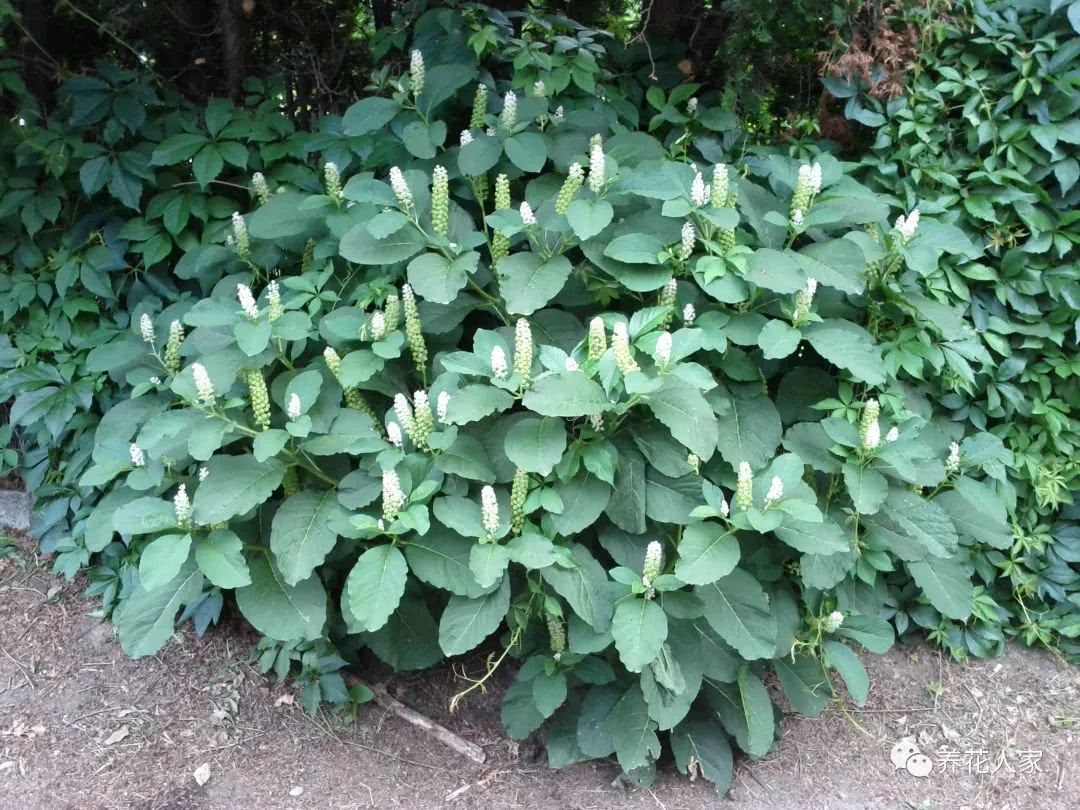
Pokeweed is a stout perennial herb in the genus Phytolacca of the family Phytolaccaceae. It can be seen in ravines, on hillsides, under forest canopies and along roadsides, while in cities it mostly grows in moist lawn corners, at the foot of buildings and beside rubbish heaps.
Pokeweed and its upright, densely flowered raceme: the main peduncle of the inflorescence is pink to purplish red, the tepals (which can simply be understood as "things that look like petals") are white or yellow-green, and its often green stems are sometimes slightly purplish red as well. (Source: commons.wikimedia.org)
In ancient times pokeweed was called xianlu. The Yi Jing, hexagram Guai [guài], says: "xianlu guaiguai," and Kong Yingda's subcommentary states: "Ma Rong, Zheng Xuan and Wang Su all say that xianlu is another name for shanglu," meaning that even if the root of xianlu is dug up and broken, it will grow again as long as it is not completely cleared away (in fact this is a misunderstanding; it does not have such strong regenerative ability, and it is presumed that its fruits had already fallen into the soil and happened to sprout and grow after the parent plant was dug up and broken, which led the ancients to misunderstand), and xianlu is also called shanglu.
In ancient times pokeweed was also called zhu [zhú] tang [tāng]. The Erya, "Explaining Plants," records: "zhutang, horsetail," meaning that "zhutang" is "horsetail," and "horsetail" is one of the alternative names for pokeweed. Guo Pu also said: "Guanxi calls it tang, Jiangdong calls it dangelu, which is pokeweed," meaning that the Guanxi region called pokeweed "tang," while the Jiangdong region called it "dangelu."
In addition, pokeweed can be called "tang" on its own, but cannot be called "zhu" on its own, because "zhu" is the ancient name of another plant. The Book of Songs, "Xiaoya": "I walk in the wild, and gather its zhu." The Commentary: "zhu, a bad vegetable." The Annotations: "It is niutui [tuí]." Lu's note: "People today call it yangti." The plant name "yangti" has been retained in the Flora of China as the standard Chinese name for Rumex japonicus. In ancient times its root was used as medicine, and because the root of pokeweed is thick and fleshy and resembles ginseng, it was also used medicinally in ancient times. Because the two are similar in this respect, the ancient name of pokeweed became attached to the character "zhu."
From this it seems that pokeweed has existed since ancient times and should also be a common species. Unfortunately, however, seeing this native pokeweed today is not an easy matter.
The pokeweed we see at present, with broad green leaves and deep purple fruits borne in clusters at the top and hanging down like strings of miniature grapes, is not pokeweed but drooping pokeweed, also called American pokeweed. Their homeland is far away in North America, and after 1960 they spread throughout Hebei, Shaanxi, Shandong, Jiangsu, Zhejiang, Jiangxi, Fujian, Henan, Hubei, Guangdong, Sichuan and Yunnan in our country, or have become naturalised (naturalised in great numbers in Yunnan).
The differences between native pokeweed and drooping pokeweed are in fact quite obvious.
1. The infructescence of native pokeweed grows upright, while the infructescence of drooping pokeweed hangs down, hence the name drooping pokeweed.
2. Next, the leaf stalks of native pokeweed are green, while the stems of drooping pokeweed are red.
3. Drooping pokeweed is poisonous; it is a plant whose whole body is toxic, especially the fruits and the rhizome. Mistakenly taking the rhizome (which resembles ginseng) or the fruits will cause poisoning.
4. The colour of drooping pokeweed fruits is more attractive, and children especially like to play with them as toys. Children must especially be warned never to pick and eat them.