Moss bonsai presents a different kind of scenery
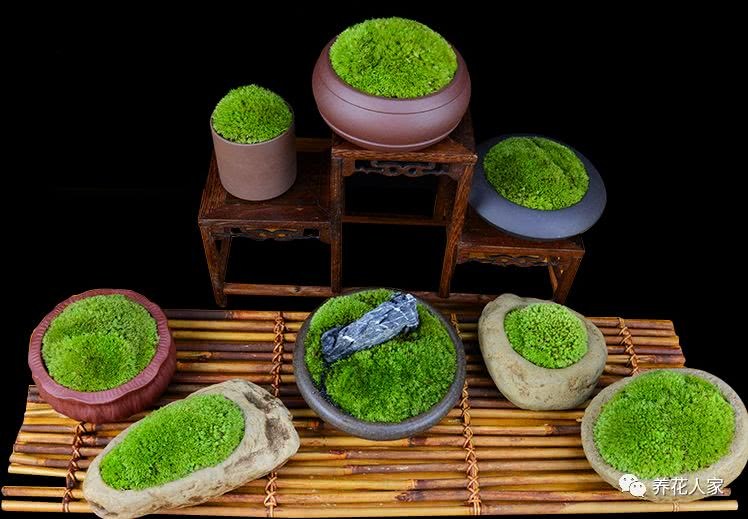
It is an "oasis" of life; wherever it grows, there is a breath of youth, and it makes every dark place come alive.
Grass still needs the full shine of the sun, while moss longs only for a rain, and then without hesitation it gives itself to the rocks along with the wind. The rocks are no longer lonely, for they have the company of moss; the rocks are no longer dull, for they have the beauty that moss gives them.
Moss, you never had the tender green of grass, yet you have its tenacity; you never had the uprightness of the pine, yet you have its selflessness; you never had the splendor of a hundred flowers, yet you have their optimism.
In the whole of life, more of it will also be like the moss - unknown and unheralded. May we all be like the moss - tenacious, selfless and optimistic.
Characteristics of moss bonsai
1. It mostly grows in damp, shady environments, commonly on rock surfaces, the surface of soil, tree trunks or branches. Its body is tiny.
2. It generally has stems and leaves, but the stems have no vessels and the leaves have no veins, so there is no conducting tissue. The roots are very simple and are called "rhizoids."
3. The sporophyte has a sporangium (spore capsule), inside which spores grow. After the spores mature, they scatter with the wind. In a suitable environment, the spores germinate into a filamentous structure (protonema). The protonema produces buds, and the buds develop into the gametophyte.
4. All moss bonsai lack vascular bundle structures, and their water-conducting ability is weak, which limits their body size and height. They have rhizoids rather than true roots. The leaves are made up of a single layer of cells, and the degree of cell differentiation in the whole plant is not high, making it one of the lower plants in the plant kingdom.
5. There is a phenomenon of alternation of generations. The main part of the moss bonsai is the gametophyte, which is able to produce gametes (sex cells). The gametophyte can form male and female reproductive organs. After the male reproductive organ matures, it releases sperm, and the sperm uses water as a medium to swim into the female reproductive organ to fertilize the egg. The fertilized egg develops into the sporophyte.
How to grow moss bonsai
Fertilizing: Generally no fertilizing is needed, though of course a very dilute liquid fertilizer can also be watered on.
Environmental requirements: Diffused light or a semi-shady environment; during care, a certain amount of light should be provided.
Temperature: The temperature must not be lower than 22°C, and it is best kept above 25°C for good growth.
Watering: Spray water several times a day (depending on air humidity); the relative air humidity should be kept above 80%.
Soil: Ordinary garden soil will do, and slightly acidic soil can also be used. The potting soil should be mound-shaped in the pot to increase the planting area as well as air and water permeability.
Potting soil: The potted yuanbao tree (money tree) should be kept with its potting soil moist at all times, but there must be no standing water. The relative humidity of the environment is best kept above 80%, maintaining a moist potting soil environment.
Growth habits: Moss is not suited to growing in dark places; it needs a certain amount of diffused light or a semi-shady environment, and most importantly it likes a damp environment and is especially intolerant of drought and dryness.
How to plant moss bonsai
Actually, the method for planting moss is very simple, but when moss has just been planted its competitiveness is very low, and other higher plants easily invade, so weeding should be strengthened just after planting. Once the moss bonsai has densely covered the surface of the substrate, weeds can hardly invade. Usually division propagation can be used, mostly carried out from May to September. The specific method of division propagation: plant the separated mother plants, several or in clumps, into the substrate, keep a high-humidity environment, and after about a week they will have taken root.
How to make moss bonsai
Moss inoculation method: Choose a few pieces of loess, grind them fine, add water and mix into a paste, put natural moss into the mud slurry and stir evenly, then use a small brush to brush it evenly onto rocks or soil surfaces that have been soaked by water and rain, and spray water frequently; after a few days the moss will appear. You can also take the fresh moss you collected, remove impurities and dry it in the sun, grind it into powder, mix it evenly with water or thin rice water, apply it to the places on the bonsai where it is needed, move the pot to a damp, shady place, and keep it moist, and moss will grow..
Natural mossing method: Place the prepared rocks into a basin of water, frequently pour rice-washing water or vegetable-washing water over them, keep them moist, and put them in a place where they can see the sky but not the sun; water-absorbing stones work even better.
Pot-surface mossing method: For the moss used on the pot surface of a tree bonsai, you can lay a sheet of plastic film flat in a damp place that sees the sky but not the sun, beat the original moss into a slurry and apply it evenly onto the film, keep it moist, and after the moss sprouts spray it once with dilute liquid fertilizer; after 15 days it can be used as needed. Stick mud slurry onto the root surface of the moss tray, the potting soil should be moist, also brush on mud slurry, and then press it on.