Get to know this trendy green plant, and don't be misled by the name florists give it
Fresh flowers really are good at stirring people's emotions.
When we see red-toned flowers we feel warmth and romance; when we see white-and-green arrangements we feel fresh and elegant, a little understated; when we see purple tones we feel nobility with a hint of mystery...
With nothing but color and posture, flowers make humans willingly bestow upon them so many emotions and stories.
The same is true of plants.
In the hot, dry summer that is about to arrive, a touch of green will calm us down; there is a flowing vitality in those leaves that makes people fascinated.
Abroad, there is a very popular trendy green plant. After it was introduced to the domestic cut-flower market, florists gave it the name "guanzhong fern". But when you search Baidu for guanzhong fern, what appears is not at all what this plant looks like.
So, before you get misled by florists, it is worth getting to know this green plant properly. At present, it does not yet have an official Chinese translation, and abroad it is calledblue star fern, blue starfern.
(Here Huaxiaoxian has to reveal a funny phenomenon in the industry: because flower material names are now more and more numerous, many flower names, especially the various roses, are just casually made up by florists for easy distinction...)
As a fern, the blue star fern belongs to the group of plants that were the first to climb onto land on this planet, multiplying generation after generation over the more than 300 million years of time immemorial up to now. It once lived in dense, deep, dappled forests, and today it is treated as a high-end indoor ornamental plant, gradually entering many people's homes.
The high-end texture of the blue star fern comes from its unique fern-leaf form: the stems and leaves are slightly cool and slender, and the color is green with a silvery gray, very graceful and free-spirited. Therefore, this flower language is defined as"aloof"-the cool, detached leaves are very much loved in Nordic-style home design.
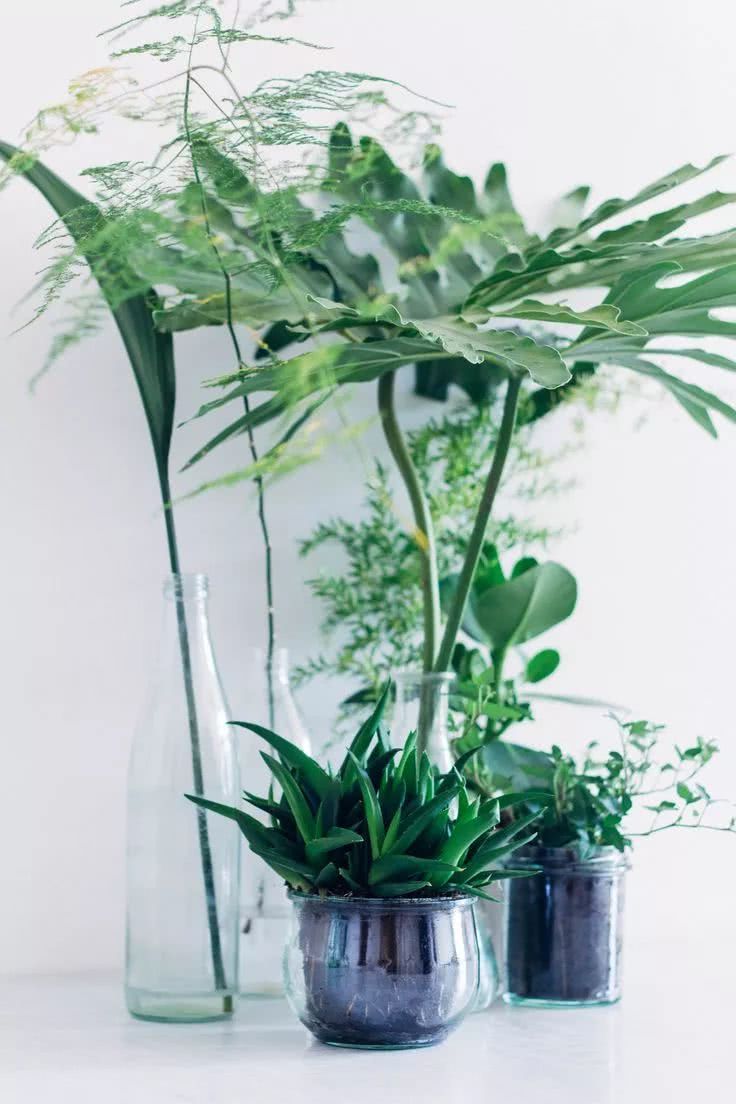
Even if it is not used as a potted plant, simply placing one or two leaves in a bottle of water is also a very popular practice now. The blue star fern has a long vase life; under suitable temperature and humidity, with regular water changes, it can keep for about 2 months.
Sometimes we collect some pretty glass bottles or used-up perfume bottles, find them useless but are reluctant to throw them away; at such times, putting a single stem of blue star fern in them is simply perfect.
It does not need to be paired with other flower materials; placed alone in a vase, it shows a high-end feel. Of course, if you insist on pairing it with other flower materials, that is fine too. You can choose equally fresh and elegant flower materials, such as chamomile.
In some flower arrangements, the blue star fern also appears as an accompanying leaf, but its presence is actually not that strong, usually at the edge of the bouquet serving as a background. Perhaps this is also where the blue star fern's cool, proud, solitary temperament lies: being itself, not competing or grabbing.
Now, more and more people choose to cut the complicated and simplify, abandoning the flashy, and begin to focus on style and texture, choosing simplicity but never monotony. Just like this bouquet made of a few leaves, those who like it will like it extremely.
But do not underestimate these leaves: the cut blue star fern used for ornament now in China is almost entirely imported from the Netherlands, and one stem is not cheap at all.
Probably, the only shortcoming of this trendy green plant is that it is "expensive."
But doesn't being expensive say everything?