Cultivation Techniques for Silver Bud Willow: Propagation Methods and Pest and Disease Control
Propagation and Pest and Disease Control Cultivation Techniques for Silver Bud Willow
Silver bud willow (Salix leucopithecia), also known as silver willow, cotton willow, cat willow, silver bract willow, and pussy willow, is a deciduous shrub of the genus Salix in the family Salicaceae. Silver bud willow is native to northern China, and has now been introduced and planted in many places. When winter arrives, the leaves of silver willow gradually fall off, revealing purplish-red bracts; after the bracts open, the flower buds covered with silvery-white soft fine hairs are exposed, and this is the main ornamental part of silver willow. When its inflorescence unfolds, the flower spike resembles a cat's tail, hence the name "cat willow"; its English name Cat-tail willow also carries the meaning of cat's tail.
Silver bud willow is mainly used for ornamental purposes by cutting its branches bearing flower buds, and it is a traditional cut flower material for winter flower arrangements among the Chinese people. Its silvery-white flower buds that look like writing brushes and its purplish-red bracts are as lovely as a little girl dressed in red; after the bracts fall off, the flower buds covered with soft fine hairs appear even more noble and elegant. Moreover, its flower bud ornamental period falls during the Spring Festival, and because silver willow is homophonous with "silver taels" in Chinese, it represents good fortune and rolling wealth, so silver bud willow cut branches are widely loved by people. Cut branches can be kept in water, with an ornamental period of more than 2 months, and dry placement lasts even longer; they can be placed in a vase alone or used as auxiliary material in flower arrangements.
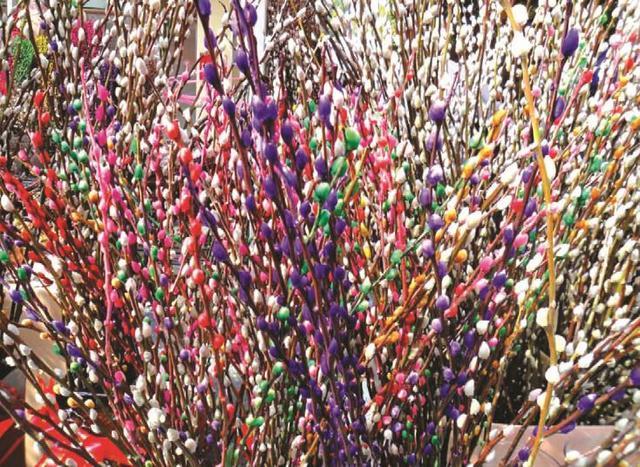
Since the 1990s, market demand for silver bud willow cut branches has increased sharply, and large-scale production has developed increasingly. The flower buds of silver bud willow can also be dyed various colors with dyes. At the Spring Festival flower markets across the country each year, silver-white silver bud willow cut branches as well as those dyed red, yellow, green, purple, and other colors are dazzling and attract many people to buy them. At present, large-scale commercial production is carried out in Shanghai, Yunnan, Jiangsu, Zhejiang, Sichuan, and other places, and products are also exported to Southeast Asia and even Europe and the United States.
I. Propagation Techniques
Silver bud willow is all propagated by cuttings from mature branches, and the cuttings are inserted directly in the field. Generally, during pre-sale sorting in winter, the lower branches are cut off, trimmed into cuttings about 20 cm long with 4-5 axillary buds, tied into small bundles, stood upright indoors, and stored with river sand to maintain moisture. To save cutting material, according to experiments by Wang Lijun and others, cuttings can be cut to only 2 leaf buds and about 8 cm long. The specific cutting time varies from place to place; in the south, February is the suitable cutting period, while in the Beijing area, open-field cutting does not begin until early April.
Taiwan, China also has a large amount of silver bud willow cultivation and export. Their practice is: after silver bud willow is harvested at the end of December, the cuttings are taken, packaged, kept moist, and stored at 4°C. This method is simple and convenient and saves storage space. Two weeks after the Start of Spring is the suitable planting period. The cuttings are cut to about 20 cm long, soaked and disinfected with fungicides such as carbendazim before cutting, then dried in the shade before cutting.
II. Planting Methods
It is best to choose fields whose previous crop was rice and to plant in paddy fields, so as to reduce the occurrence of damping-off disease. Plow and prepare the land, apply base fertilizer, make beds well, and then insert the cuttings.
The practice introduced by Ye Zengji and others in Shanghai is: plow and turn the soil in early to mid-February, apply base fertilizer (apply 2500 kg of organic fertilizer per mu); make beds 1.7 m wide with furrows 0.3 m wide, and at the same time apply 15-40 kg of ammonium bicarbonate, 10-15 kg of potassium sulfate or potassium chloride, and 25-30 kg of superphosphate per mu, and cover the bed surface with black plastic film. Four rows per bed, and insert the stored cuttings about 20 cm long at a plant spacing of 20-25 cm, about 6000 plants per mu. About 2 weeks after cutting, they sprout; if there are missing plants, they should be replanted immediately so as not to affect yield per unit area.
As the first year of cut flower cultivation, cuttings are grown into single-stem silver bud willow, and the cut branches produced have thick stems, bright color, and plump flower buds. By the second year, taking advantage of the stubble's characteristics of early sprouting, early leaf fall at the lower part of the branches, and upward movement of flower bud nodes, multi-branched silver bud willow is cultivated. After harvesting the flower branches, the plants are dug out and new plants are replanted.
III. Bud Removal and Pinching
After the cuttings sprout, 4-5 buds often appear at the same time; in the case of 2-year-old stubble silver bud willow, even more buds sprout. During bud removal, only 2-3 buds are retained per plant. When only single-head silver bud willow is produced, pinching is not required. Because some export products are multi-head silver bud willow, pinching treatment is needed to promote more than 3 branches on the upper part. When the new shoots reach 80-100 cm long, remove 3-5 cm of the tender shoot tip; the time should be early May, no later than May 20. If pinching is too late, the resulting branches will not reach the requirement of more than 60 cm. To ensure the commercial quality of multi-head silver willow, new shoots with strong growth vigor must be selected for pinching treatment, usually mostly on 2-year-old stubble plants, because 2-year-old plants branch early, and their new shoots can reach a height of 1 m 10-15 days earlier than 1-year-old plants; after pinching, the final branch length can also reach more than 1 m. In addition, because the lower part of the new shoots of 2-year-old plants drops leaves earlier, there is a relatively long section at the base of the branch (about 50 cm) without flower buds; when used as single-branch silver bud willow, the quality is not as good as that of 1-year-old plants, but when used as multi-head silver bud willow, the absence of flower buds below the branching point does not affect commercial quality, and the selling price is about 1 times higher than that of single-branch silver bud willow. Among 1-year-old plants, some particularly vigorous new shoots can also be selected and, after pinching, cultivated into multi-head silver bud willow. When cultivating multi-head silver bud willow, more attention should be paid to strengthening fertilizer and water management.
Taiwan, China adopts the wide-row planting method, with a plant-row spacing of 30 x 150 cm. Usually, after the cuttings survive, pinching is carried out 2 times. The purpose of the first pinching is to increase the number of branches of silver bud willow, thereby increasing yield per unit area; the second pinching is to increase the number of forked branches of silver bud willow, thereby increasing the selling price of single-branch silver bud willow. When the 14th leaf unfolds, it is the suitable time for the first pinching; for the new vegetative line of silver bud willow, retaining about 5-6 branches is most suitable. When the plant grows to about 100-120 cm high, carry out the second pinching, which can turn single branches into forked branches, and the best number of forks is 2.
Silver bud willow has a stronger ability to sprout branches during the rainy season, so sprouted branches need to be removed in time to ensure that the retained branches have more nutrient supply. When removing them, be careful to break them off from the base; it is best to remove them before the sprouted branches become woody, when they can be broken off by hand. Generally, the sprouted branches of silver bud willow become woody in 3-5 days, so sprout removal for silver bud willow should be carried out once every 3-5 days at most. [Jishan Huayao]
IV. Irrigation and Fertilization
Silver bud willow likes moisture. If continuous high temperature and drought last more than 7-10 days in July-August, timely irrigation is required. Irrigation should preferably be carried out after 8 p.m.; after filling the furrows, close the water inlet and let it seep in on its own, then open the ditch mouth at dawn the next day to drain the accumulated water. In September-October, when the weather gradually turns cooler, if there is no rain for more than 10 consecutive days, irrigation should also be carried out. Stop irrigation before leaf fall to promote branch maturity and fullness. In the rainy season, great attention must be paid to drainage, meeting the requirement that "the field dries after the rain stops."
Silver bud willow likes fertilizer. In addition to applying sufficient base fertilizer, 2-3 topdressings are needed during the growing period. If the base fertilizer is insufficient, topdress once in mid-to-late April when the branches have grown about 10 cm long, and 10-15 kg of urea can be applied per mu. May-June is the period of most vigorous branch growth, and a nitrogen-based compound fertilizer can be topdressed once in mid-to-late May, applying 25-30 kg per mu. August-September is the flower bud differentiation period, and a compound fertilizer balanced in nitrogen, phosphorus, and potassium can be topdressed once in early, mid, and late August, applying 30-35 kg per mu of a compound fertilizer with N-P2O5-K2O=15-15-15. In addition, in September, foliar topdressing with 0.2% potassium dihydrogen phosphate plus 0.5% urea 2-3 times has a clear promoting effect on flower bud swelling and coloring.
In addition, intertillage and weeding are also an important routine management task. Frequently loosening the surface soil can reduce water evaporation, raise soil temperature, promote the decomposition of nutrients in the soil, and create good conditions for root nutrient absorption and growth. During the seedling stage, intertillage should be carried out as early and promptly as possible; as the plants grow, intertillage is gradually stopped, and weeding becomes the main task.
V. Control of Main Pests and Diseases
The diseases harming silver bud willow mainly include damping-off disease and black spot disease. Damping-off disease mostly occurs at the seedling stage, and after onset it causes cutting rot and tender shoot blight. For control, attention should be paid to cutting disinfection; before cutting, soak the cuttings in an 800-1000 times solution of carbendazim or thiophanate. In addition, avoid continuous cropping and repeated cropping, and it is best to choose fields whose previous crop was rice. Black spot disease harms leaves, stems, and buds. At the initial stage, small brown spots appear on the leaves; in severe cases, the spots expand, the leaves dry up, and later it can harm flowers or branches, forming black spots. It can be controlled with agents such as Tuzet, Kocide, lime sulfur mixture, and thiophanate-methyl. The pests harming silver bud willow mainly include red spiders, scale insects, slug moths, bagworms, noctuid moths, geometer moths, aphids, brown marmorated stink bugs, leaf rollers, leaf beetles, and others, and timely control is also needed.