An elderly couple has grown succulents for 40 years and built a garden everyone envies, and they won't sell it even for tens of millions
Whenever succulents come up, it seems that in the eyes of many flower lovers, succulents are something young people love to grow, but that is not actually the case.
Today, Huahua will introduce everyone to an elderly couple who grow succulents, and they have been growing succulents for a full 40 years!
As a Chengdu native settled in Switzerland, the author of this article, "Jasmin yajian de hen," was lucky enough to visit this elderly couple's succulent greenhouse. Next, please follow in her footsteps and take a look at this legendary other-people's succulent greenhouse!
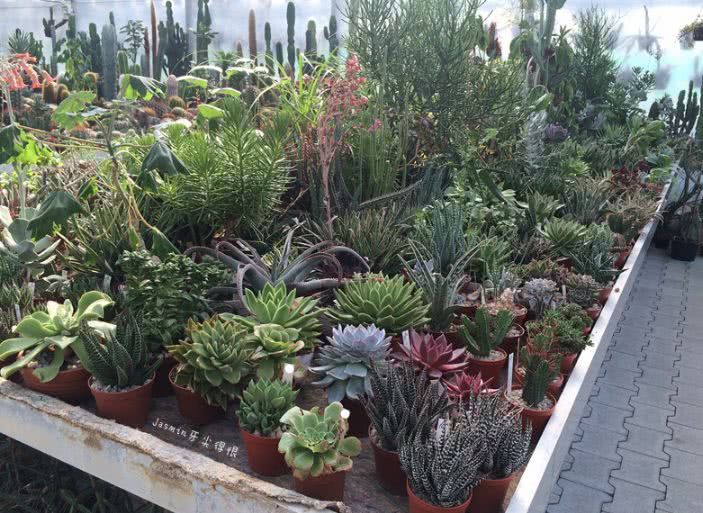
Switzerland's HAKAFLOR comprehensive succulent greenhouse is owned by a kind elderly couple who have already grown succulents for more than 40 years, and the varieties they stably propagate alone have reached more than 2,800! In the elderly couple's greenhouse, the main varieties cultivated include cactus, Euphorbia and mesembs, and there is simply everything you could want!
The first thing you see upon entering is the elderly couple's succulent greenhouse. Whether it is the outdoor growing shed or the indoor growing shed, they are densely packed with succulents, and it is almost enough to make your eyes blur!
Next to the greenhouse is the small Western-style house where the elderly couple lives, and the entrance to the house is also piled full of succulents. Doesn't it look super cute?
I have a big expert in the cactus hobby who said that the elderly couple's succulent greenhouse covers almost all the top-quality cacti. Any cactus variety you want to buy can be bought here!
I heard they are still constantly buying rare cactus varieties. Previously they proudly told me that they had bought a variegated cactus for 500 euros. Huahua counted on her fingers, and that is more than 3,700 yuan, which simply scared me to death!
And after entering the seedling room, I was practically drooling and wanted to carry off an entire tray! It is just a pity that I could only think about it...
Although Sedum only counts as a small portion here, this is still the only Sedum propagation greenhouse in Switzerland with several hundred varieties!
And the old lady seems to prefer Sedum types, because I went several times and found that the Sedum varieties were not for sale at all, and were all kept for her own appreciation. If you kept asking for them, she would slowly take out a few for you to choose from. Too cute!
Next, let's look at a succulent the old man likes best. I heard it grows one ring a year, and it takes about 5 years to bloom once, and this one is about 70 years old. The cute old grandpa kept asking me whether it was beautiful. I kept saying beautiful, beautiful, but in my heart I still did not understand its beauty.
The old lady told me that she feels she is not a merchant, but a succulent enthusiast, so they love helping fellow succulent lovers answer questions about succulents. Next, I have summarized the couple's more than 40 years of experience growing succulents, just for everyone's reference!
First, let's talk about the watering problem for succulents.
Flower lovers who grow succulents all know that watering is the first step in growing succulents, and only after this first step is done well can you continue with everything else. So for flower lovers whose normal summer temperature is above 32°C, simply cut off water completely, and there is no need to give water again until it drops below 30°C.
If during the summer period there are occasionally 2-3 days when the temperature suddenly falls to within 30°C, there is also no need to water, because if the temperature suddenly rises again in the following days, then the earlier watering may cause stuffiness and heat, and it will basically rot.
In spring and autumn the water amount is greater, and generally watering 2-3 times a month is enough. If the succulents are grown outdoors and get rained on, then reduce watering. KAHA old man's advice is that beginners should not let them get rained on, and when the temperature is above 30°C, absolutely do not let them get rained on!
The second point is about the prevention of common succulent pests and diseases.
As for attacks by fungal diseases such as sooty mold and black rot, the main cause is lack of ventilation.
If it is not serious, the old lady suggests it is best not to spray chemicals. Place it outdoors in a shady spot with strong air circulation, cut off the part attacked by the disease, cut off water, and just wait until the wound heals naturally.
And the most effective way to kill pests is to irrigate the soil twice a year.
For the first pest-killing treatment, you can choose the first week after watering resumes in early spring. Water the succulents once with warm water to let the roots relax and wake up. After the potting soil is completely dry, water a second time, and at this time add water-soluble insecticide and pour it around the roots until the entire potting soil is thoroughly watered.
For the second pest-killing treatment, mid-August is the best time. At this time, just as in March, you can apply insecticide over a large area. Before and after the 2 pest-killing treatments, it is best not to let them get rained on, and you must let the solution dry completely. Do not carry out these 2 large-area pest-killing treatments too frequently, otherwise it will cause the succulents to develop pesticide resistance.
Do you see the hole in the cactus at the very front? The old lady told me that one year it was gnawed by insects, and there were too many succulents to notice at first. By the time it was discovered, a big chunk had been gnawed away.
Huahua thinks this is a blatant show-off of wealth!
As for fertilizing, the old lady also has something to say.
The old lady told me that succulents actually do not need fertilizing at all. After all, they originally grow in the wild, and throughout the year, aside from rain, they basically have no access to much fertilizer. If you do want to give fertilizer, just a little is enough, because too much can easily cause harm.
As for choosing flower pots, the old lady said that actually any container you want is fine. Generally speaking, plastic bottles are still the best, since they are both cheap and retain water.
Look at this pot of succulents. Isn't it even bigger than my palm?
Finally, let's talk about the temperature for succulents!
Actually, 15-25°C can be considered the best growing temperature. Apart from the dormancy period, if this temperature range can be maintained all along, succulents can grow better!
So why do many flower lovers build a greenhouse? Isn't it because the temperature in a greenhouse is relatively constant!
Now the summer temperature is too high. If it stays above 30°C all the time, then you need to provide shade and cut off water. However long the high temperature lasts, that is how long you should cut off water.
Many flower lovers may ask, Switzerland's climate is completely different from ours in China, so isn't saying all this just useless talk?
Actually, Switzerland's weather is similar to the climate of Northeast China, and growing them domestically can also be completely achieved!
Finally, there is still one particularly regrettable thing to mention.
That is, because the elderly couple's children are all unwilling to inherit the greenhouse, the succulent varieties are now gradually decreasing, and perhaps in a few more years, even the succulents of these current varieties will no longer be seen!