A detailed explanation of the morphological characteristics, occurrence patterns and key control techniques of the Shanhua plum longhorn beetle
Morphological characteristics, occurrence patterns and key control techniques of the Shanhua plum longhornbeetle
1 Morphological characteristics
1.1 Adult The body is long and cylindrical, with the front end of the body expanded into a round shape, resembling a head; the head is flexible, the back is slightly flattened, and there is a pair of exceptionally long antennae, which are inserted on the protuberance of the frons and are more than 1/2 the length of the body; the claws are usually simple, and in a few cases appendiculate; the mouthparts are suitable for chewing; the body color is varied, mostly brown, sometimes mottled and bright, or similar to the color of the tree trunk, serving a concealing and protective function; the mesothoracic notum often bears a stridulatory organ, which can produce a "squeaking" sound through friction between the prothorax and mesothorax.
1.2 Egg The shape differs according to species; it is generally elongate-oval, sometimes rather broad and cylindrical, elliptical or oval, fusiform, or oblate; the color is white, and the length is generally 0.5-5.0 mm [[Jishan Huayao]].
1.3 Larva The color is pale yellow or white; the body is thick and fat, long and cylindrical, with a few species slender; the head is yellow or brown, retracted into the prothorax; the antennae are minute, with only 2 or 3 segments; the mandibles are well developed; the sides and center of the pronotum have stripes; the thoracic legs are well developed in some species and minute or even reduced in others.
1.4 Pupa It is a naked pupa, with the various body parts clearly segmented, and the shape and proportions similar to the adult; the antennae are curled around the body; the pupa is milky white or yellow, and is usually located inside the pupal chamber.
2 Damage symptoms
Longhorn beetles can cause damage from the larval stage through the adult stage, with the larval stage being the most serious. The larvae first bore and feed under the bark, causing damage until the second year, and after the insect body grows larger, they bore into the xylem to cause damage. After Shanhua plum is damaged by longhorn beetles, bore holes and scars appear on the surface of the fruit tree trunks and branches. As the larvae continue to grow, the bore holes gradually deepen, reaching the center of the branches and trunk. Outside the bore holes, reddish-brown sawdust-like or sawdust-shaped frass and wood shavings accumulate, and sometimes sap exudation also occurs. After longhorn beetles damage Shanhua plum fruit trees, they cause the tree to become hollow, obstruct the flow of sap, and weaken the tree vigor. This leads to a decline in Shanhua plum yield, smaller fruit, and reduced nutritional value, causing relatively great damage to the economic value of Shanhua plum.
3 Occurrence patterns
3.1 Life habits Adults generally appear from May to July each year, with males earlier than females. Egg laying begins from July to August. When laying eggs, there are certain requirements for light intensity and temperature, with a preference for areas with greater light intensity, and a temperature of about 21 °C being optimal [5]. The adult first bites a scar on the trunk and branches of the Shanhua plum fruit tree, then lays eggs inside it. The eggs hatch into larvae after about 2 weeks. Newly hatched larvae first move under the bark and obtain nutrients by boring and feeding on the fruit tree. After the larvae penetrate deeper into the fruit tree, they build relatively wide chambers inside the tree as pupal chambers, with both ends sealed with wood shavings, where they pupate; the pupal stage lasts 10-30 d. After emergence, adults crawl out from the emergence holes, feed and mate during the day, and lay eggs in the evening; their lifespan is generally 10-30 d. Longhorn beetles mainly feed on the tender bark, young branches, leaves, branches and trunks, sap, and fruits of Shanhua plum fruit trees. Wang Jian et al. [8] conducted a feeding test of Monochamus alternatus on felled healthy, disease-free masson pine and found that the number of larvae reproduced per female Monochamus alternatus was 3.0-28.0, with an average of 12.3, and the damage rate of subcutaneous tissues by feeding was 3.0%-85.0%, with an average of 25.6%. These data indicate that longhorn beetles supplement their own nutrition and reproduce by feeding on forest trees, causing serious damage to forest tree cultivation.
3.2 Number of generations The number of generations of longhorn beetles varies by region. Some complete 1 or 2 generations per year, while others complete one generation in 2-5 a. It has been reported that in Zhejiang, Jiangxi, and other provinces and regions, longhorn beetles have one generation every 2 a or one generation every 3 a. The same species differs greatly depending on the region. In Guangdong, generally one generation occurs per year, and the damage period lasts up to 6 months. Xu Jielian et al. found that in Guangdong, the pupal stage of longhorn beetles is generally from April to May, the adult stage from May to July, the egg stage from July to August, and the larval stage from August to April of the following year. The larval stage can reach 8 months, and the damage period lasts five to six months. Longhorn beetles generally overwinter as lar
larvae or as adults that emerge in autumn, and a small number overwinter as pupae.
3.3 Egg-laying methods There are many kinds of longhorn beetles, and their egg-laying methods are also diverse. However, almost all longhorn beetles produce secretions before and after laying eggs to build egg chambers to protect the eggs. Generally, longhorn beetles mainly have 2 egg-laying methods. One is the habit of laying eggs in notches: the female first bites through the bark with her mandibles, then inserts the ovipositor into it, laying one egg per hole, though sometimes multiple eggs are laid. After laying eggs, the female secretes a transparent gelatinous mucus to cover the egg-laying hole; this secretion can effectively protect the eggs from the external environment. The other egg-laying method does not involve biting holes, but directly lays eggs in bark crevices with the ovipositor. In a few cases, eggs are also laid on the smooth parts of branches and trunks. Longhorn beetles using this egg-laying method generally discharge secretions twice before and after laying eggs; the color is generally grass green, possibly related to egg concealment.
3.4 Damage situation
3.4.1 Occurrence survey
3.4.1.1 Survey time and location From 2013 to 2016, a survey of Shanhua plum longhorn beetle damage was conducted in the Shanhua plum orchard at Niuguling, Taoxu Town, Jianghua County.
3.4.1.2 Survey object Tree age 7-20 a, variety Shanhua plum.
3.4.1.3 Survey method The entire orchard was sampled and surveyed by the method of alternate rows and alternate plants. The species and number of longhorn beetles on each Shanhua plum fruit tree and the number of overwintering longhorn beetles were surveyed separately. By observing longhorn beetle galleries, notches, and eggs, it was determined whether the fruit trees were parasitized by longhorn beetles, and finally the damage rate and hatching rate of longhorn beetles were calculated.
4 Analysis of disaster causes
4.1 Concealed life of longhorn beetle larvae Because of the living habits of longhorn beetles, the larvae are highly concealed, and their larval stage is very long, so Shanhua plum growers are not very familiar with longhorn beetle larvae and cannot immediately identify them when seeing larval frass and take correct control measures.
4.2 Few professional personnel There are few professionals engaged in the agriculture and animal husbandry industry, and they are mainly scholars in research institutes and universities. Due to limitations of their own energy and working environment, although they have mastered advanced technology and cutting-edge knowledge, they still cannot promptly teach experience and technology to frontline fruit growers, and there is a lag. When insect pests occur, fruit growers cannot identify them due to lack of relevant professional knowledge, while professionals with relevant knowledge cannot accurately judge the situation because they cannot timely grasp the pest situation, so control cannot be carried out promptly when pests occur.
4.3 Outdated and fragmented knowledge At present, most of the longhorn beetle knowledge mastered by fruit growers comes from science and techno
logy books and personal experience, and is relatively outdated and fragmented, unable to form a systematic knowledge system,
so it is difficult to respond promptly when new situations arise, and it cannot meet the needs of current work
requirements. Therefore, when insect pests occur, fruit growers lacking a systematic knowledge system cannot
make correct judgments, which leads to further expansion of the pest damage and causes irreparable
economic losses.
5 Key control techniques
5.1 Biological control method Longhorn beetle pheromones include sex pheromones, host pheromones,
allomones, repellent pheromones, and oviposition-deterring pheromones. Because longhorn beetles have the characteristics of concealed activity
and scattered damage, conventional control methods have relatively great
limitations, while the use of pheromones for control has the advantages of strong specificity, low pollution, and
being unlikely to induce resistance [13]. For adults that do not supplement nutrition and possess long-distance
sex pheromones, sex pheromones can be released in a concentrated manner to attract longhorn beetles. For
adults in the reproductive stage, oviposition-attracting pheromones can be used to attract longhorn
beetles. For adult longhorn beetles that need to supplement nutrition, feeding-attracting
pheromones can be used to attract longhorn beetles. To improve the efficiency of pheromone attraction, combined
pheromones can also be used. Reports indicate that combined use of attractants and pathogenic microorganisms of longhorn beetles
can improve control effectiveness.
5.2 Agricultural control method Through field surveys and indoor artificial rearing experiments, people have found that adult longhorn beetles prefer Chinaberry trees and silver maples [14, 15]. Therefore, in actual planting, these two trees can be used as trap trees to attract longhorn beetles. Chinaberry trees can produce an attracting effect on longhorn beetles at a distance of 200 m or more. Generally, trap trees can be planted beside ventilated and sunny forest roads, at a certain distance from Shanhua plum. In addition, longhorn beetles not only have preferences for certain forest trees, but also have obvious aversion to another kind of tree. Studies have found that longhorn beetles have strong aversion to the camphor produced by camphor trees. This natural substance produced by camphor trees has repellent, fumigant, and contact-killing effects on adult longhorn beetles, so camphor trees can also be planted at certain intervals within Shanhua plum planting forests to repel insects. Combining the two, planting camphor trees within Shanhua plum forests to repel insects and planting Chinaberry trees or silver maples at a certain distance outside the forest to trap and kill longhorn beetles can achieve even better control results. This method is simple and economical, will not cause biological pollution, and has remarkable effects.
5.3 Physical control method For Shanhua plum longhorn beetle damage, the most direct control method is to directly capture adults, kill larvae, and remove egg masses. May to July each year is the peak period for adult emergence. According to the living habits of adults, manual capture can be carried out. For larvae, the trunk can be checked during the day. When larval frass is found, tools such as fine iron wire can be used promptly to kill the larvae. Cotton soaked in dichlorvos can also be used to plug the bore hole, or dichlorvos diluted with water can be directly injected into the bore hole with a syringe, and finally the insect opening can be sealed with mud. For those eggs laid low, the egg-laying scars can be manually tapped to kill the eggs and small larvae, but the tapping force must not be too great to prevent damage to the fruit tree; lime, sulfur powder, and water can also be mixed in a ratio of 10:1:40 to make lime-sulfur mixture and whitewash the trunk. The advantage of the direct control method is that it takes effect quickly and in a short time, but it requires more manpower.
5.4 Chemical control method Traditional control methods are not very ideal for Shanhua plum longhorn beetle damage, so a new type of longhorn beetle poison stick can be used. The poison stick is a new type of tunnel fumigant made by mixing chemical substances such as metal phosphides and oxidants. When used, the poison stick is inserted into fresh insect holes, 1 stick per hole, and the pest mortality rate can reach more than 90%. This method is simple to operate and convenient to use, but the poison sticks are relatively expensive and not easy to store, so they are suitable for short-term temporary use.
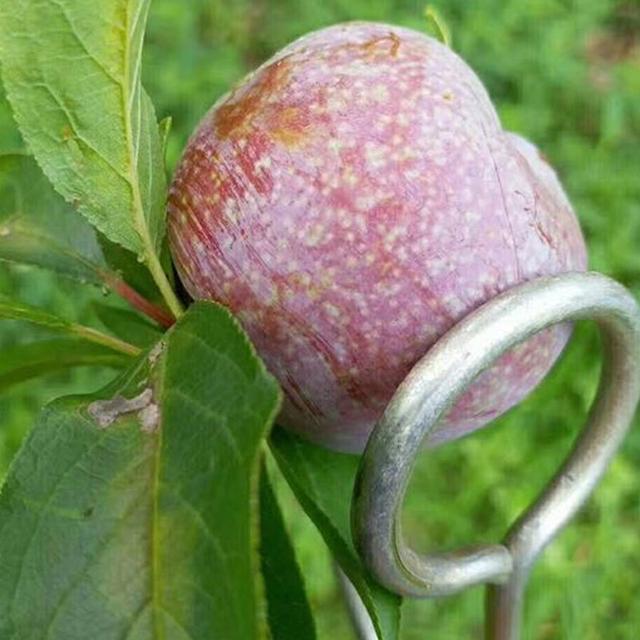
Shanhua plum, also known as Sanhua plum, belongs to the Rosaceae family and is a species of Chinese plum. It is named because it was first planted in Sanhua Town, Wengyuan County, Guangdong Province. Shanhua plum is known as the "king of plums" and one of the "top ten fine fruits of Lingnan." Because of its abundant juice, delicious taste, fragrant aroma, crisp flesh, balanced sweet and sour flavor, and rich mouthfeel, it contains 11.9% carbohydrates, 0.6%-2.0% fruit acids, and 0.7% protein, and is rich in vitamin E. It has relatively high nutritional value, is highly favored by customers, and has relatively high economic value.