The reason fruits and vegetables grow well without seeds has been found
For some of the fruits we buy, they are inherently seedless by nature rather than being insufficiently grown and ripened. With the improvement of breeding technology, more and more crops are becoming seedless, and the advantages of being seedless are obvious. When we eat them, it can be more convenient, such as watermelon, saving us from spitting out seeds, and the taste of watermelon is also more delicious.
I have mentioned the topic of seedlessness many times before. As for the essence of seedlessness, it is nothing more than humans using the physiological and reproductive laws of plant cells to carry out artificial interference. Below is a rough introduction to the principle of seedlessness.
Regarding the production of seedlessness, two approaches are generally commonly used in current agricultural production.
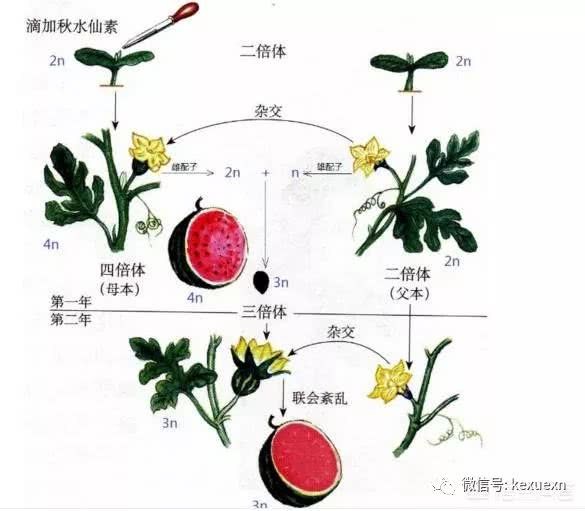
The first is to create sterile types by utilizing the characteristic of disordered synapsis in triploid reproductive cells. The most typical examples of this approach are seedless watermelon and banana, though seedless watermelon and banana are still slightly different. Seedless watermelon does not exist naturally, whereas seedless watermelon is created by people.
Watermelons in nature are basically diploid, so creating tetraploid watermelon is still difficult. Here a substance must be mentioned: colchicine. This is an alkaloid that can double the chromosomes in cells undergoing meiosis, and people use precisely this characteristic to double diploid watermelon into tetraploid watermelon through colchicine, and then cross the tetraploid watermelon with ordinary diploid watermelon to produce triploid watermelon. And triploid sterility is also what was mentioned earlier.
The second approach to producing seedlessness utilizes the characteristic that ovary development requires auxin stimulation. Generally speaking, ovary development occurs after the plant completes double fertilization, when it produces auxin itself to stimulate ovary development. Naturally, such a process will also produce seeds, which is not what we want. People use artificially prepared auxin to stimulate ovary development by dipping flowers during the flowering period, which can likewise achieve the purpose of stimulating ovary expansion. This is also the principle behind the production of seedless tomatoes.
Presumably, through the above introduction, everyone should have a relatively precise understanding of seedless crops. And for polyploid watermelon, the nutritional value will also be richer, which is also the demand for polyploid breeding in breeding, such as octoploid triticale, which is not only robust in growth but also rich in nutrition.
This is Science for Agriculture. Welcome to follow and let us grow knowledge together.