Foraging wild edibles: once you could pick a hundred jin at a time, 20 years ago they covered the mountains and nobody ate them, now they sell for 80 yuan a jin
Friendly reminder
Hemu Report aims to share and popularize information about various plants and their uses, for reference only. If you need to use them medicinally, it is recommended to consult a professional physician to avoid problems!
With the development of society, the food on people's tables is becoming more and more abundant, and you can basically buy whatever you want to eat. After eating too much good food, people instead begin to miss the wild edibles that only existed in rural areas in the past. For example, wild vegetables, wild mushrooms and wild fruits from the mountains. In the past, these things could be said to cover the mountains, but no one paid attention to them, and many rotted in the mountains with no one eating them. Nowadays wild edibles have become a scarce commodity, and many people are willing to spend money to buy some to try, to taste the freshness and recall the feeling of childhood.
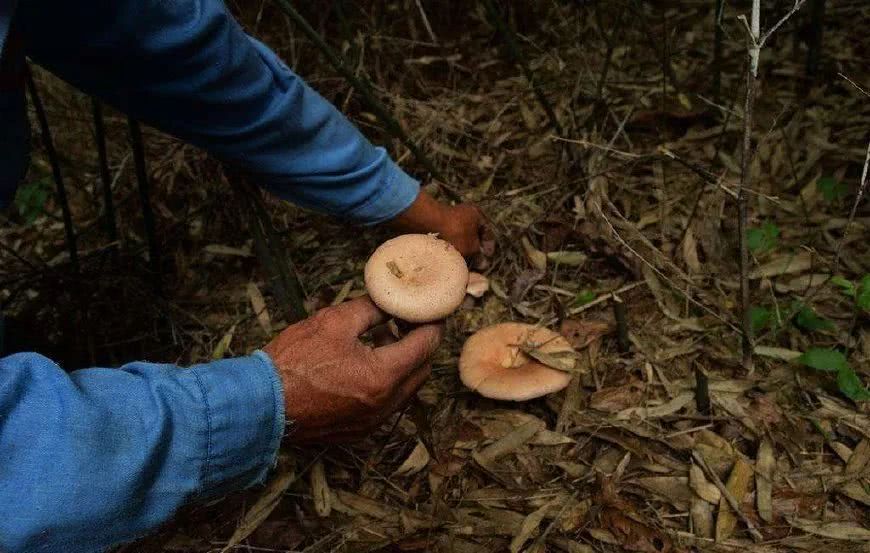
In the mountainous areas south of the Yangtze River in China, there is a kind of wild edible that grows twice a year, in early summer and late autumn. It generally grows under masson pines (Pinus massoniana). Twenty years ago, masson pines were most abundant in the mountains, in large stretches, and the ground beneath the trees was covered with a thick layer of pine needles. Then every year around this season, in May and June, after a heavy rain, a dark brown wild mushroom would grow out of the gaps in the pine needles on the ground. Its appearance looks somewhat ugly, and those who do not know it might think it is poisonous and not dare to eat it, but in fact its taste is extremely delicious.
This wild mushroom has two names. The one that grows in early summer is called "Yanlai xun" (swallow-arrival mushroom), which, as the name suggests, is the mushroom that grows when swallows build their nests. Because this is also when peach blossoms are in full bloom, farming friends also call it "peach blossom mushroom", even though its appearance cannot be linked to peach blossoms at all. The other name is also related to birds. The one that grows when wild geese return in autumn is called "Yanlai xun" (wild-goose-arrival mushroom). The two have the same pronunciation but different growing seasons, and it is said that the autumn-growing wild-goose-arrival mushroom is somewhat more delicious.
The swallow-arrival mushroom carries the fresh fragrance of pine needles and contains a variety of amino acids, which give it a unique umami flavor. There is a folk saying: "March pine mushroom, April chicken, September pine mushroom rivals an old chicken", in which "pine mushroom" refers to the swallow-arrival mushroom. Because it has very high environmental requirements and still cannot be cultivated artificially, its price is very high. In addition, because today's environment is not as good as before and the area of pine forests has decreased, a wild mushroom that 20 years ago could be picked by the hundred jin at random has now decreased in yield quite a bit. When the swallow-arrival mushroom first comes on the market, farming friends can sell it in the city for at least 80 yuan a jin, and still demand exceeds supply.
Nowadays quite a few farming friends go into the mountains to pick mushrooms in their spare time from farming. Besides the precious swallow-arrival mushroom, the pine mushroom is also very common, but its taste is far inferior to the swallow-arrival mushroom. Readers and friends, have you ever eaten the swallow-arrival mushroom?
Text/Hemu Report, images/Internet
If you like Hemu's articles, you are welcome to follow!