Do you understand the characteristics and growth habits of Cymbidium goeringii? Only by understanding them can you grow potted orchids well
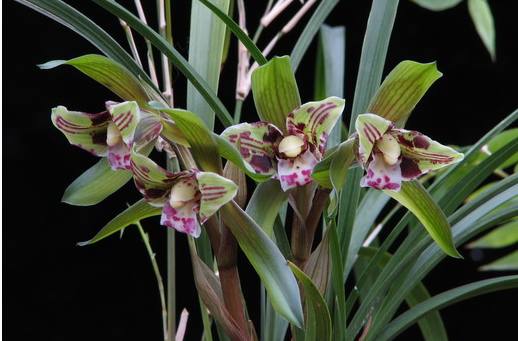
Sannong Xiaoqi: Do you understand the characteristics and growth habits of Cymbidium goeringii? Only by understanding them can you grow potted orchids well
Sannong Xiaoqi, a farmer who has long worked with production labor, we understand the characteristics of flowers, plants and trees, and we farmers have our own views on weeding and growing herbaceous plants. Farmers in our area also grow potted orchids, but many people do not understand orchids thoroughly enough. Today, a brief introduction:
Cymbidium goeringii resources are abundant. They are found in many provinces in rural mountainous areas, and many famous varieties have been passed down from the hands of farmers. Farmers have made an indispensable contribution to the popularity of orchids. Sannong Xiaoqi reminds you, do you understand the characteristics and growth habits of Cymbidium goeringii? Only by understanding them can you grow potted orchids well. If you do not know them now, that is fine too. Let us take a look together, and then you will understand:
The flowering period of Cymbidium goeringii is from February to March each year, and it can last about 1 month. The flowers have a rich and pure fragrance. Precious varieties include lotus, plum, narcissus, butterfly and other petal types in various colors. In terms of petal type, the famous varieties from Jiangsu and Zhejiang are the most typical.
Morphological characteristics: Cymbidium goeringii is a terrestrial orchid with a well-developed root system that is cylindrical and rarely branches. The pseudobulb is ovoid-spherical, relatively small, and hidden within the leaf base and sheath. It stores relatively few nutrients, so it is very difficult to propagate by separating a single plant; generally three to five plants must be divided into one clump for planting. Leaves are 4 to 7 in number, ribbon-like, 2O to 40cm long, with a few reaching as long as 60cm, and 6 to 9mm wide, with relatively obvious grooves. The leaves are often slightly folded and have fine teeth along the edges. The flower scape emerges from the base of the pseudobulb, upright or slanting, and does not rise above the leaves (does not stand out above the foliage). It is generally 2 to 15cm long, though a few do rise above the leaves. It bears a single flower, very rarely 2. The flower bud is relatively long and wide. The flower diameter is 4 to 5cm, often with a pure fragrance; the color varies greatly, from pale yellow-green, green, light brown, yellow-white to other colors. The sepals are obovate, oblong to elliptical, 2.5 to 4cm long and 8-12mm wide. The petals are shorter than the sepals and often surround and embrace the column. The lip is nearly ovate, varies considerably, and often has purplish-red spots. The flowering period is from January to March each year. The capsule is narrowly oblong.
Origin: rural mountainous areas in Jiangsu, Fujian, Guangdong, Sichuan, Yunnan, Jiangxi, Gansu and other places, and they can even be found near some farmers' homes. Many farmers also like to grow orchids. Growth habits: (1) Each growth of Cymbidium goeringii produces 2-6 leaves, mostly 4-5 per plant, with a few reaching 7-8. The more leaves, the more there are, but leaf numbers above 9 are very few. (2) The leaf buds of Cymbidium goeringii extend from the substrate from May to June each year. Autumn buds emerge from the soil in early to mid-August and cannot complete growth that year; they must continue growing the following year. After the new leaf buds emerge from the soil, there is a slow-growth period of about 20 days. From mid-June to early July, the leaves gradually unfold and growth gradually speeds up; from late October to February of the following year is the dormant period, when growth stops
(3) The flower buds of Cymbidium goeringii emerge from the soil from the end of August to early September each year. When they grow 2-3cm, growth pauses. They enter dormancy, and after about 5 months of vernalization dormancy (around 5°C), the flower stalk grows very quickly about 10 days before flowering and then blooms. The flowering period is from February to March each year. (4) Cymbidium goeringii is suited to 15-28°C, with a maximum not exceeding 35°C and a minimum not below -4°C. The reproductive growth temperature is 8-18°C. In winter, Cymbidium goeringii must undergo 3-5 weeks of vernalization, otherwise the flowering quality will be poor. Do not fertilize above 33°C or below 15°C. (5) Generally, air humidity is required to remain between 60%-70%, and during dry winters it should also remain around 50%. During the growing period, it is best to keep air humidity between 75%-85%. If light is too strong, the leaves become scorched and their ornamental value is greatly reduced. In summer and autumn, provide 70%-80% shade; in winter and spring, when sunlight is strong, there should be 50%-60% shade.
(7): It prefers cool conditions, avoids excessive moisture, and is best cultivated in deep, narrow, unglazed small clay pots. The environment and the growing medium in the pot are best kept moist, and it can tolerate 5-7 days of drought. (8) The roots of Cymbidium goeringii are best when round, long and thin, generally 20-40cm in length. Those without branching mostly bear single flowers, occasionally double flowers. The fragrance is the best. Cymbidium goeringii from Jiangsu and Zhejiang is the finest. Cymbidium goeringii from Yunnan, Guizhou and Sichuan is also good. (9) Fertilizing Cymbidium goeringii should be light; in summer it should be cool and ventilated; the growing medium should be loose; give it appropriate sunlight. Meet all the above conditions.
Today, Sannong Xiaoqi will introduce it to everyone simply here. I hope you like it.