No banana dumping site in Qishan and Meinong; journalist debunks rumor, please do not forward and hurt farmers
This morning, a friend in Taipei sent me a photo through a messaging app of a pile of discarded bananas, with a caption that read: "The news dares not report the banana dumping site in Qishan and Meinong, Kaohsiung; everything is under a news blackout." Then he asked me directly: "Is it true?"
Glancing at the photo, I found it somewhat familiar. I recalled that eleven years earlier, when I was a reporter for PTS, I had covered a special report on the sharp drop in banana prices, and suddenly I was shocked: "Isn't this the photo that photographer Chen Tian-bao and I took in 2007 while reporting in the Qishan and Meinong area of Kaohsiung?"
Because this photo and the malicious caption smearing the industry have had a huge impact on the banana industry and farmers, I am writing this explanation in the hope of reducing the harm. I also returned to the site where the photo was taken and took a new picture of the now-empty scene, hoping to let the public understand the truth.
The site that was maliciously spliced and smeared online as a banana dumping ground (top photo) is exactly the open space behind the Dakang Branch of the Meinong Farmers' Association in Kaohsiung. From April to July eleven years ago, this open space did indeed store many bananas that farmers had applied to discard, but now the wall has been reinforced with concrete and red bricks, and the site has long been empty (bottom photo).
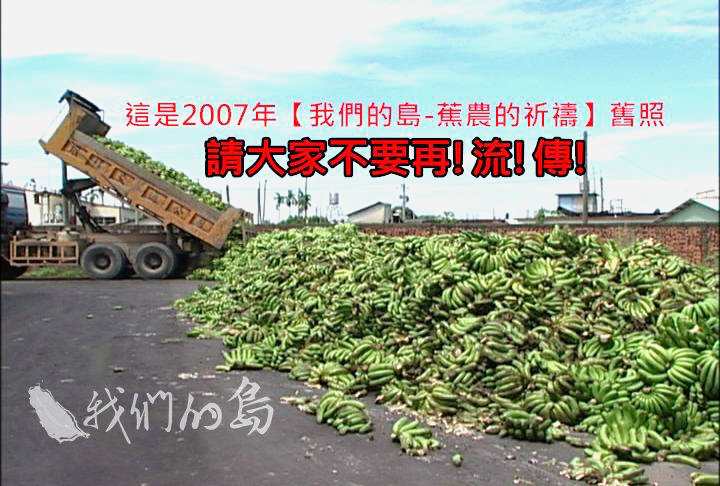
In the summer of 2007, banana prices plummeted and bananas were scattered in piles like mountains
In early summer 2007, domestic banana production surged and banana prices plummeted. Starting April 1, the Agriculture and Food Agency of the Council of Agriculture launched an agricultural safety project for bananas, purchasing bananas from farmers at 5 yuan per kilogram for three months. During this period, the government purchased a total of 9,192 metric tons of bananas.
Chen Tian-bao and I were at one of the sites where the Agriculture and Food Agency purchased bananas - the Dakang Branch of the Meinong Farmers' Association - filming farmers driving small light trucks to deliver bananas to the farmers' association. At the same time, we also saw the farmers' association bring in an excavator and a bulldozer to push the scattered bananas into a mountain of bananas, so that space could be freed up to continue storing bananas that farmers subsequently applied to discard. This photo, which was maliciously used to spread false information, was taken at this time.
In the summer of 2018, banana oversupply caused prices to fall
This year is 2018. Eleven years later, bananas once again face a crisis of oversupply and falling prices, and farmers are complaining bitterly. In response, the government has also acted urgently to rescue the situation, rolling out measures such as expanding sales channels, strengthening marketing, purchasing for processing, providing guidance for exports, and purchasing for discarding.
Although so far the Council of Agriculture has admitted that its efforts are "not strong enough," for producer banana farmers, what they worry about most is not when prices will rise, but the false information that keeps appearing online. Zhu Xiu-wen, an agricultural instructor at the Meinong Farmers' Association, said that using an old photo of piled bananas from eleven years ago, before they were commercialized, and spreading it online is extremely immoral.
He said: "When the general public sees this photo, they will think that this kind of banana is everywhere in the countryside, and when buying fruit they will expect banana prices to be low. This consumer mentality will make it even harder for banana market prices to recover. The efforts of farmers, the government, and all sectors will be greatly undermined!"
I hope all sectors of society will not be led astray by malicious rumors and false information. At this stage, eating more domestic agricultural products and buying more bananas is the greatest support for the industry and farmers.