Rain lilies can still bloom in a big mass even when left to grow freely on a balcony
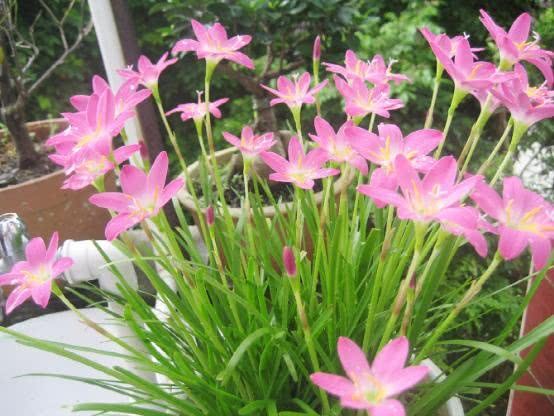
What flowers to grow in summer is a topic that many beginners who are just starting to grow plants are very interested in. In the past, when talking about this, we always thought of pothos, Chinese roses, and gardenias, but today the editor wants to introduce a new "star" - the rain lily. Its fresh, delicate flower shape, pink color, and rather linear form are all characteristics of this flower. It is fair to say that in terms of appearance, it is not inferior at all. So how exactly should rain lilies be grown? Let us take a look together below.
When it comes to choosing flower soil, rain lilies are rather "easygoing," and basically it is enough to ensure drainage and air permeability. Of course, if you put in a little effort, you can also mix several growing media together. According to the editor's experience, a combination of garden soil + leaf mold + coal cinders is quite good. As for choosing the pot, try to use a clay pot, as this is beneficial for the growth of the rain lily's root system. During potting, it is best to plant three to five bulbs in one pot, so that after blooming they will form a "mass of clustered flowers" effect.
People all say rain lilies are easy to grow, and the first point of that ease is reflected in watering. Rain lilies during the flowering period do not need to be watered every day. Just water thoroughly once after the potting soil has completely dried out. Doing this can induce rain lilies to send out flower stalks to the greatest extent and is also very helpful for achieving a full pot of blooms later. Of course, if you see the stems and leaves turning yellow or wilting, you can also use a spray bottle to mist the leaves.
If you want rain lilies grown on a balcony to bloom into a sea of flowers, then during their growth process you must ensure sufficient light. Although when facing the harshest sun of a midsummer afternoon we still need a little shading measure, at other times letting them bask in the sun is always right. This is because with insufficient light, rain lilies do not easily produce offset bulbs, and flowering will also be relatively sparse, affecting the overall visual effect.
Of course, just as some bloom into a sea of flowers, naturally others grow leggy stems and leaves. For this phenomenon, we usually choose the method of giving rain lilies a " buzz cut," cutting the leaves off like chives, and then flower buds will appear. To a large extent, this method happens to rely on the right timing, place, and conditions. In fact, the secret to flowering all lies in a rain. Wait for the rain to come and you will naturally see flower buds. With no wind and no rain, there is nothing to do but wait.