What are the uses and symbolic meanings of the Himalayan banana (Musella lasiocarpa)? Only by growing it this way can it thrive
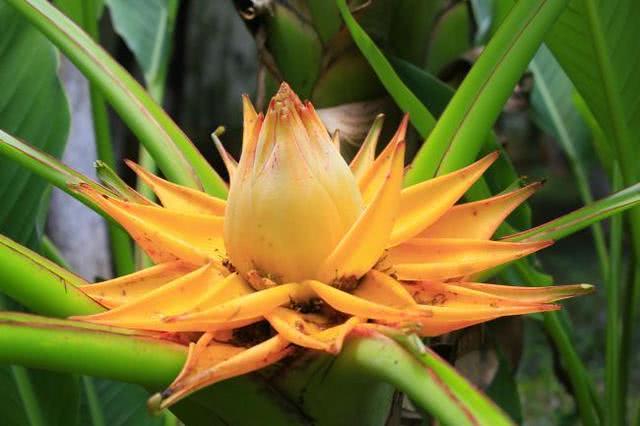
The Himalayan banana (Musella lasiocarpa), also commonly known as "earth golden lotus," is mainly distributed in the Yunnan region of China and is a flower unique to China. Because of its extremely unusual appearance, it has also been introduced and cultivated in some areas as an ornamental landscape plant; its very base resembles a Guanyin lotus seat, while the flowers grow densely toward the center. In northern regions, it can only be grown as a potted plant. So what are the uses of the Himalayan banana, what symbolic meanings does it have, and how can it be grown well? Below I will introduce them one by one.
The Himalayan banana (Musella lasiocarpa) carries the fine symbolic meanings of simplicity and elegance, purity, and sacredness. The reason lies in its tremendous connection with Buddhism. In Buddhism, the lotus can be said to be its sacred flower, and the base of the Himalayan banana is just like a lotus, which represents the relationship between goodness and the punishment of evil. Therefore, the beautiful symbolism of the Himalayan banana is the most important reason why the general public likes it. Placing a Himalayan banana plant at home also represents a person's uprightness and kindness, making it an excellent choice.
Its uses are mainly divided into medicinal and edible value. Medicinally, it is one of the important ingredients in many hemostatic medicines, and the sap in the leaf and stem parts can also be used to counteract alcohol intoxication and has a detoxifying effect on certain plants; as for edibility, first of all it can be used as a food ingredient in the Yunnan region, while the unripe or half-ripe fruit has good effects in treating stomach ailments, gastroenteritis, and other conditions.
So how do you grow the Himalayan banana?
1. Light and temperature conditions
Since the Himalayan banana prefers sunlight, it needs sufficient light during the growing period; otherwise its leaves will not grow upright, the overall plant shape will be much smaller, and the color will be rather dull. However, it must absolutely not be exposed to scorching sun, and it is also not cold-tolerant. In winter, potted plants need to be moved indoors to avoid frost damage, while also taking care to maintain a certain amount of diffused light to sustain growth.
The ambient temperature is best kept at 18-25 degrees, as this is most favorable for the growth and development of the Himalayan banana. Below 5 degrees, it will stop growing. When the summer climate is hot, the plant can be shaded to a certain degree, and placing it in a backlit spot is most suitable, while spraying a certain amount of water mist around the environment to increase air humidity.
2. Soil conditions
The choice of soil should be relatively careful. It is best to use sandy soil that is relatively loose and good at both drainage and water retention. Do not use mixed soil with strong stickiness. An appropriate proportion of river sand can also be mixed in. At the same time, when transplanting the plant, adding old soil to the new soil can increase the plant's adaptability and allow it to continue growing seamlessly.
3. Appropriate fertilizing
During the growing stage, the Himalayan banana has a relatively high demand for fertilizer. On the one hand, when planting begins, a piece of cake fertilizer can be placed at the bottom of the flower pot to improve nutrient supply; on the other hand, daily fertilizing must use rotted fertilizer, usually mainly barnyard manure and compost. Take care to make more use of mixed fertilizer and organic fertilizer, so that the plant's resistance to disease is stronger.