How to grow a wisteria bonsai? Teach you the correct care methods
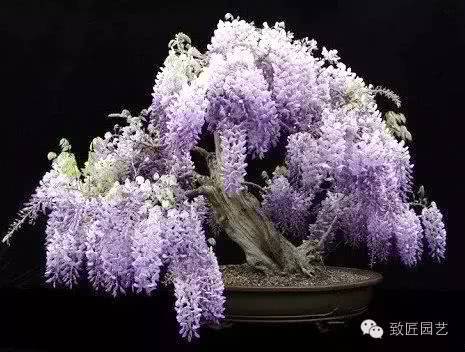
WisteriaIt has a deep taproot and few lateral roots. It likes sunlight, tolerates slight shade, cold and drought, and has strong adaptability; it prefers deep, fertile, loose, well-drained soil.
The old tree stumps used for making wisteria bonsai are mostly dug up from the mountains in spring, and according to the needs of the styling, the trunk and taproot are cut short to form a bare trunk and bare roots, then processed into a cascading style or slanting style, weeping style, cliff style, etc. The stump is planted in a deeper, slightly larger training pot, placed in a cool place for a week, then moved to a spot that gets morning sunlight. After a year of cultivation, the root system becomes well developed, with many lateral roots, and the branches and vines grow vigorously, which is beneficial for raising the roots, pruning and repotting. In the second spring, before the stump buds, repot it and transplant it into a display pot. After further styling, it can be enjoyed with routine care.
For the display pot, it is best to choose a deeper round or square Yixing zisha pot or Foshan bonsai pot. For the potting soil, use sun-dried pond mud, garden soil or leaf mold.
When repotting, prune the stump once, cut the vine stems short, thin out the overly dense vine branches on the dry stems, and deal with the transition point between the top branches and the stem. When potting, the roots can be raised appropriately, and after potting, place it in a sunny spot.
Wisteria likes fertilizer. During the growing season, frequently apply thin, well-rotted organic fertilizer. Except during the flowering period, apply liquid fertilizer once a month. Water frequently to keep the potting soil moist. Note that after autumn, water should be controlled to prevent autumn shoots from sprouting and growing excessively, making the tree too vigorous with too many branches and leaves, which makes it hard to flower.
For styling, use a combination of bud removal, pinching and pruning with wiring. After sprouting in spring, keep 2?3 buds on each branch. When the new shoots grow to 15 cm, pinch them to promote the formation of flowering branches, and flowers will bloom at the tips of the new shoots, creating a splendid display of flowers when in bloom. During the dormant period, the branches should be cut back short to adjust the distribution structure of the branches and maintain a beautiful shape. Usually, prune the vigorous shoots, overly dense branches and overly long weeping branches so that nutrients are concentrated in the flowering branches.
When the flowers fade, promptly cut off the flower spikes and shorten the flowering branches. Repot and change the soil once a year, and repotting should be done in early spring before the branches bud. While repotting, also cut off old roots and overly long roots, replace half of the old soil, and add loose, fertile soil and base fertilizer. Repotting and changing the soil can increase nutrients, strengthen the tree, accumulate nutrients and encourage more flowering.
The young shoots of wisteria are easily damaged by aphids. When found, spray with 40% dimethoate 800 times solution. When noctuid moths are found eating the leaves, spray with 50% dichlorvos 1000 times solution in the evening.
Under sufficient sunlight, as long as water and fertilizer are supplied in a timely manner, pinching and bud removal are done in time, and pruning after flowering and during the dormant period is done well, and the soil is changed, roots are trimmed and base fertilizer is added every year, a properly styled and cared-for wisteria will bloom every year.
Featured content