Detailed Explanation of Bonsai Repotting Methods, Intervals and Techniques
I. Purpose of Repotting
The main purpose of repotting is to replace the potting soil and the pot, and to enhance the ornamental value of the bonsai.
1. Renewing the potting soil. The potting soil is the material foundation on which the bonsai plant depends for survival. After 1 to 2 years of cultivation, the root system of a potted flowering plant fills the entire pot, and a large number of new fibrous roots grow along the pot wall, forming a net-like mat around the inside of the pot. Some of them cannot absorb nutrients, and some absorb insufficient nutrients. At the same time, the soil fertility is exhausted, the soil becomes compacted, and its water retention, fertilizer retention, drainage and aeration properties gradually decline. If repotting is not done in time, the normal growth of the plant will inevitably be seriously affected. For some established tree bonsai, repotting is done only to replace part of the potting soil, while the original pot is still used. The new soil used should meet that tree species' requirements for nutrient composition.
2. Changing the pot. As the potted plant gradually grows, the proportion between the pot and the plant becomes unbalanced. A somewhat larger pot needs to be used, and some new soil added. For some small flowering and fruiting trees, after shaping and styling, the purpose of cultivation is to let them grow and take shape as quickly as possible. At the beginning, little attention was paid to the pot, and some were planted only in ordinary clay pots or terrazzo pots. After several years of cultivation, the sapling has grown up, the wiring has been removed, and the tree has taken shape, so it should be transferred into a bonsai pot for viewing. Therefore, this kind of repotting is especially important. The new pot should take into account both ornamental value and plant growth. The pot should not be too deep, and attention should be paid to coordinating the color of the pot with the color of the flowers and fruit. Generally speaking, the width of the crown should be greater than the length of the pot; otherwise, with a large pot and a small tree, it will look very unattractive.
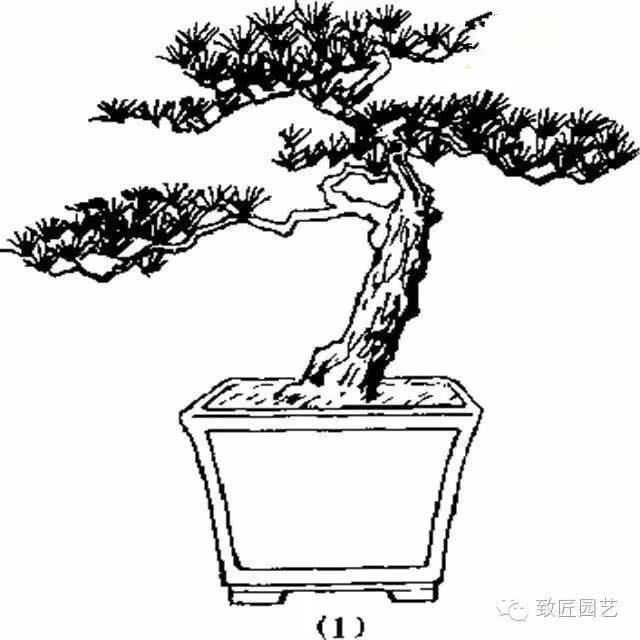
Above: Changing the style of the pot makes the bonsai more beautiful
(1) A pine tree planted in a deep pot (2) Switched to a shallow pot, it looks more beautiful
3. Enhancing ornamental value. According to the needs of styling, either switch a deep pot for a shallow one, or change the planting position or posture of the tree, and at the same time carry out the necessary shaping to make the bonsai more beautiful and more ornamental. Some potted flowering plants suffer from pests and diseases that are difficult to cure or eliminate with chemicals, and they also need repotting.
II. Repotting Interval
The repotting interval should be handled flexibly according to differences in tree age and tree species. Generally, young trees grow fast and need repotting once a year into a pot one size larger, and at the longest it must not exceed two years. Established tree bonsai can be repotted once every two years; old trees can be repotted once every three years. Flowering and fruiting trees are best repotted once a year, with some soil richer in phosphorus fertilizer added; deciduous miscellaneous trees can be repotted once every two years; pine and cypress trees grow slowly, so repotting once every three years is enough.
III. Repotting Time
1. For ordinary flowering plants, it is best to repot in spring before they sprout. However, our country is vast, and the climate varies greatly from place to place, so it should be handled flexibly according to local conditions.
2. The repotting time for some flowering plants should be determined according to their characteristics. For example, the best time to repot Buddha's belly bamboo (Bambusa ventricosa) is in May or September. Plum blossom should be repotted after the flowers fall, at the same time as pruning the branches.
3. If repotting is only moving a small pot into a larger pot without breaking the root ball, it can be done in any of the four seasons.
IV. Repotting Methods
1. Knocking the pot. If repotting a flowering plant grown in a deep pot, the pot can be laid on its side on the soil, and while turning it, strike the side of the pot below the rim with the fist to separate the potting soil from the pot wall, then knock the root ball out. If it is a shallow pot, first remove the soil around the inside edge of the pot, then turn the pot upside down or lay it on its side, hold the tree with one hand, and with the index or middle finger of the other hand reach in through the drainage hole at the bottom of the pot and push the root ball out. As shown in the figure below.
Knocking the pot
(1) Lay the pot on its side and strike the pot wall with the fist (2) Hold the tree with one hand and the bottom of the pot with the other, and push the potting soil out with the fingers
2. Removing old soil. When repotting, whether switching to a pot one size larger or still using the original pot, part of the old soil should be removed. If moving a small pot into a larger pot, less old soil can be removed; if still using the original pot, more old soil should be removed, but at most no more than 1/2 of the original potting soil. If too much old soil is removed, in mild cases the time for the plant to recover its vigor will be prolonged, and in serious cases it will cause poor growth of the plant. While removing the old soil, the root system should be checked once, cutting off dead roots, diseased roots and overly dense roots, and shortening overly long roots. When removing old soil, use a bamboo strip, bamboo stick or wooden stick to avoid injuring the root system. As shown in the figure below
3. Planting. The tree should be planted in an appropriate position in the pot according to the requirements of the styling. If making a raised-root bonsai, more soil should be placed in the bottom of the pot so that the tree roots are exposed above the pot rim. When repotting bamboo, it can be done at the same time as division.
4. Filling soil. Under normal circumstances, when filling soil, add soil while tapping the pot on the ground. If the pot is too large or it is a shallow pot that is inconvenient to tap, add soil while gently pressing with the hand so that the potting soil is moderately loose and firm. If the potting soil is too loose, the plant is likely to lean after watering.
5. Watering. After the potting soil is filled, generally water thoroughly immediately. Because the plant has just been repotted, the potting soil is relatively loose, and during watering the potting soil may sink, so it should be filled level in time, but do not press or stir the potting soil with your hands. Otherwise, the potting soil will easily become compacted after drying. After watering thoroughly, first place the bonsai in a shaded place for about 10 days, then place it in a semi-shaded place for 3 to 5 days, and it can then be placed in the sun for cultivation.
Wonderful content