What are the key cultivation techniques for large bearing trees of fresh-eating mulberry?
Cultivation techniques for large bearing trees of fresh-eating mulberry
The mulberry fruit is bright purple-red in color, with a sweet-sour and delicious flavor, rich nutrition and high medicinal value. The fruit ripens in early May, right in the season when spring fruits are scarce, and is deeply loved by people. The mulberry tree has a beautiful shape and is used both for fruit and leaves; the fruit can also be processed into juice and so on, and it has good ecological, economic and sightseeing value. The cultivation techniques for large mulberry trees are introduced below for the reference of the many mulberry growers.
1 Spring management of bearing trees
1.1 Germination stage
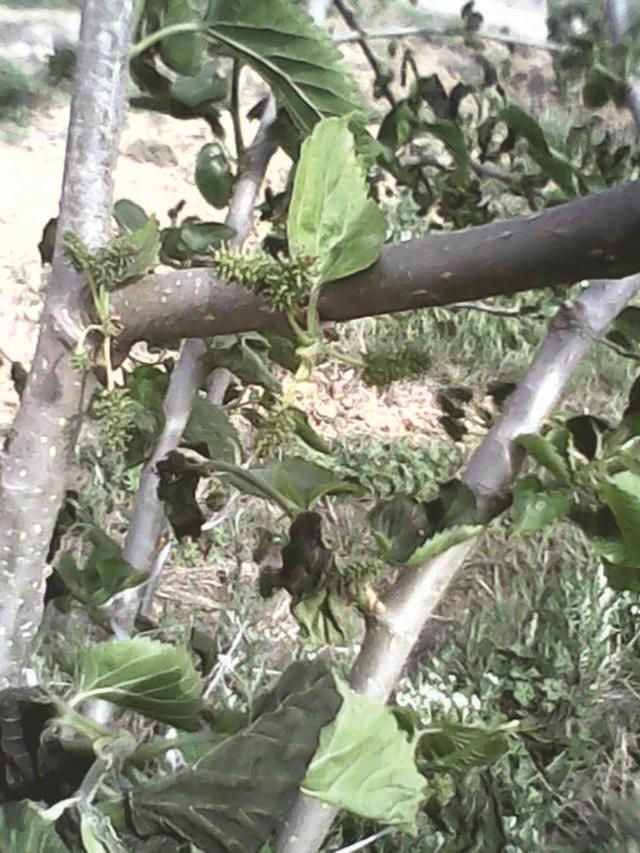
In the Hefei area, mid-to-late March is the germination stage. At this time there is more rain and cold air is frequent, so it is necessary to clear the field ditches and drain water well, remove field weeds, and not create an environment for diseases to breed. If drought occurs, irrigation should be carried out to keep the soil moist. If the temperature drops below 0°C (Figure 1), open-field plantings must be protected by smoking the field to keep warm.
Figure 1 Damage from a late spring cold snap
1.2 Flowering and fruiting stage
(1) Early April is the flowering and fruiting stage. Apply fruit-swelling fertilizer to promote the enlargement of young fruit, applying 250 grams of nitrogen-phosphorus-potassium compound fertilizer per plant in dug holes.
(2) After 7 leaves have grown on the new shoots of the fruiting branches, pinch the tips using the method of 'pinch at 7, keep 6'; 6 leaves are enough to ensure fruit growth.
(3) From late April to early May, when the mulberry fruit is about to ripen, appropriately remove the denser leaves on the middle and lower parts of the branches to facilitate ventilation and light penetration and increase the sugar content of the fruit.
1.3 Pest and disease control
In the Hefei area, the main pests and diseases of mulberry are sclerotinia disease and mulberry longhorn beetle, and if drought occurs, localized red spider mite damage may occur. Integrated control measures combining agricultural, physical and chemical control are adopted. Mulberry sclerotinia disease, commonly known as white fruit disease, is one of the main diseases harming mulberry. It mainly harms the mulberry fruit and overwinters as sclerotia. The sclerotia fall to the ground with the mulberry fruit. When the mulberry trees bloom in early April of the following year, because there is more rain, a large temperature difference between day and night, and relatively high humidity, conditions are suitable for sclerotial growth. The sclerotia in the soil, through sun exposure, produce apothecia and ascospores. The spores spread with the wind and infect the mulberry flowers, then harm the fruit. If control is not strengthened, it will affect the yield and quality of the mulberry, and in severe cases there will be no harvest at all (Figure 2).
Figure 2 Damage from sclerotinia disease
1.3.1 Agricultural control (1) Plant as sparsely as possible to increase ventilation and light penetration, reduce humidity, and reduce disease occurrence. (2) Dig ditches to lower humidity, so that the ditch systems inside and outside the mulberry orchard are unobstructed, ensuring the field dries after rain, reducing field humidity and reducing opportunities for pathogen reproduction. (3) Plow and clean the orchard. In winter, remove dead branches and fallen leaves in the orchard and burn them promptly; plow and weed, and bury sclerotia. (4) Combine winter pruning, spring tip pinching and leaf picking during the fruiting period to make the mulberry orchard well ventilated and lit, improve disease resistance, and facilitate chemical control. (5) If mulberry longhorn beetle damage to branches and trunks is found, larvae can be controlled by injecting medicine into the bore holes or inserting medicated plugs, and adults can be caught by hand. (6) After winter pruning and orchard cleaning, apply lime sulfur mixture to the trunks and spread lime on the tree disks to reduce pathogen reproduction.
1.3.2 Physical control Before germination, lay colored plastic film on the ground to prevent underground spores from contacting the fruit, which is especially effective in areas with severe white fruit disease.
1.3.3 Chemical control Chemical control should use pesticides with high efficiency, low toxicity and low residue, with early prevention and thorough control. The first application is in mid-March, about 7 days before the mulberry buds break, spraying potassium permanganate at 1,500 mg/L comprehensively on the branches and the ground. The second is in late March when the mulberry buds have just broken, spraying 50% carbendazim wettable powder at 600 mg/L comprehensively on the tree body and the ground. The third is in early-to-mid April during the flowering period; this is the key to disease control, spraying 80% Daconil M-45 wettable powder at 1,000 mg/L comprehensively on the tree body and the ground. After that, alternately use fungicides such as carbendazim and thiophanate-methyl, spraying once every 7 days. If rainy weather occurs during the spraying period, immediately spray again after the rain stops and the branches and trunks dry. Diseased fruit found should be removed promptly, taken out of the orchard and buried deeply. If plastic film is laid on the ground, the surface must first be sprayed once with fungicide before laying it.
2 Picking and sales
The ideal ripeness for picking the fruit is about 80% ripe, which can extend the shelf life. Mulberry fruit should be harvested in batches, generally with a picking period of about 25 days. Mulberry fruit has high nutritional value but does not store or transport well. Picking can be done by hand. In early May, when the mulberry fruit has just turned from red to black and is crystal bright, it indicates that the fruit is ripe (when the fruit of 'Baiyu Wang' and 'Korean Large White Pearl' is milky white, and when the fruit of Taiwan Long Fruit Mulberry, China turns from green to red, it indicates that the fruit is ripe). It should be harvested promptly in the early morning, taking care to handle it gently and not break the skin. Pick and pack it in small plastic boxes, about 300 grams per box (Figure 3), then put them into fruit baskets, generally 10-15 kilograms per basket. It must not be too heavy, to prevent crushing damage from mutual pressure.
Figure 3 Mulberry packaging
3 Post-harvest management
3.1 Summer pruning
Immediately after the fruit is harvested, carry out summer pruning; the earlier the better, so that the shoots produced are thick and strong and the flower buds are plump and full.
In the first year of summer pruning, cut 60-70 cm above the ground to establish the branch trunk, selecting and keeping 4-6 branch trunks per plant distributed evenly above and below on the main trunk, and cutting off the rest. After germination, select and keep 4-5 strong buds on each branch trunk and thin out the rest. (Figure 4)
Figure 4 Summer pruning
In the second year of summer pruning, cut 80-90 cm above the ground to establish the knuckle and determine the tree shape, forming mulberry knuckles (Figure 5).
3.2 Branch thinning
After summer pruning, germination begins 15-20 days later. When the new shoots are 20-30 cm long, thin the buds and keep the shoots, removing thin and weak branches, drooping branches, diseased and pest-damaged branches, overly dense branches and shoots sprouting from the lower part of the main trunk. Keep at most 5 branches per branch trunk. After the second to third trunk establishment, keep no more than 30 branches per plant.
3.3 Field management
After summer pruning, the main tasks of field management are pest prevention, field weeding and topdressing.
Figure 5 Mulberry knuckles
(1) After summer pruning, when the new buds have just sprouted, if pests such as mulberry weevil feed on them, it will affect the rapid growth of the new buds and affect the yield and quality of the following year; in severe cases the whole tree has no buds and the tree body is stifled to death. Spray the tree body with 2.5% cyhalothrin at 1,000 times dilution (or 40% chlorpyrifos at 1,200 times dilution), and thereafter spray once about every 20 days.
(2) Weed the whole orchard once before and after summer pruning, because after summer pruning the weeds suddenly see sunlight and grow rapidly, affecting mulberry growth. Weeding can be done chemically or by hand. For chemical weeding, use glyphosate, but when spraying herbicide, prevent the spray liquid from reaching the tree body and causing phytotoxicity.
(3) Do not apply topdressing immediately after summer pruning, otherwise it is easy to cause the new branches to elongate too quickly, making the branches prone to lodging, and flower buds to sprout, which will seriously affect the yield of the following year. Wait until the branches grow to more than 1 m and the branches are fully lignified, then apply about 150 grams of nitrogen-phosphorus-potassium compound fertilizer per plant, depending on tree vigor; apply more for weak trees and less for vigorous trees.
4 Autumn fertilization
Start applying base fertilizer in mid-to-late October, so that the tree body accumulates sufficient nutrients and overwinters safely. Apply 10 kg of commercial organic fertilizer or decomposed farmyard manure (such as chicken manure, pig manure, etc.) per plant + 250 grams of nitrogen-phosphorus-potassium compound fertilizer + 250 grams of superphosphate (or calcium magnesium phosphate fertilizer). [Jishan Huayao]
5 Winter pruning
Winter pruning of mulberry adopts the principle of "mainly cutting the tips, with branch thinning as a supplement." Fully concentrate nutrients to improve the yield and quality of the following year. During winter pruning, thin out overly dense branches, diseased and pest-damaged branches, drooping branches and thin and weak inner branches, and in the first and second years cut off the tender tip portion 15-20 cm from the top of the branches, and after the third year cut off the tender tip portion 30-40 cm from the top of the branches (Figure 6) 〈Qingqianliu〉.
Figure 6 Winter pruning