How to control the oriental fruit moth? Integrated control techniques for export pear orchards
Integrated control techniques for the oriental fruit moth in export pear orchards
In recent years, the area of export pear orchards in Botou has continued to expand, but with the banning of organophosphorus pesticides that were formerly highly effective and the restricted use of chlorpyrifos and others, combined with a large amount of irrational pesticide use leading to increased pest resistance and reduced natural enemies, the oriental fruit moth has become increasingly serious. In recent years, the average fruit-boring rate in bagged pears in export orchards reached 7%-8%, and the fruit-boring rate in unbagged pears was above 70%, with annual losses in the whole city exceeding 5,000 yuan. Once the oriental fruit moth bores in, the fruit becomes a defective fruit; a small number of boring marks are not obvious, and after harvest the fruit must be manually sorted out during processing. If the larvae have not left the fruit before export, they cannot be removed, resulting in container rejection and causing huge economic and reputational losses to exporters. The increase in the number of pesticide applications and the amount applied during control also brings great hidden dangers to the quality and safety of pears. Since 2012, Botou City's Dongfang Pear Orchard and Yafeng Pear Orchard have adopted the mating disruption method with sex pheromones combined with comprehensive measures such as clearing the orchard to eliminate overwintering cocoons, pruning off infested shoot tips, bagging, trapping and killing with sugar-vinegar liquid, and pesticide control at key periods, greatly reducing the damage from the oriental fruit moth. At present, this technique is being promoted in pear orchards throughout the city.
1 Life habits and damage characteristics of the oriental fruit moth
1.1 Life habits
The oriental fruit moth overwinters as mature larvae spinning cocoons under old scaly bark on pear and peach trees, at the root crown, in branch forks, at pruning and saw cuts, in grass bundles, and in shallow soil layers around the trunk; overwintering larvae are also found in main branch forks and fruit bags, and underground overwintering larvae mainly come from fallen infested fruit. By creating overwintering sites for them, some overwintering larvae can be trapped and killed, reducing the pest population density for the following year, which is an effective control measure. Because the oriental fruit moth has the habit of transferring hosts, damage is relatively serious in orchards where peaches, apricots, and pears are mixed. Adults rest quietly on branches and leaves during the day, become active and mate around sunset, have a strong taxis toward sugar-vinegar liquid and black light lamps, and have a specific taxis toward sex pheromones. According to many years of monitoring records, from April 1 to September 30, 5 sex pheromone basins trapped more than 1,500 male adults, and one insect-killing lamp trapped more than 100; from the trapping results of multiple types of traps, the sex pheromone had the best effect.
1.2 Damage characteristics of the oriental fruit moth
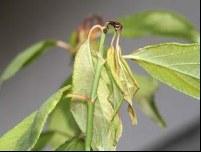
The oriental fruit moth belongs to the family Tortricidae in the order Lepidoptera. It is an important pest damaging pear and peach trees. Besides damaging pear and peach trees, the oriental fruit moth also damages apricot, apple, and others, seriously affecting fruit quality and yield and reducing fruit growers' economic income. This insect occurs 3-4 generations per year in Botou City, with the 3rd and 4th generations causing the most serious fruit boring. Bagged pears are mainly infested by the larvae entering the bag through the gap between the fruit stalk and the paper bag, while unbagged pears are bored into from the fruit surface. From April to May, the larvae of the oriental fruit moth mainly damage peach shoot tips (Figure 1). From June to July, a small portion of larvae damage peach shoot tips, while most damage pear fruit; from August to September they concentrate on damaging pear fruit. Larvae damaging tender shoots bore in from the base of the 2nd to 3rd leaf stalk of the damaged shoot and bore downward to the semi-woody part; the bored tender tip wilts and droops, with gum and frass at the bore hole, and soon the tip of the new shoot wilts and dies. Late May to early July is the peak period of shoot boring. Newly hatched larvae boring into fruit mostly enter from the calyx or stalk cavity (Figure 2). They bore into and damage the flesh; early-infested fruit have frass discharged outside the bore hole, while late-infested fruit have no frass. Infested fruit often rot at the bore hole, appearing as a black paste-like mass (Figure 3). Larvae in bagged pears bore into the flesh around the fruit stalk, causing fruit drop.
Figure 1 Symptoms of tender shoots damaged by the oriental fruit moth
Figure 2 Pear fruit bored into from the stalk cavity
Figure 3 The bore hole of infested fruit made by the oriental fruit moth appearing as a black paste-like mass
2 Life history
Based on many years of continuous investigation at oriental fruit moth monitoring points in Botou City, by analyzing the number of adults trapped by sex pheromones and insect-killing lamps and the peak occurrence periods, the occurrence pattern of the oriental fruit moth in Botou was found to be as follows: 3-4 generations occur per year; overwintering-generation adults are first seen as early as March 22; the peak occurrence of overwintering adults is mid-April to late April; first-generation larvae are first seen in early May boring into peach shoot tips and causing damage; the peak occurrence of first-generation adults is mid-May to early June; early to mid-June is the peak period of larvae boring into peach shoot tips, and they also bore into tender pear shoots and fruit clusters; the peak occurrence of second-generation adults is late June to mid-July; larvae continue to damage pear and peach shoot tips and begin to bore into pear fruit one after another; the peak period of third-generation adults is late July to early September (Figure 4) [Jishan Huayao].
Figure 4 Occurrence dynamics of the oriental fruit moth detected by sex pheromones in Yafeng Pear Orchard
Larvae cause massive damage to pear fruit. Afterward the number of larvae gradually decreases, basically ending in mid-October. After mid-September, mature larvae leave the fruit one after another and move to overwintering sites. The oriental fruit moth has many generations, and later generations overlap obviously. Under conditions of temperature 23-28°C and relative humidity 60%-70%, the egg stage is 3-5 days, the larval stage 10-14 days, the pupal stage 7-10 days, and adult lifespan 4-7 days; each female adult lays 70-80 eggs. Under conditions of monthly rainfall above 150 mm and relative air humidity 80%-90%, adults lay large numbers of eggs, the hatching rate is high, and larval damage is severe.
3 Integrated control techniques
The oriental fruit moth has strong reproductive capacity, many generations, and many overwintering sites; after larvae bore into new shoots and fruit, pesticide and control effects are poor, so multiple measures must be taken to control it.
(1) Build orchards scientifically. New pear orchards should avoid mixed planting of multiple hosts as much as possible, or avoid pear orchards being adjacent to peach orchards, to reduce mutual transfer damage by the oriental fruit moth.
(2) In February, scrape off old scaly bark on the trunk and branch forks to eliminate overwintering cocoons of the oriental fruit moth.
(3) In late March, spray the ground with 50% phoxim emulsifiable concentrate at 300 times dilution to kill overwintering cocoons; covering the ground with plastic film can prevent adults from emerging from the soil and kill adults.
(4) Bag all pear fruit, and be careful to tie the bag opening tightly. Prevent larvae from entering through the bag opening to cause damage.
(5) During the growing season, promptly prune off damaged tender shoot tips, remove damaged fruit on and under the trees and bury and destroy them in a centralized deep pit, reducing the pest population density of the next generation.
(6) Use sex pheromones, sugar-vinegar liquid basins (hang 5 basins per mu, evenly distributed), and insect-killing lamps for trapping and killing (install 1 lamp every 3.3-4 hectares), and release Trichogramma to parasitize the larvae of the oriental fruit moth.
(7) Mating disruption control, suitable for pear orchards planted in contiguous blocks, relatively isolated, and regular in shape. Mating disruption dispensers are hung on the middle and lower parts of the pear tree canopy, with about 60 per mu; at the outer edges of the pear orchard or at higher slopes and edges in the main wind direction, hang 2 per tree, and within the orchard hang 1 per tree. To complete a full year of control, hanging must be done 2 times, the first in early April (before emergence of the overwintering generation of the oriental fruit moth), and the second in mid-to-late June. To monitor the effect of mating disruption control at any time, one set of sex pheromone traps should be placed per hectare in the controlled pear orchard, and control strategies should be adjusted promptly.
(8) Pesticide control as a supplement to mating disruption control, used when pest population density is relatively high, with the key being to grasp control before the 2nd and 3rd generation larvae hatch and bore in; at this time occurrence is uniform, control is more targeted, and the auxiliary effect is better. Doing a good job in citywide sex pheromone monitoring and joint prevention and joint control can effectively control the damage of the oriental fruit moth to pear fruit. Through experiments it was found that 48% chlorpyrifos at 1,500 times dilution and 1% emamectin benzoate emulsifiable concentrate (emamectin benzoate·cypermethrin) at 2,000 times dilution had relatively good control effects.
(9) Promptly pick up and bury infested fruit deeply. Before the soil freezes, turn over the tree dish to kill overwintering larvae under the tree dish.
(10) Starting in late August, tie grass bundles on the main trunk of pear trees and tie cloth strips or waste paper bags on main branches to trap overwintering larvae, and destroy them in a centralized manner in December, reducing overwintering pest population density.