What effect do different planting models have on the yield of Bletilla striata?
The effect of different planting models on the yield of Bletilla striata
Fund project: funded by the Key Technology Research and Industrialization Demonstration Project for Standardized Cultivation (GAP) of Bletilla striata (2016AE002)
Bletilla striata, also known as Lianjicao, Gangen, Baigei, Ruolan, Zhulan, Zilan, Zihui, Baili, etc. Taxonomically it belongs to the genus Bletilla in the orchid family (Orchidaceae), Bletilla striata, and is a perennial herbaceous plant with fleshy roots [1], having pseudobulbs, roots, leaves, etc. The roots are tuberous roots, and the flowers are purplish red, pink, white, blue and yellow, etc. It is mainly distributed in China, Japan and northern Myanmar, and is mainly produced in Yunnan, Sichuan, Guizhou and other provinces in China, and is widely distributed in the Yangtze River basin and the provinces and regions to its south. Its taste is bitter, sweet and astringent, and its nature is neutral and slightly cool. It has the effects of tonifying the lungs, stopping bleeding, reducing swelling, promoting tissue regeneration and astringing sores [2], and has relatively high medicinal value and ornamental value. With the deepening of research on the effects of Bletilla striata in China's pharmaceutical industry, the clinical application of Bletilla striata has continued to expand, and the market demand for Bletilla striata tubers as medicine has increased sharply [3]. In cultivation, the demand for Bletilla striata seedlings has surged, and cultivation has shown a trend toward large-scale development. In order to explore the effect of different planting models on the yield of Bletilla striata, a comparative experiment of three different planting models, namely open-field, greenhouse and understory planting, was carried out in Ning'er Town, Ning'er County, Pu'er City, and at the same time the cultivation of superior Bletilla striata seedlings [4] and cultivation technical measures [5] were practiced, and the phenology and corresponding indicators of Bletilla striata were observed and recorded.
1 Basic conditions of the planting sites
From May 2013 to November 2016, open-field intensive cultivation, greenhouse cultivation and understory cultivation of Bletilla striata were carried out in Group 4, Min'an Village, Ning'er Town, Ning'er County, with planting areas of 0.23 hm2, 0.2 hm2 and 0.2 hm2 respectively. The altitude of the planting sites was 1,310-1,400 m, the average annual rainfall was 1,414.9 mm, the average annual temperature was 18.2°C, and the average annual sunshine duration was 1,921.2 h [Jishan Huayao]. The slope aspects were northeast slope, southeast slope and south slope respectively, the soils were yellow-red soil and sandy soil, and the soil layer thickness was >=80 cm. The upper-layer trees on the understory planting sites mainly included Simao pine, Betula alnoides and Alnus nepalensis, etc., and the canopy density was 0.3-0.4.
2 Cultivation of superior Bletilla striata seedlings and pest and disease control at the seedling stage
The Bletilla striata variety used in the experiment was the "Pu'er No. 1 superior clone of Bletilla striata". One-third tuber explants with young buds were taken, washed clean, wiped clean with 75% alcohol, the heart buds were taken, soaked and disinfected with mercuric chloride at a mass concentration of 0.1% for 12 min, then rinsed with sterile water 5-8 times, and inoculated on MS+NAA 1 mg/L+6-BA 0.5 mg/L+2,4-D 2 mg/L+banana mash 10 g/L medium for induction culture; the subculture medium was MS+6-BA 1.0 mg/L+NAA 0.1 mg/L, and the rooting medium was 1/2MS+NAA 0.5 mg/L+banana mash 75 g/L. When tissue-cultured seedlings grew to 5-8 cm after rooting, they were transplanted and acclimatized in a greenhouse, with the substrate being vermiculite:perlite at 3:1 or sterilized peat soil (humus soil)+an appropriate amount of perlite. The hardened bottle seedlings were taken out, fully washed, soaked in 1,000-fold carbendazim solution for 15-20 min, the water adhering to the plants was air-dried, and they were promptly planted into the substrate, with 60% shading, keeping the soil moist and the relative air humidity at 80%. After survival, 0.1%-0.2% N, P, K high-efficiency water-soluble foliar fertilizer and 10% concentration fulvic acid slow-release fertilizer were sprayed weekly. After 4-6 months of cultivation, seedlings with a height of more than 15 cm, tubers of more than 1.5 cm and 3-5 leaves could be planted. The main disease is root rot. In the early stage of the disease, 77% Keshade 101 wettable powder 500-800-fold solution was sprayed. In severe cases, agricultural streptomycin 600-fold solution and chlorothalonil 1,000-fold solution could be mixed and sprayed. It is necessary to prevent crickets, locusts, snails, slugs and other insects from gnawing. To control crickets and locusts, dichlorvos can be sprayed; to control snails and slugs, Mita can be sprayed for trapping and killing.
3 Different planting models and technical measures
3.1 Open-field intensive cultivation and tending management
3.1.1 Planting
[Land preparation] Deeply plow the land with a tillage depth of 30 cm, make beds 1.2 m wide and 30 cm high, and level the bed surface after fine cultivation of the ditch width.
[Planting density] At a row spacing of 20 cm x 25 cm, 6,000 plants/mu.
[Application of base fertilizer] Apply 4-5 t of organic fertilizer per mu and 200 kg of ordinary superphosphate, and mix the base fertilizer thoroughly with the soil.
[Planting] Plant from January to July, open planting furrows 5 cm deep, ensure the seedlings are upright and the roots are spread during planting, cover with 3 cm of soil, then cover with pine needles, preferably so that no soil is visible.
[Building shade net sheds] The shade shed height is 2.0 m, and the shading degree is 40%-50%.
3.1.2 Tending management
[Weeding] In the first year of planting, 4-6 weedings are needed. The first time is after the Bletilla striata seedlings have all emerged in April; the second time is from mid-to-late May to early June; the third time is in July; the fourth time is in August-September; the fifth time is after the Bletilla striata enters dormancy and is combined with loosening the soil. In the second and third years after planting, weeding is carried out at the appropriate time.
[Topdressing] Combined with intertillage and weeding, topdressing is needed 3 times each year. The first time is after the seedlings have all emerged in April, spraying 0.3% concentration foliar fertilizer per mu. The second time is during the vigorous growth period in May-June, applying 30-40 kg of superphosphate per mu. The third time is during the bud splitting period of the rhizome in August-September, applying 1,000-1,500 kg of livestock manure mixed with farmyard manure per mu.
[Water management] During the rainy season, attention should be paid to clearing the bed ditches to facilitate drainage. During the dry season from January to May, artificial watering is carried out once every 7-10 days.
[Overwintering protection] In planting areas at higher altitudes with lower temperatures, snow and freezing often occur in winter, which can easily cause frost injury or death of Bletilla striata rhizomes or young buds, so grass should be covered in time for cold protection.
3.2 Greenhouse planting and tending management
Greenhouse construction: Steel pipes that are both rust-proof and relatively sturdy (with wind and snow resistance) must be selected. The frame is required to be hot-dip galvanized steel pipes, with a steel pipe diameter of 28-32 mm and a wall thickness of 1.5 mm. The shoulder height is 1.5-1.8 m, the top height is 1.8-2.2 m, the span is 4-5 m, the length is 10-15 m, the vent height is 1-1.2 m, and the steel pipe spacing is 0.6-1 m. The greenhouse foundation is built firmly with bricks. Greenhouse planting and tending management are the same as open-field intensive planting and tending management.
3.3 Understory planting and tending management
3.3.1 Planting
[Forest land clearing] Clear miscellaneous shrubs, weeds, etc. under the forest, and adjust the canopy density to 0.3-0.4.
[Land preparation] Deeply plow the land with a tillage depth of 30 cm, and remove tree roots, grass roots, etc. Make beds 1.2 m wide and 30 cm high; leave ditches 30 cm wide and 15 cm deep; level the bed surface after fine cultivation of the ditches.
[Planting density] At a row spacing of 25 cm x 30 cm, 4,000 plants/mu.
[Application of base fertilizer] Apply 2-3 t of organic fertilizer per mu and 200 kg of ordinary superphosphate, and mix the base fertilizer thoroughly with the soil.
[Planting] The planting time is June-August, and the other methods are the same as those for open-field planting.
3.3.2 Tending management
Understory tending management methods are the same as open-field tending management methods.
3.4 Pest and disease control
The main diseases are root rot and rust, and the main insect pests are cutworms and thrips. Control should implement the policy of "prevention first, comprehensive control", take forest management techniques as the foundation, and combine biological measures with chemical control.
4 Plant growth and tuber yield under different planting models
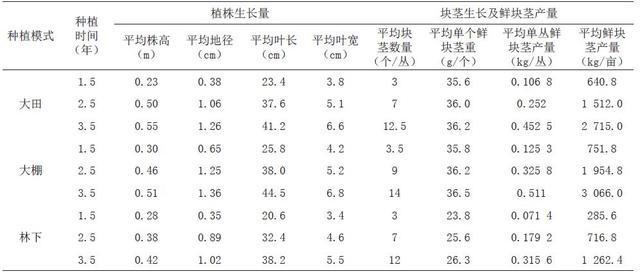
The density of both open-field intensive planting and greenhouse planting was 6,000 plants/mu, and the density of understory planting was 4,000 plants/mu. The fixed-plant observation method was used for observation. The main observation indicators were: plant height, ground diameter, growth and development of leaves and tubers, fresh tuber yield, etc. Continuous observation was carried out from July 2013 to November 2016, and the observation results are shown in Table 1:
Table 1 Plant growth and tuber yield
From the perspective of the change in average single fresh tuber weight: whether under open-field, greenhouse or understory planting, after one and a half years, two and a half years and three and a half years of growth, the weight increased very little, that is, within one and a half years a single tuber had already grown to maturity, and in essence the growth period of a single tuber was one year; for open-field, greenhouse and understory planting, the average single fresh tuber weights were 35.93, 36.17 and 25.23 g respectively, that is, greenhouse planting was slightly less than 1% higher than open-field planting, while open-field planting was 42.4% higher than understory planting. Therefore, for single fresh tuber weight, greenhouse and open-field planting showed little difference, but both were significantly higher than understory planting.
From the perspective of the change in the average number of tubers per clump: for greenhouse, open-field and understory planting, at one and a half years, the numbers were 3.5, 3 and 3 respectively; at two and a half years, the numbers were 9, 7 and 7 respectively; at three and a half years, the numbers were 14, 12.5 and 12 respectively. Therefore, greenhouse planting was superior to open-field planting, and open-field planting was superior to understory planting.
From the perspective of the change in average fresh tuber yield per mu: according to the planting densities under the three planting models, and comprehensively considering the two indicators of average single fresh tuber weight and average number of tubers per clump, the average fresh tuber yields per mu for greenhouse, open-field and understory planting were 751.8, 640.8 and 285.6 kg at one and a half years; 1954.8, 1512.0 and 716.8 kg at two and a half years; and 3066.0, 2715.0 and 1262.4 kg at three and a half years. The three planting models had a relatively large effect on the average fresh tuber yield per mu. Greenhouse planting had an average yield per mu 12.92% higher than open-field planting, while open-field planting had an average yield per mu 115% higher than understory planting.
5 Phenology and indicators of Bletilla striata
The Pu'er No. 1 superior clone of Bletilla striata is a perennial herbaceous plant. The plant growth period is from early March to mid-October, and the growth period of a single tuber is one year. When planted at an altitude of 800-1,700 m, bud differentiation and growth are fast, the plants grow vigorously, and the tubers are large, and the best harvest time is three and a half years after planting; when planted at an altitude of 1,800-2,200 m, bud differentiation and growth are slightly slower, the plants grow relatively well, and the tubers are slightly smaller, and harvesting is done 4-5 years after planting.
Table 2 Phenology and indicators of the "Pu'er No. 1 superior clone of Bletilla striata"
6 Conclusion
Using the Pu'er No. 1 superior clone of Bletilla striata, under the three different planting models of greenhouse planting, open-field intensive planting and understory planting, the average fresh tuber yield per mu could reach 751.8, 640.8 and 285.6 kg at one and a half years, 1954.8, 1512.0 and 716.8 kg at two and a half years, and 3,066.0, 2,715.0 and 1,262.4 kg at three and a half years. The three planting models had a relatively large effect on the average fresh tuber yield per mu of Bletilla striata. The average yield per mu of greenhouse planting was slightly higher than that of open-field planting, while the average yields per mu of greenhouse and open-field planting were far higher than that of understory planting. However, under the circumstances of scarce high-quality land resources and a relatively good market price for Bletilla striata, understory planting of Bletilla striata is also a good choice.
The Pu'er No. 1 superior clone of Bletilla striata is a perennial herbaceous root plant. Its phenological characteristics are: the plant growth period is from early March to mid-October, and the growth period of a single tuber is one year. The growth of both the plant and the tuber is affected by altitude. When planted at an altitude of 800-1,700 m, bud differentiation and growth are fast, the plants grow vigorously, and the tubers are large, and the best harvest time is three and a half years after planting; when planted at an altitude of 1,800-2,200 m, bud differentiation and growth are slightly slower, the plants grow relatively well, and the tubers are slightly smaller, and harvesting is done 4-5 years after planting. In the past three years, the market price of fresh Bletilla striata tubers has been very good, reaching an average of 150 yuan/kg. In order to respond to rapid market changes, harvesting can also be done two and a half years after planting.