How to prevent and control pests and diseases in pear trees from the mature stage to the leaf-fall stage?
How to prevent and control pests and diseases in pear trees from the mature stage to the leaf-fall stage?
1 Main characteristics and occurrence patterns of pests and diseases
1.1 Pear scab
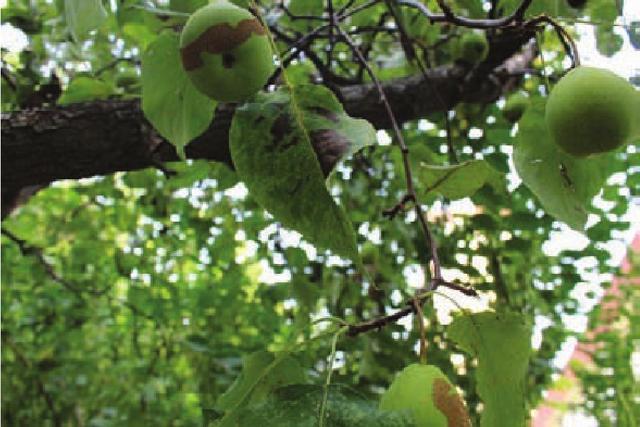
During the young fruit stage, the fungal spores formed on the damaged new shoots are the source of re-infection for the spread of the disease. In the early stage of leaf damage, yellow-white small spots appear on the underside of the leaf along the main vein or branch veins, which later form circular or irregular lesions; soon afterward, dark green mold-like growth appears on the lesions. In severe cases, the leaves turn yellow and even drop off. Fruit can be infected from the young fruit stage to the mature stage, but in normal years the infection rate is high during the fruit enlargement stage. In the early stage of fruit infection, pale yellow small spots appear on the fruit surface, and the lesions then gradually expand to form circular or irregular lesions; under suitable conditions, black mold-like growth quickly emerges on the lesions. The tissue at the lesions becomes hard and growth stops; as the fruit enlarges, the affected area becomes sunken and cracked. Severely affected fruit is deformed, bitter in taste, and prone to early dropping (Figure 1).
Figure 1 Damage symptoms on fruit and leaves after infection by pear scab (Photo: Liang Kuijing)
1.2 Pear black spot disease
Generally, young leaves are susceptible to infection. On infected leaves, the lesions expand into nearly circular or irregular spots in July-August, and black mold appears on the surface of the lesions when humid. Several lesions often join together to form one large lesion, causing leaf deformity and premature dropping. After young fruit is damaged, needle-head-sized black round spots appear on the fruit surface and gradually expand into circular or oval shapes (Figure 2). The lesions are slightly sunken and cracked, and sometimes the cracks can reach deep into the fruit core. Black mold-like growth often appears on the lesions, and affected fruit tends to drop early. High humidity favors the spread of the disease, and a dense orchard with poor ventilation favors disease occurrence.
Figure 2 Damage symptoms on fruit after infection by pear black spot disease (Image from the internet)
Figure 3 Damage symptoms on fruit and trunk after infection by pear ring rot (Image from the internet)
1.3 Pear ring rot
Infected fruit shows symptoms near the mature stage (Figure 3). Initially, brown water-soaked small spots centered on the lenticels form on the fruit surface and gradually expand into brown circular lesions with concentric rings, and small black dots grow on the lesions. New lesions on branches and trunks appear in mid-August, initially centered on the lenticels and producing reddish-brown water-soaked nearly circular lesions, after which tumor-like protrusions appear.
1.4 White-spotted flower chafer
It mainly damages fruit, and damage is more severe on injured fruit. Often several adults gather on one fruit to feed, causing the fruit to rot. Its adults appear in early May, with the largest occurrence from June to July, continuing until fruit harvest. Adults are active during the day and often gather on wounded fruit to feed. They can bite the fruit into a very large hole. Adults have phototaxis and death-feigning behavior, and are strongly attracted to the sour taste of fruit juice. Adults lay eggs in soil or feces, and the larvae feed on humus or plant roots in the soil.
1.5 Oriental fruit moth
In orchards where pears and peaches are mixed or where pear orchards and peach orchards are adjacent, the oriental fruit moth occurs severely. The first and second generation larvae of the oriental fruit moth mainly damage peach shoots, while the third and fourth generations mainly damage pear fruit. In pear orchards planted alone, before June, pear fruit has many stone cells and firm flesh, so young fruit is not easily bored into, and generally only new shoots and leaf stalks are damaged. Adults sometimes lay eggs on fruit damaged by the pear fruit borer or pear weevil, or on mechanically injured young fruit, and the larvae after hatching feed at the wounded part of the fruit, but the survival rate is relatively low. After early June, pear fruit begins to receive eggs, continuing until fruit harvest. However, before late July the number of eggs is very small; after late July the number of eggs increases, and until mid-August the number of eggs laid on fruit remains high. Adults like to lay eggs in the calyx depression of the fruit, and the eggs are laid singly. After hatching, the larvae crawl on the fruit surface for 1-2 hours and then bore in from the side of the fruit. When boring into fruit early in the season, the entry hole is relatively large, the larvae do not bore into the fruit core, and frass is expelled; the area around the entry hole turns black and rots and gradually expands, and the damaged area is slightly sunken (Figure 4). When damaging fruit after late July, the entry hole is very small, yellowish-brown around the edge like a fruit dot, with no symptoms at the entry hole, making it hard to detect; the larvae can bore directly into the fruit core and feed on the flesh and seeds. After leaving the fruit, the young larvae pupate in hidden places such as under loose bark on the trunk or under soil clods and stones. In late August, third-generation adults appear, mainly laying eggs on pear fruit, and the larvae still bore into the fruit to cause damage. After leaving the fruit, the mature larvae look for a suitable place to overwinter.
Figure 4 Entry holes of the oriental fruit moth on fruit (Image from the internet)
1.6 Peach fruit borer
It is one of the main pests of pear trees in northern Hebei and western Liaoning, and is also a main pest of apple. The larvae bore and cause damage, tunneling in all directions within the fruit, gradually reaching the fruit core, feeding on the seeds, and depositing frass inside the fruit. Damaged fruit turns yellow early and drops. After the larvae leave the fruit, the area around the exit hole gradually turns black and rots. When damage is severe, large numbers of fruit drop. In pear-growing areas of Hebei, overwintering larvae begin to emerge from the soil in late May, with the peak emergence period in mid-to-late June. After emerging from the soil, the larvae crawl to places such as soil cracks and stone crevices at the base of the trunk, where they spin silk cocoons and pupate. Adults appear in mid-June, with the peak occurrence period in early-to-mid July. Adults mostly emerge in the evening and are active, mate, and lay eggs at night. After hatching, the larvae first crawl on the fruit surface and then bore into the fruit; the entry hole is very small and hard to detect, and after 1-2 days white fruit juice flows from the entry hole, forming a small round dot. The larvae feed and cause damage inside the fruit for 25-28 days before maturing and leaving the fruit. Mature adults leave the fruit in late August, with the peak fruit-leaving period in early September, continuing until fruit harvest. After leaving the fruit, the larvae look for a suitable place to enter the soil and make a flat round cocoon to overwinter.
1.7 Brown marmorated stink bug
Nymphs after the 2nd instar are relatively active and crawl quickly, and several nymphs often rest and cause damage on one fruit or leaf at the same time. Severely damaged fruit can become deformed fruit (Figure 5); in lightly damaged fruit, at harvest, dark green slightly sunken damaged spots can be seen on the fruit surface. The occurrence period of eggs and nymphs is relatively long, and eggs were still hatching until August; adults appear in early August, and adults and nymphs continue to damage fruit. After mid-September, adults fly to houses, stone crevices, and other places to overwinter.
Figure 5 Damage symptoms on fruit caused by the brown marmorated stink bug (Image from the internet) [Jishan Huayao]
1.8 Green leafhopper
In young tree orchards, adult green leafhoppers cause damage by laying eggs on branches, causing young trees to shrivel and die, and it is a main pest of young pear trees. It has 3 generations a year. The first and second generations occur on crops and vegetables, and the third-generation adults occur from September to November, moving to autumn vegetables to cause damage after field crops are harvested. They begin migrating to fruit trees to lay eggs in mid-October, with the peak egg-laying period in late October, and overwinter in the egg stage. Adults lay eggs on 1-2-year-old branches or nursery stock, leaving crescent-shaped wounds at the egg-laying sites, with 7-10 eggs inside each wound. On severely damaged trunks or branches, scars accumulate, causing branches or young trees to shrivel due to water loss, and they are prone to freezing damage, even leading to death.
2 Control measures
The prevention and control of pests and diseases during the fruit mature stage is mainly based on manual control, roughly including the following 5 aspects.
2.1 Picking up dropped fruit
Fruit damaged by pests and diseases tends to drop early. Near the fruit mature stage, dropped fruit should be frequently picked up and promptly cleaned up. This is to eliminate pathogens that overwinter on fruit and the oriental fruit moth and peach fruit borer larvae that have not yet left the fruit.
2.2 Manual capture and killing of adults
During or after fruit harvest, most adult brown marmorated stink bugs fly to the orchard to prepare for overwintering. This habit can be used for manual capture to reduce the pest source for the next year. Use the death-feigning behavior of adult white-spotted flower chafers by shaking the tree to catch them, or use their attraction to apple juice by using apple vinegar for trapping and killing.
2.3 Preventing damage from green leafhopper egg-laying
(1) Whitewashing: before adults lay eggs, whitewash the trunk and branches to prevent adults from laying eggs. (2) Trapping and killing: use black light lamps to trap and kill adults. (3) Wrapping with paper or plastic tape: wrapping paper or plastic tape on the branches of young trees can prevent green leafhoppers from laying eggs and also has the effect of preventing water loss. (4) Spraying: when occurrence is severe, during the adult egg-laying period spray the trees with 20% fenvalerate emulsifiable concentrate at 2 000 times dilution, 10% cypermethrin emulsifiable concentrate at 2 000 times dilution, or 90% trichlorfon crystal, etc.
2.4 Returning pear tree fallen leaves to the soil
Returning fallen leaves of fruit trees to the soil is an economical and effective method to solve the shortage of organic fertilizer in orchards and to prevent and control pests and diseases. In northern pear-growing areas, generally from late October to mid-November, when more than 90% of pear tree leaves have fallen, dig a ditch 60 cm deep and 40 cm wide under the tree canopy; the ditch length varies with the size of the canopy. Bury dead branches, fallen leaves, diseased and insect-infested mummified fruit, and weeds together in the ditch, or do this together with autumn application of base fertilizer; after burying, firm the soil and water it.
2.5 Strengthen cultivation management and improve the ability of fruit trees to resist pests and diseases
Prune reasonably, regulate the relationship between vegetative growth and reproductive growth of fruit trees, enhance nutrient accumulation in the tree by controlling the load, and apply fertilizer and irrigate reasonably during the growing season. When spraying in summer, add an appropriate amount of urea or potassium fertilizer to increase nutrient accumulation in the tree. Keep the tree vigorous, enhance leaf function of the fruit tree, improve resistance to various diseases, especially some weakly parasitic pathogens, and also have a certain tolerance and compensatory capacity for pest damage. In short, when carrying out pest and disease control, the roles of all factors affecting the occurrence of pests and diseases should be comprehensively considered to improve the stress resistance of the fruit tree itself.