Detailed Explanation of the GAP Cultivation Technical Regulations for Jiuhua Polygonatum
GAP Cultivation Technical Regulations for Jiuhua Polygonatum
Polygonatum is a perennial herbaceous plant of the genus Polygonatum in the Liliaceae family, with functions of tonifying qi and nourishing yin, strengthening the spleen, moistening the lungs, and benefiting the kidneys. Modern medical research suggests that Polygonatum has anti-aging, immunity-enhancing, anti-tumor and blood pressure-, blood lipid- and blood sugar-lowering effects. The legend of Jiuhua Mountain that "Jin Dizang ate Polygonatum and attained Buddhahood at the age of ninety-nine" has cast a mysterious color over the medicinal and health-care value of Polygonatum. With in-depth research on Jiuhua Polygonatum and the continuous development and utilization of its nutritional value and medicinal effects, it has gradually been accepted by consumers, hence the saying "in the north there is Changbai ginseng, in the south there is Jiuhua Polygonatum." In 2015, Jiuhua Polygonatum was confirmed by the China Forestry Industry Federation as one of the first batch of forest ecological products; in 2016, Jiuhua Polygonatum was named a "National Geographical Indication Protected Product" by the General Administration of Quality Supervision, Inspection and Quarantine, and the Anhui Provincial Administration of Traditional Chinese Medicine designated Jiuhua Polygonatum as one of the top ten Anhui medicines; in 2017, Jiuhua Polygonatum obtained the "Agricultural Product Geographical Indication" from the Ministry of Agriculture of the People's Republic of China. With people's growing attention to health and the continuous development of the tourism economy of Jiuhua Mountain, natural Polygonatum resources can no longer meet market demand. Implementing large-scale, standardized artificial cultivation of Polygonatum is of great significance for protecting natural Chinese medicinal material resources, safeguarding people's health, and developing the tourism economy. Based on the GAP (Good Agriculture Practice) product standards for Chinese medicinal materials, combined with the biological characteristics of Jiuhua Polygonatum and recent pollution-free cultivation technical practices in Qingyang County, the author has formulated the GAP cultivation technical regulations for Jiuhua Polygonatum.
1 Subject content and scope of application
According to China's GAP product standards for Chinese medicinal materials, these regulations specify the standardized cultivation technical requirements for Jiuhua Polygonatum. These regulations apply to the production area designated for Jiuhua Polygonatum as a "National Geographical Indication Protected Product" in Qingyang County, Anhui Province. The Jiuhua Polygonatum referred to in these regulations is the genuine Chinese medicinal material of the Jiuhua Mountain region - Polygonatum cyrtonema. Under normal conditions, when these regulations are implemented, 4- to 5-year-old Polygonatum can yield 52,500-67,500 kg/hm2 of rhizomes or 7,500-10,500 kg/hm2 of dried Polygonatum.
2 Normative references
GB 3095-2012 Ambient Air Quality Standard; GB 3838-2002 Environmental Quality Standard for Surface Water; GB 4285-1989 Standard for Safety Application of Pesticides; NY/T 1276-2007 General Guidelines for the Safe Use of Pesticides; GB 5084-2005 Standard for Irrigation Water Quality; GB 16518-1995 Environmental Quality Standard for Soils (Class II Standard); Good Agricultural Practice (GAP) for Production of Chinese Medicinal Materials; Guidelines for the Rational Use of Fertilizers (General Rules); Pharmacopoeia of the People's Republic of China (2015 edition); Green Industry Standard for Import and Export of Medicinal Plants and Preparations, Ministry of Foreign Trade and Economic Cooperation.
3 Production conditions
3.1 Natural conditions of the production area
3.1.1 Geographic location. Qingyang County is located in the northern part of the mountainous area of southern Anhui, adjacent to the south bank of the Yangtze River, with beautiful mountains and rivers and a gathering of talented people. Jiuhua Mountain, one of the four great Buddhist sacred sites in China, is located within its territory. National Highway G318 runs east-west through the area, the G3 expressway and the Tongling-Jiujiang Railway pass through and have stations there, and Provincial Highway S103 runs straight north-south. It borders Nanling and Jingxian to the east, Huangshan and Shitai to the south, Guichi to the west, and is separated from Tongling to the north. The county has a total area of 1,180 km2, about 65 km from north to south and about 40 km from east to west, accounting for about 0.87% of the province's total area.
3.1.2 Climatic conditions. Qingyang County has a subtropical monsoon humid climate, with a mild climate, humid air, abundant rainfall, four distinct seasons, and sufficient sunshine. The average annual temperature is about 16 degrees C, the frost-free period is 230 d, the average precipitation is 1,650 mm, and the sunshine duration is 2,100 h. There is no extreme heat in summer and no severe cold in winter. It is suitable for the natural growth of medicinal plants such as Polygonatum, peony, Eucommia ulmoides, and Platycodon grandiflorus.
3.1.3 Soil conditions. The main soil-forming parent materials in Qingyang County are limestone, granite and argillaceous rock, etc. The soil texture is mainly sandy loam, supplemented by clay, with a deep and loose cultivated layer and rich organic matter, suitable for the growth of many plants. According to the results of soil survey analysis and testing from 2007 to 2014, the county's soil organic matter is 21.99-49.22 g/kg, total nitrogen is 1.36-2.68 g/kg, available phosphorus is 7.32-17.11 mg/kg, available potassium is 55.39-114.91 mg/kg, slowly available potassium is 180.20-489.75 mg/kg, and pH is 6.5-7.2. Among these, the current nutrient status of dryland soil is pH 5.8, organic matter 21.7 g/kg, total nitrogen 1.37 g/kg, alkaline hydrolyzable nitrogen 138 mg/kg, available phosphorus 18.7 mg/kg, available potassium 114.2 mg/kg, slowly available potassium 455.2 mg/kg, and the contents of trace elements copper, manganese, iron and zinc are 1.61, 15.62, 29.54 and 3.94 mg/kg respectively, available sulfur is 24.37 mg/kg, and available boron is 0.35 mg/kg. In addition, according to a special survey, the proportion of selenium-rich soil in the county reaches 27%, and crops such as tea and Chinese medicinal materials are all rich in selenium, making it one of the excellent areas for producing selenium-rich agricultural products.
3.2 Species and variety type. Polygonatum is a perennial herbaceous plant of the genus Polygonatum in the Liliaceae family. Jiuhua Polygonatum in Qingyang County is Polygonatum cyrtonema, scientific name Polygonatum cyrtonema Hua. The cultivated variety is a local fine variety from Qingyang that originated in the Jiuhua Mountain area and has ovate leaves.
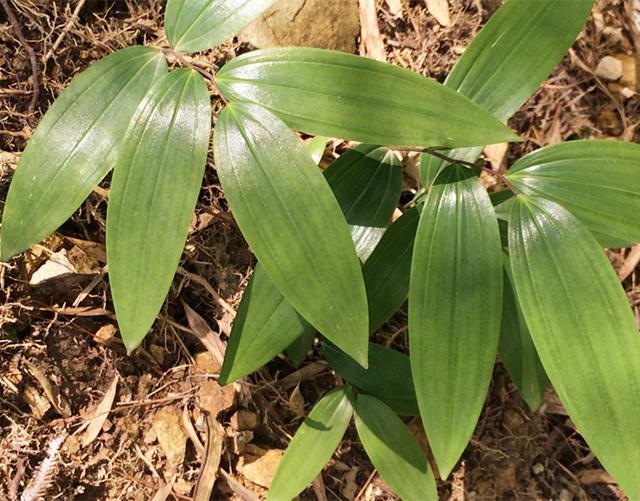
3.3 Biological characteristics of Polygonatum cyrtonema. It is a perennial herb, with horizontal, thick and fleshy rhizomes that are nodular or bead-like. Leaves are alternate, grayish green on the underside and green on the upper surface, with 3-5 parallel veins, raised 2.5 mm, and 6 lobes, triangular-ovate, about 3 mm long; 6 stamens, inserted above the middle of the floral tube, filaments 3-4 mm long, apex papillose or enlarged and sac-like, ovary nearly spherical, style 12-15 mm long, berry spherical and purple-black. Flowering period is April-June, fruiting period is June-October. Polygonatum seeds are round and bead-shaped, hard, with an obvious hilum, dark brown, and a thousand-grain weight of about 33 g. Seeds stored dry at room temperature have a low germination rate. Low-temperature sand storage and alternating-temperature sand storage are beneficial to embryo development, breaking seed dormancy, shortening germination time, and improving germination rate and uniformity. The suitable germination temperature for seeds is 25-27 degrees C.
Polygonatum has the characteristics of preferring warmth, fearing intense heat, avoiding strong light, and fearing both drought and waterlogging (water damage) [1]. It is suitable for cultivation in cool mountainous areas at low to medium altitudes and under sparse forests.
4 GAP cultivation techniques for Jiuhua Polygonatum
4.1 Site selection and land preparation
4.1.1 Site selection. Polygonatum can be planted in most areas of Qingyang County. The most suitable planting sites are moist and fertile forest land or mountain land, forest edge land, grassy areas, or open areas under forests; planting under sparse forests is also acceptable. The best soil is fertile, loose sandy loam rich in humus [2]; clayey, heavy, barren or dry soil, as well as soil with excessive heavy metals such as lead, mercury, chromium and arsenic and toxic and harmful substances, are not suitable for cultivation.
4.1.2 Land preparation. The soil should be deep-plowed more than 30 cm; for paddy soil cultivation, deep plowing of more than 50 cm is required to break the plow pan. On sloping land, terraces should be built along contour lines and beds made to prevent soil erosion. Generally, the bed surface is 1.2 m wide, the bed length is 10-15 m, and the bed surface is 10-15 cm above ground level. Apply sufficient basal fertilizer in the bed, 60,000 kg/hm2 of high-quality decomposed farmyard manure, evenly applied into the bed soil, then deep-plow 30 cm so that fertilizer and soil are fully mixed, then rake finely, level, and make beds ready for sowing.
4.2 Propagation of Polygonatum
4.2.1 Seed propagation. Select robust 3- to 4-year-old plants free of pests and diseases for seed production, strengthen field management, and control pests and diseases well. In autumn, when the berries turn from green to yellow, pick them, put them in a sieve basket and wash away the flesh and skin in river water, dry them indoors, and treat them with low-temperature sand storage. The method is: dig a deep pit in a sunny, wind-sheltered place in the courtyard (40 cm deep, 30 cm wide), thoroughly mix 1 part seeds with 3 parts clean fine river sand; the moisture of the sand should be such that it forms a ball when squeezed in the hand, disperses upon falling to the ground, and does not drip between the fingers; place the mixed seed and wet sand into the pit; place corn or soybean straw in the center to facilitate ventilation; then cover with fine sand, keep the pit moist, check frequently to prevent drying out and rodent damage, and when the seed buds begin to sprout around Jingzhe (the Awakening of Insects) in the following spring, take out the seeds, sieve off the wet sand and sow, or sow directly. Broadcasting or drilling can be used. Drilling: on the prepared seedbed, open furrows 3-5 cm deep at a row spacing of 15 cm, and evenly sow the treated, germinated seeds into the furrows. Cover with soil 2.5-3.0 cm thick, press lightly, and keep the soil moist [Jishan Huayao].
Polygonatum embryos exhibit secondary dormancy. Under natural conditions, the seedling emergence rate in the year of sowing is less than 10%, and only in the following year can it reach 80%-90% [3]. In the nursery field in the sowing year, attention should be paid to clearing ditches, drainage and weeding. After emergence in the following spring, management should be strengthened and a shade shed built. Weed promptly to prevent weed infestation, and apply dilute manure water as topdressing to promote robust growth of the seedlings. In late August, the shade shed can be removed. Generally, it takes 4-5 years to cultivate large-grade commercial seedlings.
4.2.2 Rhizome propagation. In the seed-production field, select robust plants with basically consistent traits and free of pests and diseases as stock plants. In early spring, dig them up and directly cut rhizomes with buds (5-7 cm long, 2-3 nodes) as planting material. Soak the planting material in a 500-fold dilution of 50% carbendazim, or treat the wounds with plant ash, and plant after the surface dries.
4.3 Planting. Spring planting is carried out from late March to early April, and autumn planting from September to October. When planting, on the side near the bed ditch, open holes at a row spacing of 27 cm x 27 cm and a depth of 13-17 cm, plant 1 segment of rhizome per hole, with the bud tips oriented toward the shaded plants. After planting, water with dilute human and livestock manure water, and cover with fine soil level with the bed surface.
4.4 Field management
4.4.1 Interplanting. Polygonatum is a shade-loving plant. Proper interplanting with tall-stalk crops is not only beneficial to the growth of Polygonatum but can also increase economic returns. Cultivation under forests is most suitable, and intercropping with economic fruit forests such as peach, plum, apricot and Chinese chestnut is also possible.
4.4.2 Cultivation, weeding, topdressing and straw mulching. Carry out cultivation and weeding once each in April, June and November each year, and combine cultivation with topdressing. Cultivation should be shallow to avoid damaging the roots. After the two cultivations in April and June, apply topdressing of human and livestock manure water plus a small amount of chemical fertilizers such as urea. After weeding in November, apply 750 kg/hm2 of superphosphate and 750 kg/hm2 of rapeseed cake fertilizer. It is recommended to use biological bacterial fertilizer (organic fertilizer), biogas residue fertilizer, liquid fertilizer; organic fertilizers such as spent edible mushroom sticks and rapeseed cake fertilizer, chlorine-free three-element compound fertilizer, potassium dihydrogen phosphate, etc. In mountainous areas, cutting and burying green manure can be used to increase soil organic matter. The use of industrial waste fertilizer and municipal waste fertilizer is prohibited.
Summer straw mulching can not only inhibit weed growth, avoid soil erosion, maintain soil moisture and nutrients, and improve the soil environment, but can also increase the yield and quality of Polygonatum. Crushed rice straw, wheat straw, rapeseed hulls, etc. can all be used as mulch.
4.4.3 Drainage and irrigation. Polygonatum prefers moisture and fears drought, so the field should often be kept moist; during the high-temperature and dry weather from July to August, water should be applied promptly, and where conditions permit, drip irrigation or sprinkler irrigation can be used. In the rainy season, special attention should be paid to clearing ditches and drainage to avoid waterlogging damage and root rot.
4.5 Pests and diseases
4.5.1 Main pests and diseases. Diseases include leaf spot, southern blight, black spot, anthracnose, soft rot, and Fusarium wilt, among which leaf spot is the most common and southern blight causes the heaviest losses; major insect pests mainly include white grubs, black cutworms, wireworms, leafhoppers, and a kind of bud-eating gall midge.
4.5.2 Green control techniques.
4.5.2.1 Use disease-free planting material. Plant quarantine must be implemented for introduced material from other places; planting material should be treated with chemicals before planting. Soak in a 500-fold dilution of 50% carbendazim for 30 min, dry, and then plant.
4.5.2.2 Agricultural measures. According to the growth and development characteristics of Polygonatum, create an environment favorable for its healthy growth. Focus on shading (cultivation under forests or shading), preventing waterlogging, and preventing drought.
4.5.2.3 Physical and chemical trapping. Frequency-vibration insect-killing lamps and black light lamps can effectively trap and kill scarab beetles (adults of white grubs), planthoppers, leafhoppers, etc. According to different terrain, install one frequency-vibration insect-killing lamp every 1.3-2.7 hm2. Sugar-vinegar liquid to trap cutworms: use 1 part sucrose, 4 parts vinegar, 1 part liquor, 16 parts water, add 0.1 part 90% trichlorfon technical material to prepare a sugar-vinegar trapping liquid, which can effectively trap and kill cutworms. Place one basin every 90-150 m2 [Jishan Huayao].
4.5.2.4 Chemical control. Polygonatum grown under forests or in imitated wild cultivation generally has relatively mild pests and diseases and generally does not require chemical control. However, in the case of continuous cropping on dryland or improper management, southern blight, white grubs, leaf blight, etc. may occur more severely and require focused prevention and control.
(1) Southern blight. Rotation or paddy-upland rotation; disinfect with a soil disinfectant before planting; before onset or in the early stage of onset, use a 800-1,000-fold dilution of 5% validamycin or 23% thifluzamide suspension, and apply by root irrigation, pouring 0.4-0.5 L per plant (hole). Irrigate again after 7-10 d [5].
(2) White grubs. In plots with relatively severe damage, irrigate for control with a 1,000-fold dilution of 40% chlorpyrifos or 90% trichlorfon.
Pesticides for pest and disease control must be used strictly in accordance with green food production standards; highly toxic and high-residue pesticides are strictly prohibited.
4.6 Harvesting and processing. Polygonatum can be harvested 2 years after planting, but the highest yield is obtained when harvested 4-5 years after planting; growing for 1 more year can increase yield by 30%-50%. Harvesting in autumn from October to November, when the leaves turn yellow and wither, is best. Use a double-toothed hoe for digging. Following the direction of ridge planting, dig out the Polygonatum rhizomes with soil one by one, remove the remaining aboveground parts, and scrape off the soil with a bamboo knife or wooden stick. Be careful not to damage the rhizomes; fibrous roots need not be removed, and if roots are damaged, handle them separately. Before processing, do not wash with water. During primary processing, they may be washed clean with water, placed in a steamer and steamed for 3-4 h, and after being steamed through, taken out and dried in the sun while being kneaded until completely dry.
Commercial specifications for Polygonatum: qualified products are sweet in taste and not bitter, with no white core, no fibrous roots, no mildew, no insect damage, and no excessive pesticide residues; the best products are large in size, plump and moist, yellow in color, with a semi-transparent cross-section, and a Polygonatum polysaccharide content above 10%.
5 Discussion
The artificial cultivation techniques for Jiuhua Polygonatum are currently relatively mature, but seedling propagation remains a bottleneck for large-scale planting. Propagation methods for Polygonatum include seed propagation and vegetative propagation (rhizomes, tissue culture propagation), but in production, rhizomes with buds are mainly used as propagation material. Although seed seedling raising has a relatively large propagation coefficient, it takes 4-5 years from sowing to seedling formation, with a long time and high cost; although there are successful reports of artificial tissue culture, it is far from reaching the technical level of Chinese medicinal materials such as Bletilla striata and Dendrobium.
Southern blight is currently a soil-borne disease causing relatively large damage and losses in artificial cultivation of Polygonatum. Because the pathogen of southern blight has a wide host range and the pathogen is ubiquitous, and because the field cultivation cycle of Polygonatum is long, once the disease occurs it is difficult to control effectively. In production, it is necessary to start with the selection of disease-free planting material and soil environment management, and combine this with chemical control [6]. There is an especially urgent need for a compound biological preparation that can effectively control the reproduction and damage of the southern blight pathogen through antagonism, induced resistance, immunity and other effects.
As a geographical indication agricultural product and one of the top ten Anhui medicines, Jiuhua Polygonatum has received great attention and policy and financial support from the Chizhou City and Qingyang County governments. Experts and scholars from Anhui University of Chinese Medicine and related institutions inside and outside the province have conducted sufficient research on the classification, morphology, ecology, physiology, biochemistry, history and culture of Polygonatum, laying a theoretical foundation for its production and processing. In order to accelerate the industrialization of Jiuhua Polygonatum, it is hoped that more colleges, universities and research institutes will pay attention to technologies such as rapid seedling propagation, standardized cultivation, and deep processing of products for Jiuhua Polygonatum. This study provides a preliminary discussion of the GAP cultivation techniques for Jiuhua Polygonatum and is hoped to play a positive guiding role in the standardized artificial cultivation of Jiuhua Polygonatum.