Orchid Plum Petal Morphology Analysis and Beginner's Guide
From ancient times to the present, in the course of continuous development and evolution, Chinese orchids have gradually established a theoretical system with orchid petal shape, flower color, leaf shape, and leaf color as the main appreciation standards. This system is an established convention rather than a standard verified by botanists. It is a custom, a custom integrated into Chinese culture. This set of petal appreciation standards summarized by predecessors in orchid cultivation has been widely recognized by everyone and has formed a nationally unified standard. This has also provided an important reference basis for the selection and breeding of Chinese orchids and has had a profound influence on later orchid cultivation.
Cymbidium goeringii standard plum petal flower - Song Mei
We often use orchid petal shape to measure the quality of an orchid, and this is also basic knowledge that orchid enthusiasts must master when getting started. According to the petals, orchids can be divided into three major categories: standard-form petal flowers, unusual petal flowers, and colored flowers.
Standard-form petal flowers, as the name suggests, are flowers with upright petal forms, proper and regular, not out of line. Among them, standard-form petal flowers are further divided into: plum petals, lotus petals, and narcissus petals; unusual flowers are divided into: butterfly flowers, peony, chrysanthemum petals, tree form, lion head, and crystal; colored flowers are divided into: plain heart, white, green, red, orange, yellow, black, etc.
These 3 classifications of standard-form flowers were first applied to Jiangsu-Zhejiang spring orchids and Huilan, and then gradually developed nationwide. In addition, there are also folk terms such as super petals and group petals. Today we will only talk about plum petals among standard-form flowers. The other petal forms will be explained to everyone step by step in later lessons. Remember to keep following!
Cymbidium goeringii Zhizu Sumei
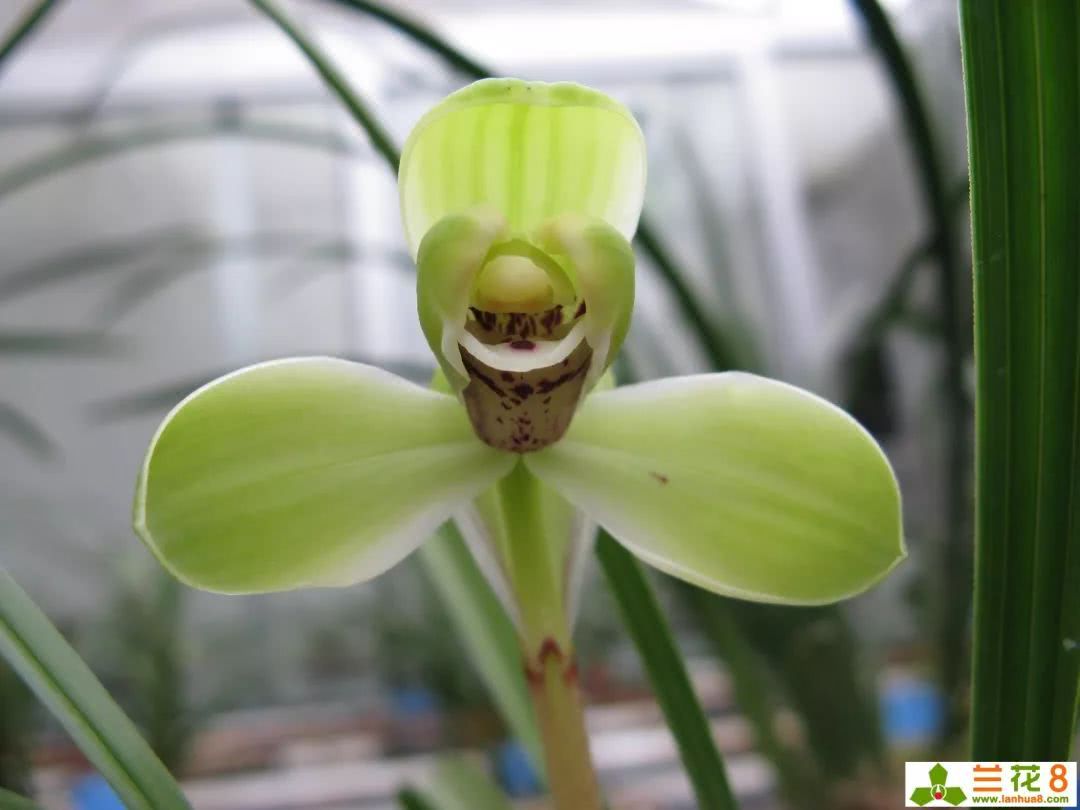
Generally speaking, an orchid flower is composed of 3 outer petals, which in botanical terms are called sepals, 2 inner petals, and 1 lip. The flower shape of an orchid plum petal flower resembles a plum blossom that has just opened.
The ideal standard for plum petal flowers can be summarized in one sentence: the three outer petals are short and round with tight edges, the inner petals are short and round with a pouch and embrace the column, and the lip is short and firm and does not curl backward. The details are as follows:
1. The three outer petals are thick in texture, round and compact in structure (some petal tips may have a pointed peak), the sepal body is short (a length-to-width ratio of 2:1 is preferred), the sepal edges are tight and strong, that is, the sepal edges contract inward and curve inward, forming a spoon shape, and the sepal base narrows at the root (about one third of the width of the sepal tip), resembling the petals of a plum blossom.
Cymbidium kanran hard-pouch plum
2. The inner petals must have a pouch. This is the most important standard. Those without a pouch cannot be called plum petals. The pouch refers to the form of the fleshy petal tissue at the tip of the inner petals. The front end of the pouch has a white edge, also called a "white head," and curls inward, giving the inner petals a blocky, thickened feel, also called masculinization. According to thickness, it can be divided into soft pouch and hard pouch; according to the depth of the space formed by inward curling, it can be divided into deep pouch and shallow pouch.
Cymbidium tortisepalum soft-pouch plum
3. The lip is short in shape and round in form, must be firm, spread straight and not curl backward, not turn upward, and the ruyi tongue is preferred.
Cymbidium faberi plum butterfly
People today have also further subdivided them. Those that strictly meet the above 4 standards are standard plum petals; those that do not strictly meet them and have slight shortcomings are general plum petals; those with various defects are plum type. For example, according to the length of the three outer petals, they can be divided into four types: oval, long sepal, egg sepal, and fan sepal; according to the degree of masculinization of the inner petals, they can be divided into hard-pouch plum and soft-pouch plum; those whose inner petals and tongue meet the standards while the three outer petals have a slight pouch are called plum-form narcissus; those whose petals have butterfly transformation are called plum butterfly; those whose tongue is uniform in color without other variegation are called plain plum; those whose three outer petals curl backward and turn upward are called floating plum; those whose petals have crystal are called crystal plum; and then according to petal color they are further divided into yellow plum, red plum, green plum, etc. Because there are not yet specific and strict defining standards at present, we will not discuss this too much here. It is enough for everyone to know that such a thing exists!
Cymbidium goeringii plum-form narcissus - Xi Shen
In short, the key requirement of plum petal flowers for the petals lies in whether the inner petals have a pouch. If they do, then it can be established; if not, then it cannot be called so. As for the size, length, and width of the three outer petals, this is judged according to the grade of that variety, and is not pursued very harshly. In the past, when judging petals, people looked at the three outer petals; now people emphasize the central palace. Nowadays judging plum and narcissus is very simple: inner petals with a pouch and blocky form are plum; with a pouch forming a spoon are narcissus; and then the three outer petals are judged for shape. If the three outer petals are round, it is plum form; if slightly longer, it is narcissus form; if the base narrows and the corners flare, it is lotus form. Why has it become like this? Is it because people's aesthetic standards for orchids have lowered? Definitely not. I myself do not know the specifics either. It may be to accommodate other varieties and take the overall situation into account! Author: Mei Fei (founder of Orchid Bar), written on June 4, 2018. Reprinting is welcome!
Orchid Bar, your good teacher on the path of orchid cultivation