Mounted Phalaenopsis orchids don't get root rot, and even beginners with no experience or a habit of killing orchids can grow them well
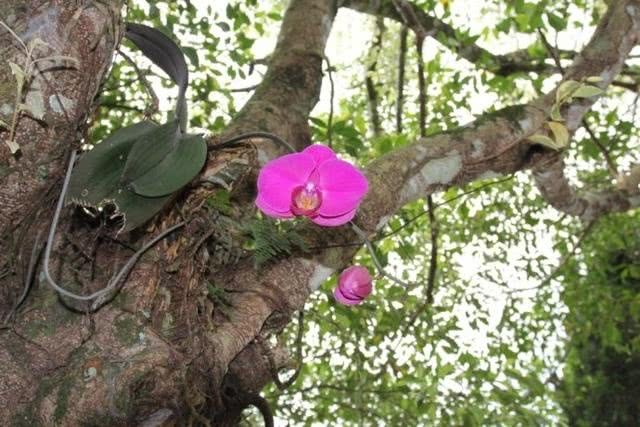
Because of water control and root rot problems, many friends try mounting, which is actually the closest thing to the state of Phalaenopsis in the wild. Below are a few pictures of wild orchids growing on trees. You can see that the wild ones mostly have leaves that are tilted or pointing downward, which prevents water from collecting in the leaf crown and rotting the leaves, and 90 percent of the wild roots are exposed to the air. Yet they grow very well. Many orchid growers always worry about orchids lacking water and water them frequently, but you have all fallen into a misunderstanding. You should not always be fixated on the watering issue. You should instead put your effort into how to increase the roots' exposure to air. The stems and leaves of Phalaenopsis store water very effectively; it is a succulent-stem plant, so as long as it is not kept in a drought environment for a long time, it will not easily die of thirst.
The first few pictures are all wild ones, and precisely because they are in the wild with no one tending them, they inevitably suffer the encroachment of insects and snails, so the leaves are rarely intact. But if someone tends them and imitates the wild growing conditions, it looks like the following.
You can actually see that the bark is still fairly dry, yet none of the dozen or so Phalaenopsis orchids on this tree have yellowing or withered leaves, so don't keep agonizing over the water shortage issue. Because the stems, leaves and even roots of Phalaenopsis all have the function of storing water, though somewhat less so than cacti, so after many growers' Phalaenopsis roots rot away completely, as long as the leaves and succulent stem are intact, they can sit for many days without dying and will even grow new roots, because there is enough water and nutrients in the stem and leaves to keep it alive, and it still has reserves left to grow roots. Look at the mounted one below: the roots are green, vigorous and firm. If you take a section of green root and cut it open, you will find that although the outside of the green root is dry and smooth, there is a lot of water inside, so even watering once a day by spraying is enough for a mounted plant, unless it is summer in the high-temperature north. Phalaenopsis roots are fleshy roots, not the fibrous roots of ordinary soil plants; they have a water-storing function. So being this thick, firm and green, even if the mount is dry there will be no problem. From the picture below you can notice that in fact the roots on the dry parts of the mount grow better than those on the moist parts. If the mount is semi-moist, there is no need to spray at all. Precisely because its roots store water, what it needs more is an airy environment. The first wood-mounted one had poor water control, so the roots began to show signs of rot, while the one below grown on a tree fern board had good water control, so the roots grew very well.
If you spray too much, even a mounted plant will show root rot. The picture below is a rather well-mounted orchid; here I borrow his picture. You can look carefully and see that although it is mounted, the orchid in the picture still shows signs of soft rot at the roots from overly frequent spraying. If this continues, even a mounted plant will get root rot. Because the roots store a large amount of water and you are also spraying heavily on the outside, Phalaenopsis very easily gets root rot. Water inside and water outside, how could it not rot? The one below grown on a tree fern board had good water control, so the roots are good.
In fact, many times going back to the starting point lets you discover where the problem lies. Why do Phalaenopsis roots store water? Because in the wild it is usually dry with no water, so it evolved into water-containing fleshy roots. So occasionally spraying water and being without water most of the time is the ideal living environment. If anyone's orchid is about to die, they might as well switch it to mounting right away, and it will generally come back to life. Beginners can all start by growing on tree fern boards, and generally won't kill them. Once you are skilled with tree fern boards, it becomes easy to master water and humidity when growing in sphagnum moss pots.