A Detailed Guide to the Wiring and Shaping Methods for Camellia Bonsai
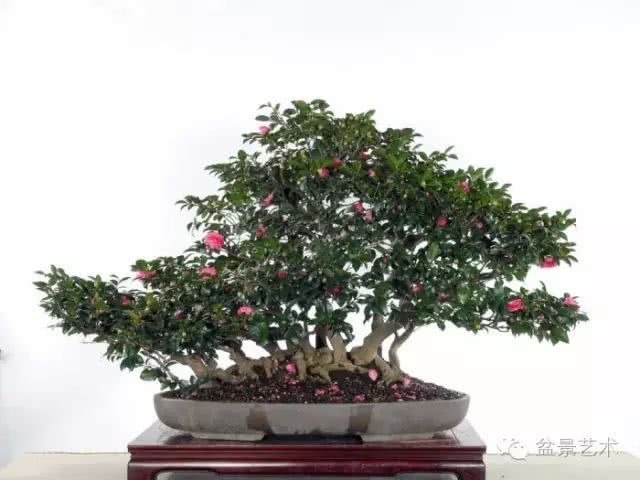
Among the many plants used in Sichuan-style stump bonsai, the camellia is one of the earliest tree species adopted.
The camellia is one of China's top ten famous flowers; with its traits of remaining unwithered through winter, braving frost and snow, and blooming in the cold, it adorns gardens in winter and early spring. If used for bonsai, its natural combination of an elegant and stately plant form, glossy green leaves, and beautiful yet not gaudy flowers can bring brilliance and lively vitality to indoor spaces.
I. The Bonsai Growth Habits of the Camellia
The camellia originates from the mountainous regions of the Yangtze River basin in China and was a component tree species of ancient subtropical forests. Since its history of being taken from the forest for cultivation is only a little over a thousand years, it still retains pronounced subtropical forest plant habits and prefers slightly acidic, moist soil. Therefore, when potting, absolutely avoid using poorly draining dead yellow clay and old compacted soil. Otherwise, the plant will fail to sprout and grow, appearing like a diseased specimen, until the root system turns black, rots, and dies. It also dislikes direct sunlight and prefers a semi-shaded environment with high air humidity.
II. Potting and Wiring
For camellias used in bonsai, seedlings should be selected in nurseries where the plants are spaced relatively far apart. The selected plants should be camellias with relatively low branching, a greater number of branches, uniform leaves, normal development, and no pests or diseases.
The flower bud differentiation period of the camellia is in May, and flower buds begin to form in June. The best seasons for potting are the second lunar month and the eighth lunar month in spring and autumn. At this time, the camellia's leaf buds have just sprouted or have sprouted only slightly, so the young shoots and tender leaves after transplanting will not wilt and affect growth vigor. If potting at other times is desired, more of the soil ball should be retained, and after quick lifting and quick planting, the plant should be moved to a shaded place for several days. Even so, growth will not be as vigorous as in the second and eighth lunar months. The soil used for potting must be mountain humus soil or red sandy loam from hilly areas (soil beneath Masson pine and oil tea forests).
Camellia potting and shaping generally use the cliff-hanging style and the rolling-branch style. For the cliff-hanging style, Yixing tall-footed cylindrical pots or tall bucket pots may be used; for the rolling-branch style, proportionally balanced round pots or square pots may be used.
Camellias used for bonsai wiring should all be planted at a slant when potted, so as to facilitate the manipulation of the main trunk's posture. Generally, the main trunk is first bent into a posture favorable for wiring the branches. Commonly used postures include the drop-bend and the rolling-dragon-embracing-pillar bend. When bending the main trunk, the camellia's side branches, fine branches, and leaves should generally all be retained. After the main trunk is formed, the side branches are then worked on. The wiring method for side branches can be determined according to the characteristics of the surface area that branch should occupy, using upright bends, slanting bends, and irregular reverse curves respectively, to the extent of filling the gaps on the surface of the crown. All the above wiring is done with palm fiber using the double-strand tie method. The wiring operation should be carried out after potting, once the new branches have hardened, that is, about one month after potting. Because the camellia's wood is relatively hard, like that of osmanthus and golden-larch, during the operation of each bend the branch should be carefully "kneaded," that is, each small section of the branch segment involved in that bend should first be flexed, bending it in both forward and reverse directions so that the bark and phloem of the branch and trunk, through stretching and compression, and the xylem, through squeezing and pulling, adapt to the external force before the palm fiber is tied to fix the shape. Otherwise, after shaping is completed, the plant's branches and trunk will break due to increased sap flow.
Finally, through the wiring of small branches, the leaf surface of each leaf is turned outward. Because the tree species used for rolling-branch shaping are all flowering trees and shrubs that bear flowers in the leaf axils (camellia, osmanthus, plum blossom, wintersweet, elm-leaved spirea, etc.), the effect after shaping is that flowers can bloom all over the surface of a spherical or inverted-ovoid plant crown, displaying an air of elegance and luxury. Therefore, the process of wiring small branches and turning leaves should be carried out even more meticulously. In order for the alternately arranged camellia leaves on the branches to all turn their surfaces outward, the small branches should be carefully kneaded and twisted when bent, so that they neither break nor fail to achieve the leaf-turning effect. After the operation is completed, only then may individual redundant branches and leaves that cannot be dealt with be pruned away. If some gaps during wiring need to be filled in by young shoots, this must be done only after the young shoots have aged and hardened.