The secrets succulent greenhouse owners won't easily tell you, do you know them all?
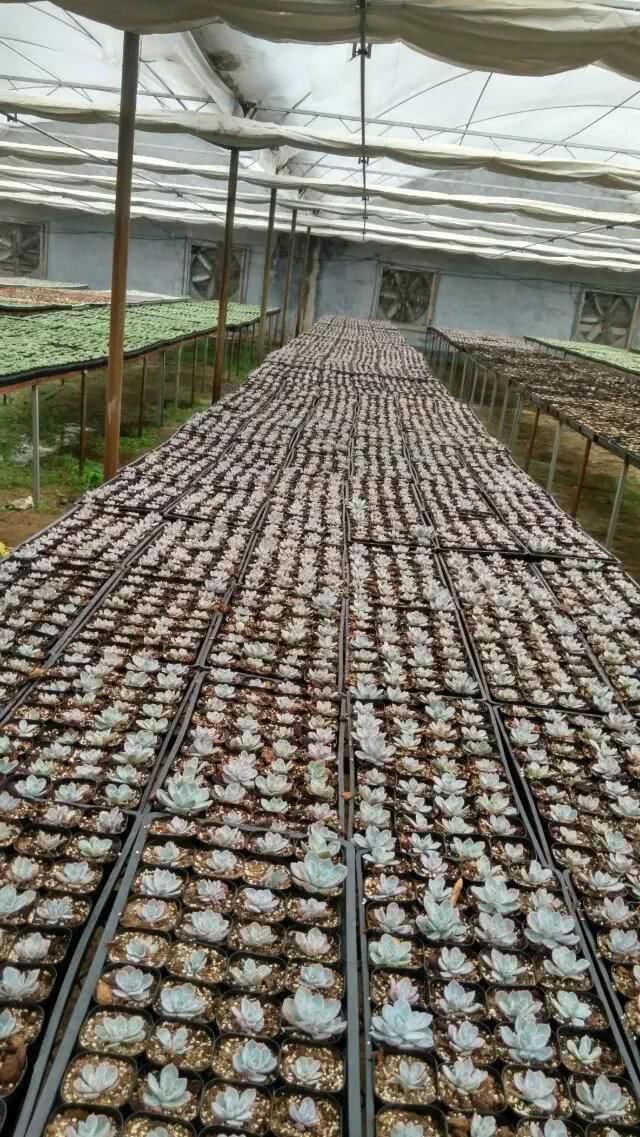
We all know that succulents grown in greenhouses grow fast and big. Generally speaking, a small seedling grows into a mature plant in 3, 2 months and can leave the greenhouse. So have you ever wondered what kind of soil is used for succulents in greenhouses to make them grow so well? Generally speaking, this is a "little secret" that greenhouse owners won't easily tell you.
A succulent greenhouse owner who runs 7 greenhouses said that there are really many soil mixes for succulents now, and if you are not particularly chasing the ultimate state of the plants, they are actually all about the same.
Like garden soil, we use a lot of it in our greenhouses, because the cost is low and it is easy to obtain. But if you are growing succulents at home, it is best not to use garden soil. Not only does it easily compact, but if you don't prevent problems well, it is even more likely to get pests and diseases. It is not like the succulents in greenhouses, where fungicides and insecticides are sprayed on a large scale regularly, so the preventive measures are quite thorough. Therefore, succulents bought from greenhouses and brought home are best repotted.
Many succulent lovers think volcanic rock and perlite are relatively cheap, so they buy a lot at once, but only when watering the succulents each time do they discover that these granules really tend to "float", cannot hold down the soil, and the plants easily tilt over. Maifan stone is different. Although it is a bit more expensive, it has a certain weight. It can not only be used for mixing into soil and as a bottom layer, but its smooth edges also make it more suitable for top dressing.
Peat soil can be said to be one of the soils with quite a good water-retention effect among succulent soils. As for how much to use for succulents, it also depends on the local climate environment and air humidity, generally with a ratio between 10% and 30%.
Some succulent lovers asked me whether there is any medium that can replace peat soil. There indeed is: coconut coir. It is cheaper than peat soil, and its water retention and air permeability are also quite good. The only thing is that each time you use it, you have to break up the coconut brick yourself, which is a little troublesome.
Usually, succulent greenhouses like ours also sell various granular soils, peat soil, flower pots, and so on, and quite a few succulent lovers want to save trouble, so they choose pots in the greenhouse and directly ask us to pot them up so they can take them away. Actually, this way the price becomes a bit expensive. It is still more practical to take them home and pot them yourself. Granules with good air permeability can be replaced by coal cinder and coarse sand, and you do not necessarily have to buy very good granular soil.