What are the potted bonsai techniques of carved trunks and decorated trunks?
What are the potted bonsai techniques of carved trunks and decorated trunks?
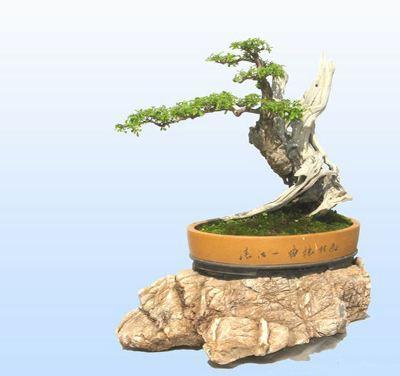
After the tree stump's shape has basically taken form and already shows the beginnings of an ornamental silhouette, in order to enhance the aged appearance of the stump bonsai (figure) and give it more weathered, wild charm, the branches and trunk can be appropriately modified and treated to make up for the deficiency of insufficient age in self-cultivated small stumps, and so on. Common methods include carving, bark prying, decay erosion, ant boring, tearing, and other methods.
(1) Carving method: Use tools such as carving knives and drills to create grooves and holes on the trunk surface that imitate natural forms. The carved shapes should be natural, avoiding regularity and artificiality, and the characteristics of the wood grain should be taken into account when carving. Larger saw cuts or pruning cuts left during shaping and pruning can be carved with a knife into natural-looking scar forms.
(2) Bark prying method: Insert a small knife into the bark layer of the trunk and gently pry it so that the bark (periderm) partially separates from the xylem, then stuff some debris such as wood shavings and mud into the separation gap. After 1-2 growing seasons (1-2 years in subtropical and temperate zones), the surface of the branches and trunk becomes rough and shows aging. The bark prying method is suitable for species whose bark can be easily peeled, such as Ficus species and Ulmus species.
(3) Decay erosion method: Use a sharp knife to peel off part of the bark from the tree stump and cut into the xylem, then apply strong corrosive agents such as sulfuric acid to the cut, or use corrosive fungi to decay and erode the trunk, creating holes. Once the dead trunk meets the requirements, clean the wound with clean water or a sterilizing agent [Jishan Huayao].
(4) Ant boring method: If conditions permit, ants can also be lured to bore into and eat the xylem to achieve the purpose of "carving." During the ants' active period (March to October), some phloem and xylem can be cut away on the trunk with a knife, then some holes can be drilled in the xylem and coated with maltose or honey to lure ants to gather and bore. Apply once a week and scrape once a week. The speed of boring into the xylem is very fast, but ants must absolutely not be allowed to nest there (drive them away with 20 times formalin).
(5) Tearing method: For branches or trunks that need thinning, do not use scissors but use your hands to tear them off together with the bark and part of the xylem, exposing a wooden groove on the tree. After the wound heals, it looks as if it formed naturally, giving people an impression of antique elegance and aged, weathered charm.