Succulent old stumps hard to form? Try these 9 common varieties that easily form stumps
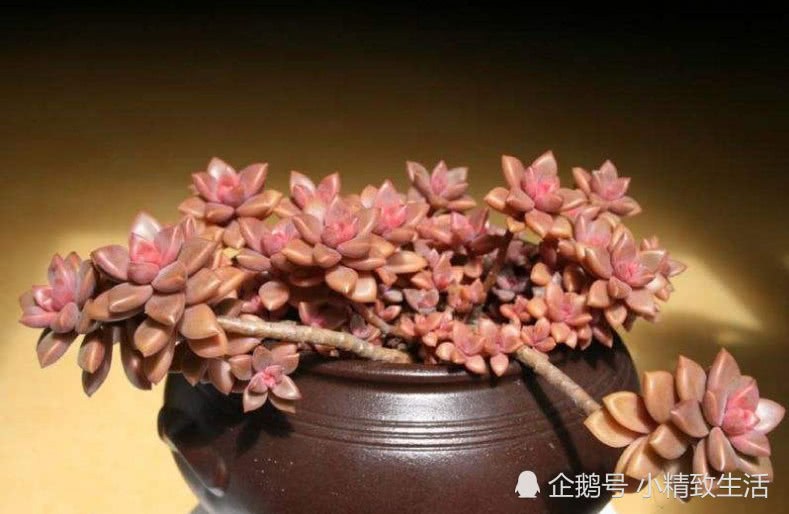
The definition of a succulent old stump doesn't seem very clear. Generally speaking, once a succulent grows a stem, it should really be called an old stump. If a standard must be added, it's that it makes people want to possess it the moment they see it. Growing succulents into old stumps is the pursuit of most succulent lovers. But in the eyes of many beginners, growing a succulent old stump is a very long process, so long it feels endless. Some friends, eager for quick results, choose to force leggy growth to make fake old stumps. Personally, I feel this forced approach is not really advisable. Actually, as long as you choose the right succulent varieties, your old stump dream is relatively quick. Below, Xiao Jingzhi Shenghuo will take a look with everyone at which succulent varieties easily and effortlessly form stumps.
1. Graptopetalum paraguayense 'Bronze' (Ghost Plant)
The big common variety Graptopetalum paraguayense 'Bronze', a must-have for beginners. It's tough and easy to grow, easily forms clusters, and of course, easily grows into an old stump. With proper care, it generally takes about a year or so to grow into an old stump without question. A few leaves thrown into the soil can survive, and Xiao Jingzhi Shenghuo found that leaf-propagated Graptopetalum paraguayense 'Bronze' at the same time, compared to other succulents, roots and sprouts much faster and grows much faster.
2. Echeveria runyonii 'Topsy Turvy'
The leaves of Echeveria runyonii 'Topsy Turvy' are very peculiar, tough and easy to grow, very suitable for beginners. During growth, the lower leaves gradually dry up and fall off, slowly forming an old stump, and the old stump stem very easily sprouts small pups. Often, succulent lovers can't repot fast enough to keep up with the rate at which Echeveria runyonii 'Topsy Turvy' produces pups.
3. Echeveria 'Imbricata' (Blue Rose)
Echeveria 'Imbricata' is good-looking and inexpensive, and also a succulent that very easily grows into an old stump, and it also loves to sprout pups. Many friends say Echeveria 'Imbricata' is prone to black rot and rather difficult to grow, but actually it's very tough, and once the old stump stem becomes woody, it's even less prone to disease.
4. Sedum morganianum (Burro's Tail)
Sedum morganianum is also an extremely prolific succulent. How prolific? It's said many friends use it to deal with people who ask for free cuttings... And Sedum morganianum forms a stump very quickly, and as an old plant it hangs down over the edge of the pot, very beautiful.
5. Pachyveria 'Clavifolia' (Winter Beauty)
The veteran common variety Pachyveria 'Clavifolia' is probably the most common succulent in rural areas. It's also tough, easy to grow and fast-growing, and before you know it, it's an old stump. Pachyveria 'Clavifolia', a must-have for beginners to practice with, you deserve to have it.
6. Sedum adolphi (Golden Sedum)
Sedum adolphi grows in different colors at each stage. If you want golden-yellow compact leaves, just sun it as much as you like, anyway this thing won't die from sun. A big common variety, two yuan and two years of growing gives you a solid old stump. Is it worth it?
7. Echeveria pulidonis (Pulido's Echeveria)
Echeveria pulidonis is called the most beautiful common variety. In autumn and winter, the old stump Echeveria pulidonis has beautiful red edges on its leaves, just like a beautiful woman wearing a qipao.
8. Graptopetalum mendozae
Another big common variety, tough, cheap and easy to grow. Once it colors up, it has a breathtaking unique luster, a fighter among common varieties.
9. Kalanchoe luciae (Flapjack)
A thin-leaved succulent, simple and unadorned, with a white powder on the leaves. Once it colors up, the leaves turn fiery red, very ornamental.
Friends who have read previous articles by Xiao Jingzhi Shenghuo may have this question: why are most of your articles about common varieties? Here, Xiao Jingzhi Shenghuo wants to tell everyone that common varieties are cheap and easy to grow. It's precisely because they're easy to propagate and highly adaptable that they become common varieties. As for expensive varieties, it's mainly because they're hard to grow and slow to propagate, so rarity makes them precious and they become expensive varieties. A well-grown common variety is no less beautiful than an expensive one. And the main point is... Xiao Jingzhi Shenghuo has no money and can't afford expensive varieties.
The above was compiled and published by Xiao Jingzhi Shenghuo, hoping it can be of some help to everyone.