Detailed Explanation of the Technical Regulations for Pollution-Free Cultivation of Long Yam in Zhoukou City
Technical Regulations for Pollution-Free Cultivation of Long Yam in Zhoukou City
1 Scope of Application
This standard specifies the production site environment, cultivation techniques, pest and disease control, harvest, storage and production records for pollution-free long yam production. This standard is suitable for the production of pollution-free long yam in Zhoukou City.
2 Normative References
The following documents are indispensable for the application of this document. For undated references, the latest edition applies to this document. "Standard for Safety Application of Pesticides" (GB 4285), "Guidelines for Rational Use of Pesticides" (GB/T 8321), "General Rules for Rational Use of Fertilizers" (NY/T 496), "Organic Fertilizers" (NY 525), "Environmental Conditions for Pollution-Free Agricultural Product Vegetable Production Areas" (NY 5010).
3 Terms and Definitions
The following terms and definitions apply to this document.
3.1 Bulbil
The aerial tuber borne in the leaf axils of yam stems and vines is the bulbil, which can be used for seed propagation to renew yam planting sets.
3.2 Yam Planting Set
The upper end of the yam tuber is relatively thin, bearing latent buds and stem vine scars, and is usually used as seed for planting, called the yam planting set or yam mouth.
3.3 Yam Segment
The edible middle and lower portion of the yam tuber contains dormant buds, and when planting sets are insufficient, it is cut into small segments for planting, called yam segments.
4 Environmental Conditions of the Production Base
4.1 Natural Resources
The long yam production area requires good light conditions and abundant light and heat resources. The annual average daily temperature is above 12 °C, the effective accumulated temperature of ≥10 °C is 4 300 °C, the frost-free period is ≥200 d; the annual average sunshine hours are above 2 200 h.
4.2 Soil Conditions
Yam is a deep-rooted crop that prefers sandy light loam and requires deep soil, generally with a depth of more than 1.5 m (in which there must be no clay interlayer thicker than 15 cm), loose soil texture, and flat terrain (the middle of the plot slightly higher and the surroundings slightly lower). The soil is relatively fertile, containing organic matter 1.5%-1.8%, total nitrogen 0.08%-0.10%, available nitrogen 60-80 mg/kg, available phosphorus 20-30 mg/kg, available potassium 150-200 mg/kg, pH 6-8.
4.3 Irrigation Conditions
Irrigation water is mainly well irrigation, the groundwater quality is good, the surface layer water depth of the groundwater source is greater than 15 m, and all water quality indicators meet the water quality standards for farmland irrigation.
4.4 Surrounding Environment
The plot is more than 200 m away from major traffic roads, with no pollution sources around; there are high-standard ponds, ditches and canals around it to facilitate the discharge of accumulated water.
4.5 Previous Crop
The previous crop is gramineous crops such as wheat and corn.
5 Cultivation Techniques
5.1 Variety Selection
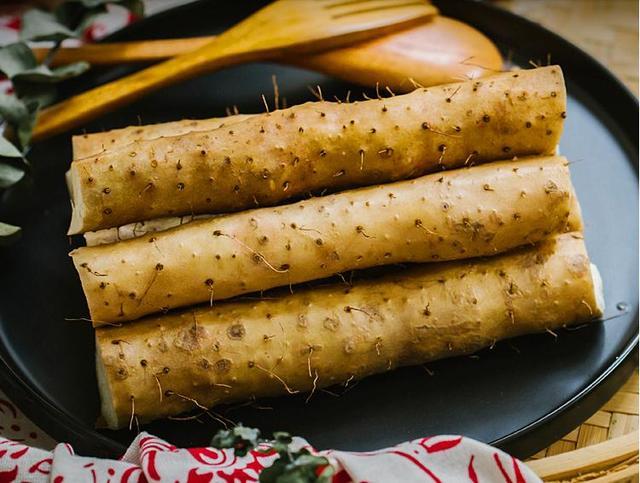
Jiujinhuang is a yam variety selected from long yam with high quality, high yield, disease resistance, strong adaptability and good marketability. Its characteristics are that it produces no or few bulbils, the tuber is generally 1.0-1.5 m long and 5-10 cm thick, the single tuber weighs about 2.5 kg, with the heaviest reaching 8-10 kg, and the fresh yam yield is 75-90 t/hm2. It has twining stems, right-handed, with stem vines about 4 m long, halberd-shaped leaves, thin skin and sparse hairs on the tuber, smooth with few tumors, white flesh and abundant juice, crisp at the upper part and dry and mealy at the lower part, and easy to peel and process. It is cultivated with trellises above ground and planted in furrows below ground, with a density of about 42,000 plants/hm2, sown in early to mid-April, harvested in early to mid-October, and has the characteristics of high input, high yield and high benefit.
5.2 Preparation of Propagation Materials
5.2.1 Yam planting sets. Yam planting sets should have the characteristics of short and sturdy stems, full buds, no disease or spots, and no damage to the epidermis. When digging yams in late autumn and early winter, cut off the planting sets, with a cut length of 25-30 cm and a weight of 200-300 g, then dip the cut surface with 70% mancozeb wettable powder, place them in sunlight for a short time or air-dry them in a ventilated indoor place for 7-10 d to heal the cut wound, and store them in a warm indoor place. When the indoor temperature is below 0 °C, cover them with straw mats and other materials to prevent freezing. Take them out in late March of the following year, and after sorting and air-drying, they can be used as seed sets for planting.
5.2.2 Yam segments. When yam planting sets are insufficient, yam segments can be used instead. About 30 d before planting, when the weather is fine, select yam tubers harvested after Frost's Descent with a diameter of 2-4 cm, smooth and bright color, few fibrous roots, sparse hair tumors, no pest or disease damage, no rotten spots, and uniform thickness, cut them into yam segments with a bamboo skewer or fingernail (the bottom of the yam strip is not easy to use as seed), leaving at least 1 dormant bud, with a length of about 20 cm and a weight of 250-300 g per segment, dip the cut surface in 70% mancozeb wettable powder, and mark the upper end of the tuber with ink using a writing brush. Place the cut seed pieces in the sun to dry, with straw mats underneath, arrange the tubers in one layer, and turn them frequently to keep drying uniform. Generally, air-dry for about 10 d, until the cut surface of the tubers shows inward shrinkage and cracking. The general seed reserve is 7 500-9 750 kg/hm2.
5.2.3 Chemical seed soaking. Before sowing, soak the air-dried seed tubers in 1 000 times dilution of 70% carbendazim wettable powder for about 5 min, remove and air-dry before sowing. When planting with yam segments, seedling emergence is about 10 d later than with yam planting sets, so before planting the soaked yam segments can be buried in sandy soil with a humidity of about 20%, kept at 25 °C for germination. When the buds grow to 1.0-2.5 cm, lower the temperature to 15-18 °C, and after hardening the seedlings for 5-7 d, transplant[1].
5.3 Fertilization and Land Preparation
Apply sufficient base fertilizer, generally applying fully decomposed organic fertilizer 45-60 t/hm2, soybean cake fertilizer 750 kg/hm2, 51% potassium sulfate compound fertilizer (17-17-17) 1 500-1 800 kg/hm2, broadcast and then deep plough 25-30 cm, then rake level. Before land preparation, use 3% phoxim granules 30-45 kg/hm2, broadcast on the soil surface to control underground pests. In the leveled field, mark lines with quicklime at a row spacing of 1 m, and use a self-propelled yam furrowing machine to open furrows along the lines, requiring the spiral drill bit to be 1.75 m long and 20 cm in diameter. After operation, a loose soil belt with a ridge height of 20-25 cm and a ridge width of 50-60 cm is formed. If it is not yet the sowing period, the top and both sides can be patted flat to preserve moisture.
5.4 Sowing
Plant 1 crop per year, sow in spring and harvest in autumn. Try not to plant yam continuously; if continuous cropping is necessary, adopt alternate furrow planting in the second year. Sow when the soil temperature at 5 cm stably passes 10 °C and tends to be stable, generally around the "Grain Rain" solar term, around April 20. On the flat surface of the ridge, directly facing the deep furrow, open a sowing furrow 10 cm wide and 10 cm high, and lightly tread the bottom of the furrow with the foot. Place the yam planting sets or yam segments with the upper end of the seed bud facing the same direction at a plant spacing of 25-30 cm along the furrow bottom, in single-row sowing. Yam planting sets and yam segments should be sown separately. After sowing, spray along the sowing furrow with 1 000 times dilution of 70% hymexazol wettable powder, and after air-drying cover with soil 8-10 cm thick, pat firm to preserve moisture[2]. According to the requirements of row spacing 1 m and plant spacing 25-30 cm, the sowing density is 37,500-42,000 plants/hm2.
5.5 Field Management
5.5.1 Thinning. Under the conditions of soil moisture content 18%-20% and ground temperature 10-15 °C, yam planting sets emerge in about 20 d after sowing and yam segments in about 30 d. When seedlings emerge, if plants with multiple stems are found, the method of pressing firmly and pulling gently can be adopted, using one hand to press the soil at the base of the yam seedling and the other hand to gently remove excess stem vines, leaving only 1 sturdy main stem vine per plant.
5.5.2 Trellising and Vine Guiding. When the main seedling is about 30 cm tall, set up the trellis. Use thin bamboo poles 150-170 cm as trellis material; old trellis material needs to be soaked and disinfected with 1 000 times dilution of 70% carbendazim wettable powder. One trellis for two furrows, 6 pieces of trellis material form a "four-corner trellis", with the lower end inserted 20 cm into the soil, crossed at 30 cm from the upper end, tied together with rope, and connected between trellises with horizontal rods to ensure firmness. If trellising is too late and the stem vines are too long, the stem vines can be manually guided onto the trellis[3].
5.5.3 Topdressing. From late June to early July, apply 45% potassium sulfate compound fertilizer (15-15-15) 225-300 kg/hm2. The topdressing method is to first open a small furrow between the two ridges, apply the fertilizer, then cover with soil. The second fertilization is around August 10, with an application rate of 300 kg/hm2.
5.5.4 Irrigation and Drainage. About 10 d after emergence, that is, from late May to late June, when the seedlings are in the early leaf-expansion stage, lightly water by sprinkler or drip irrigation. In the late stage of vigorous stem and leaf growth, keep the soil alternating between dry and wet; during tuber expansion, water appropriately to keep the soil moist. Stop watering 15 d before harvest. In the rainy season, pay attention to timely drainage to strictly prevent rainwater from overflowing the bed surface and causing furrow collapse and root rot. In addition to treading the base of the ridge firm during land preparation, shallow drainage ditches can be dug between 2 rows in combination with ridge cultivation, and 1 cross ditch should be dug every 50 m in the field. During heavy rain, water can be directly drained from the field along the ridges into the cross ditch and then out of the field through the cross ditch.
5.5.5 Weeding. After the seedlings emerge, shallow hoeing and weeding should be carried out in time, and intertillage and soil loosening should be carried out after watering and rainfall.
6 Pest and Disease Control
6.1 Control Principles
In accordance with the plant protection policy of "prevention first, integrated control", adhere to the harmless management principle of "giving priority to agricultural control and physical control, with chemical control as a supplement". Focus on control at the sowing stage, strengthen soil treatment and seed tuber disinfection measures, and adopt integrated pesticide application during the growing period to achieve multiple effects such as disease prevention, pest control, fertilizer supplementation and regulation.
6.2 Control Methods
6.2.1 Agricultural control. Achieve crop rotation with gramineous crops for more than 3 years; deep ploughing and deep digging; increased application of decomposed organic fertilizer, with reasonable combination of phosphorus and potassium fertilizers; cleaning the field; trellis cultivation; selection of disease-free seed tubers.
6.2.2 Physical control. Use insect-killing lamps and attractants to trap and kill adult moths of the Noctuidae family and adult underground pests.
6.2.3 Chemical control and chemical regulation. Chemical control and chemical regulation should focus on high efficiency, low toxicity and low residue, with multiple pesticides used in alternating rotation. It is prohibited to use pesticides with high toxicity and high residue that are explicitly banned by the state. ① Yam leaf-expansion stage. In the early leaf-expansion stage (generally from late May to early June), irrigate the roots with 1 000 times dilution of 3% metalaxyl-hymexazol wettable powder + 1 000 times dilution of root-promoting and seedling-strengthening agent to prevent soil-borne diseases and promote rooting; spray the leaves with 2 000 times dilution of 5% emamectin benzoate water-dispersible granules + 800 times dilution of 70% mancozeb wettable powder to control Noctuidae larvae and brown spot disease. ② Peak stem and leaf growth stage of yam. In late June or about 55 d after yam emergence, spray 500 times dilution of 10% Weitaling special for tubers + 0.4% potassium dihydrogen phosphate solution + 500 times dilution of 80% chlorothalonil wettable powder to control the length of the yam mouth and prevent the occurrence of spot blight, fusarium wilt and anthracnose. ③ Tuber expansion stage of yam. Around July 25, spray 300-500 times dilution of 10% Weitaling + 1000 times dilution of 70% thiophanate-methyl wettable powder + 1500 times dilution of 0.01% brassinolide soluble concentrate to promote tuber expansion and control anthracnose. In early August, spray 500 times dilution of 10% Weitaling + 1 500 times dilution of 0.01% brassinolide soluble concentrate + 2 000 times dilution of 32.5% benzyl-azoxystrobin suspension concentrate; after 15 d, spray 500 times dilution of 18% chlormequat chloride-naphthaleneacetic acid wettable powder + 2 000 times dilution of 30% tebuconazole-prochloraz wettable powder; entering September, foliar fertilizers such as Huimanfeng, potassium dihydrogen phosphate, or amino acid and trace element types can be sprayed to prevent premature leaf senescence.
7 Harvest
7.1 Harvest Time
In late October, around Frost's Descent, when the aboveground part of the yam has completely withered, it can be harvested. The specific harvest date can also be determined according to market demand. Clean up all stem vines and leaves and transport them out of the field for centralized composting, and bundle and store the trellis material[4].
7.2 Harvest Method
At one end of the yam furrow, dig a ditch about 1 m deep and 20 cm wide, use a yam shovel to remove the surrounding soil, and gently take out the whole yam plant by hand. Prevent mechanical damage during the digging process.
8 Storage
8.1 Packaging
Remove all soil, break off the upper mouth and store it as planting sets, and grade the remaining parts according to standards and specifications such as thickness, length and color, box them and sell them.
8.2 Storage
Yams prepared for storage are required to have no disease spots, no insect marks and no wounds. Generally stored in indoor piles, with crop straw laid on the bottom layer, one layer of yams and one layer of sandy soil, pile height 1.0-1.5 m, covered with straw mats on top, suitable storage temperature 2-4 °C, relative humidity 80%-85%.
9 Establishment of Production Records
Establish production technology records, recording relevant contents such as the yam production site environment, management measures, pest and disease control and harvest, and keep production records for 2 years.