A single handful of leaves from the dung bucket grass can bring down a sheep, yet it is a fine folk remedy for snake bites
Friendly reminder
Hemu Report aims to share and popularize information about various plants and their uses, for reference only. If you need to use them medicinally, it is advisable to consult a professional physician to avoid problems!
Our country is vast in territory and rich in natural resources. Whether in the rural wilds of the south or the rural wilds of the north, there are all kinds of wild grasses. Although quite a few wild grasses are found only in certain places, there are still some that are nationwide, growing in rural areas of every province. Perhaps because of geographical differences, different places have different names for these wild grasses, which has also given them quite a few bizarre names. Below, the author introduces one such wild grass whose name is truly odd.
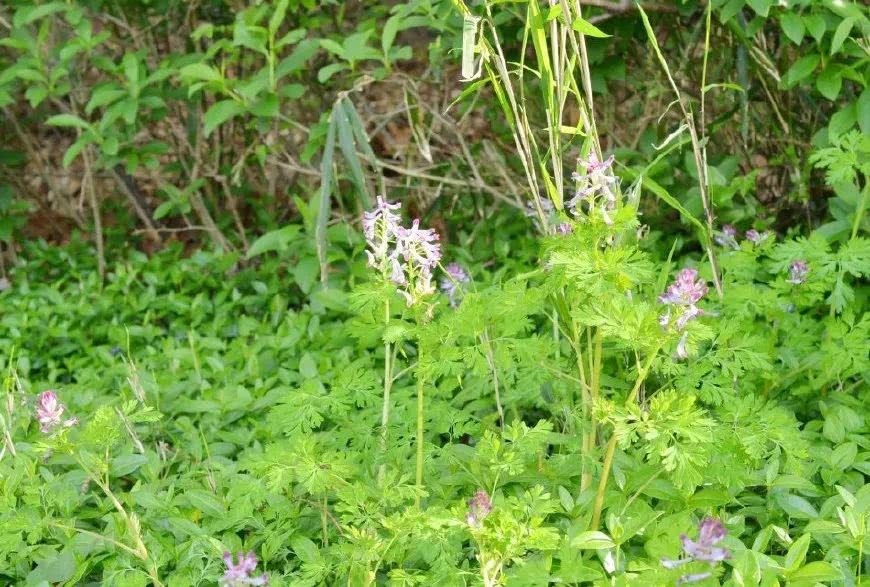
In the afternoon, the author returned to the old village and went with his uncle to help weed the farmland. Beside a ditch near the farmland, the author saw a peculiar wild grass. Looking at its leaves, the author thought it was celery, but then a glance at its strange flowers ruled that out. He immediately asked his uncle, who said that in the rural areas around here, this wild grass is called "dung bucket grass." As for why it has this name, friends who have seen it will understand: after this wild grass blooms, it gives off a peculiar stench, just like the smell of the night soil used to fertilize vegetables, so many farmer friends call it dung bucket grass.
In fact, the scientific name of this wild grass, dung bucket grass, is "purple-flowered corydalis" (Corydalis edulis), and in some places it is also called "sheep won't eat." Friends who have raised sheep should know that sheep like to eat all kinds of wild grasses, yet they are afraid of just a few particular ones, and purple-flowered corydalis is one of them, because a sheep that eats it will be poisoned. Just one handful of leaves is enough to bring down a sheep, which is why sheep fear it most.
Many farmer friends living in rural areas also greatly dislike purple-flowered corydalis. Although its flowers are very beautiful, the special stench it gives off is unbearable. In addition, purple-flowered corydalis likes to grow near paddy fields, where it affects the growth of crops, so many farmer friends also remove it as a major harmful weed in the fields.
In fact, no matter what wild grass it is, it has two sides. Although it stinks and harms crops, it also has its good points, and purple-flowered corydalis is the same. Many farmer friends in mountainous areas are very fond of it, because it is also a fine folk remedy for treating illness.
According to the "Chinese Materia Medica," the whole plant and root of purple-flowered corydalis can be used as medicine. Its taste is pungent and its nature is cold, and it is slightly toxic. As medicine it has the effects of detoxifying and killing parasites, and can be used to treat sores and swellings, scabies and stubborn ringworm, eczema, venomous snake bites and many other conditions.
Because purple-flowered corydalis is slightly toxic, it can only be used externally. Especially for external injuries such as snake bites, you can pound the leaves of purple-flowered corydalis into a paste, mix it with wine or vinegar and grind it into juice to apply externally, which is very effective. Therefore, some older farmer friends in mountainous areas also regard purple-flowered corydalis as a fine remedy for ordinary snake bites.
The author reminds: since purple-flowered corydalis is slightly toxic, the author does not recommend using it. After all, a snake bite is no small matter, and it is best to seek medical treatment. Moreover, the strange stench it gives off is something many friends surely cannot stand, so admiring it from afar is the best policy.
Dear friends, have you ever seen this "purple-flowered corydalis" that gives off a strange stench? You are welcome to leave a comment and share!
Text/Hemu Report, images/Internet
If you like Hemu's articles, you are welcome to follow