The Yangtze finless porpoise, not the Mona Lisa, is the true goddess of smiles
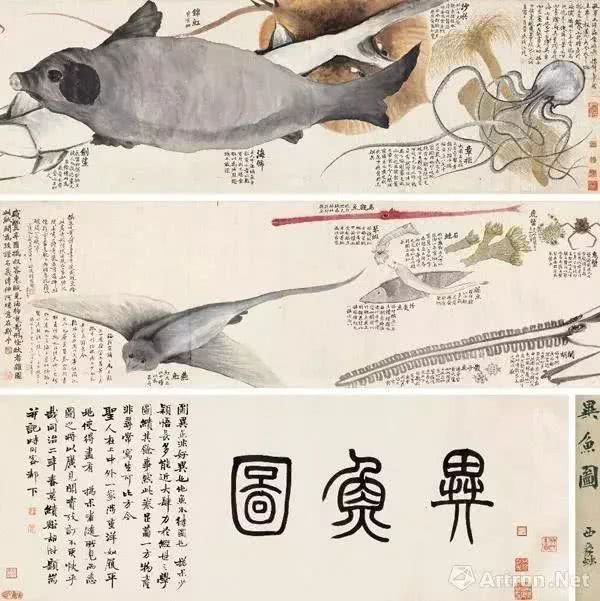
Images of animals and plants in ancient texts often relied on eyewitness descriptions and the imaginations of illustrators. Although they bear some connection to the real forms, what tends to draw more attention is the discrepancies. This can be seen in the "pig in the water" animal.
In the Qing Dynasty painting "Illustrations of Strange Fish" by Zhao Zhiqian, there is a large creature with a pig's face and a fish's body. Image: artron.net
They live in water and are skilled swimmers. The ancients did not regard them as fish, but treated them as beasts. Because the divine beast shows its head but not its tail, knowledge and records of it could only come from hearsay passed down and distorted along the way. In some folk tales of spirits and monsters, they appear amid wind and waves, cast as guardian deities of the waters who protect merchant ships sailing safely on the river; or as troublesome water monsters that stir up huge waves to capsize boats and attack crew members. So what exactly are these "pigs in the water"?
The "Illustrated Catalog of Sea Creatures" also features such a sea porpoise, where the character "?" is also written as "porpoise".
The famous"Illustrated Catalog of Sea Creatures"also depicts such a large fish, with a smooth back lacking a dorsal fin and a relatively short snout.Only the right whale dolphin and the finless porpoise meet these two characteristics. Since the right whale dolphin is not distributed in China, it should more likely be the finless porpoise.
The adorable finless porpoise. Image: ori2uru / flickr
The smiling angel swimming in the water
The finless porpoise refers to the cetaceans of the genus Neophocaena in the family Phocoenidae. They measure 1.2 to 1.7 m in body length, with grayish-black skin, a relatively short snout, a rounded and slightly convex forehead, a flattened tail, and no dorsal fin. Their eyes are very small and their eyesight is poor; like other whales and dolphins, they rely on echolocation to "see."
A finless porpoise swimming freely in the water. Image: Akimasa Harada / flickr
They rarely leap high out of the water like some dolphins, and they basically do not have the habit of following boats, so when humans work on the water surface, they seldom catch sight of them. Even when they do, most of the time they only see their backs breaking the surface.
The back of a finless porpoise breaks the surface of the water. Image: Jean-Pierre Sylvestre / Biosphoto
Finless porpoises generally breed at the turn of spring and summer. As mammals, female finless porpoises gestate and nurse in the water. The gestation period is 11 to 12 months, similar to that of other toothed whales. After birth, the calf will stay with its mother for a relatively long period. Newborn finless porpoises begin learning hunting skills from 3 months of age, but actual weaning does not occur until after 7 months. Fish, shrimp and soft-bodied organisms in the water are the finless porpoise's main food.
Finless porpoises are distributed in the coastal waters of the Indian Ocean and the tropical, subtropical and temperate zones of the Pacific Ocean in Asia. Although they are called "river porpoises," theyactually do not belong to the strictly defined category of freshwater dolphins。
The genus Neophocaena is now generally divided into two species,the Indo-Pacific finless porpoiseN. phocaenoides andthe narrow-ridged finless porpoiseN. asiaeorientalis. The former is distributed along the coast of the Indian Ocean and in Hong Kong, China; the latter includes two subspecies: N. a. sunameri (the East Asian subspecies), distributed in South Korea and Japan; and N. a. asiaeorientalis, which is the familiarYangtze finless porpoise. It is found only in the main stream of the middle and lower reaches of China's Yangtze River and its large river-connected lakes,and is the only freshwater population in the genus Neophocaena and in the entire family Phocoenidae。
Distribution map of the finless porpoise. Image: Jiuqiaozai / wikipedia
The Yangtze finless porpoise, at risk of extinction
The Yangtze finless porpoise has a relatively narrow distribution range,living only in a few tributaries and lakes of the middle and lower reaches of the Yangtze River, highly overlapping with areas of human activity, so it is extremely vulnerable to the impact of human activities.
Image: animalia-life.club
The development of fisheries and shipping on the Yangtze, the construction of water conservancy projects, and the resulting water pollution and ecological destruction seriously threaten the survival of the Yangtze finless porpoise. Ship propellers cut their bodies; illegal fishing gear and electric fishing methods cause them death and injury; fishing methods that drain the water to catch every last fish leave them starving to death in winter; continuously lowered water levels from water conservancy projects strand them in shallow water cofferdams... This creature, which has survived on Earth for more than 20 million years, is now seeing its population plummet under the disturbance of human activities, and it faces the risk of extinction.The current population of the Yangtze finless porpoise is far smaller than that of our national treasure, the giant panda。
The adorable Yangtze finless porpoise, now rarely seen. Image: animalia-life.club
Sharing a highly overlapping range with the Yangtze finless porpoise is the "goddess of the Yangtze," the baiji [jì] (Yangtze river dolphin), a true freshwater dolphin of the superfamily Platanistoidea. In 2004, the carcass of a wild baiji was found, and after that they never appeared in the public eye again (reports of suspected sightings do not count). In 2007, the baiji was officially declared functionally extinct, and all individuals captured for scientific research have also died (the last male baiji to die was named Qiqi, who passed away in 2002 at the Institute of Hydrobiology, Chinese Academy of Sciences in Wuhan, and was the individual that survived the longest under captive conditions in the world). Now only specimens remain for people to remember.
The once-active baiji is now basically impossible to see. Image: samo-opusteno.info
The "goddess of smiles," the Yangtze finless porpoiseis now following step by step down the road once walked by the "goddess of the Yangtze," the baiji. In 2006, the estimated population of the Yangtze finless porpoise was about 1,800; by 2012 it had dropped to 1,200; by 2014 only 1,045 remained, a decline of more than 10% per year. Research in recent years has also found that the sex ratio structure of the Yangtze finless porpoise population is undergoing marked changes, with a significant imbalance in birth rates between the two sexes, causing the female-to-male ratio among adults to decline year by year.
The photo shows a mother Yangtze finless porpoise with two male calves. Image: Gao Baoyan
In addition, underwater noise generated by human activities also interferes with the development of sonar ability in Yangtze finless porpoise calves. Acoustic communication and acoustic detection abilities play a vital role in the survival and reproduction of whales and dolphins. Excessively strong man-made underwater noise may not only cause irreversible effects on calves in the critical period of acoustic ability development, but may also cause calves and mother porpoises to lose contact and die.
Image: Gao Baoyan
In May of this year, the Fishery Administration and Supervision Office of the Yangtze River Basin of the Ministry of Agriculture organized a special demonstration meeting in Shanghai on raising the protection level of the Yangtze finless porpoise, and the meeting ultimately unanimously passed a proposalto upgrade the Yangtze finless porpoise from a national second-class protected animal to a national first-class protected animal。
and strive to restore their population
For the sake of their own development, humans have repeatedly reached out to take from nature. The baiji, now functionally extinct, is very likely to become the world's first dolphin species driven to extinction by human activities. To prevent the Yangtze finless porpoise from falling into the same predicament, scientists are working hard to advance conservation efforts.
Workers move Yangtze finless porpoises from Poyang Lake to their new home. Image: Li Kui / WWF
At the end of 1992, the Chinese government began establishing in the Tian-e-Zhou oxbow of the Yangtze River in Shishou City, Hubei Province, the "Tian-e-Zhou National Baiji Nature Reserve" and implemented a plan to capture Yangtze finless porpoises and relocate them into the reserve. For more than 20 years, this ex-situ breeding and conservation project has achieved initial success. The Yangtze finless porpoises released there have naturally reproduced to more than 80 individuals, and there are now plans to further expand the reserve area and introduce more Yangtze finless porpoises to improve the genetic relationships among the porpoises in the reserve.
Before examination, scientists carefully transport a Yangtze finless porpoise. Image: Li Kui / WWF
In June 2016, the Ministry of Agriculture announcedthat itwould establish 2 Yangtze finless porpoise rescue centers in Poyang Lake and Dongting Lakeand build 5 new ex-situ conservation areas for the Yangtze finless porpoise at Honghu, Qiandao Lake, Zhelin Lake, Gaobao Lake and Liaojiaqou, striving to achieve restorative growth of the Yangtze finless porpoise population before 2020.
The determination of government departments, the efforts of scientists and the dedication of volunteers all let us seehope. May the smile of the "goddess of smiles" bloom forever in the Yangtze River.
Image: Yi Qing / WWF
Hurry, collect your goddess of smiles
June 5 is World Environment Day
The calendar lady has learned of an official spoiler for "Travel Frog"
At 9 a.m. today, the frog's "Journey Through China"
will releasea finless porpoiserare postcardand a big wave of updates
A major spoiler, guess what this SSR postcard looks like
Now, you arethe first to know this news people
Hurry to mobile Taobao and search for "Travel Frog" to start playing
Perhaps you will be the first to receive the "goddess of smiles" postcard
!
The calendar lady's avatar today
Phocoenidae, vaquita