Detailed Explanation of Cultivation Methods and Techniques for Old Chinese Elm (Ulmus parvifolia) Stumps
Mastering the Water Spraying Stage During the Root-Cultivation Phase
Although old Chinese elm stumps are easy to transplant and cultivate, never spray water on the branches and trunk during the root-cultivation phase; keeping the soil at a certain level of moisture is sufficient. If cultivating the stump in the ground or in a pot, during the root-cultivation and root-promotion stage, frequently spraying the branches and trunk of the stump - when the branches and trunk and the tuberous roots are excessively wet, the moisture in the tree's bark becomes saturated, the sap will seep out and be lost, seriously affecting survival. This is a point that people do not pay attention to. In practice, such things often happen: someone finally digs up an ideal wild old stump from the wild, and during the process of ground cultivation or pot cultivation to nurture the stump, worries that the branches and trunk will dry and crack from lack of water, which would affect survival, so they keep spraying water on the old stump, sometimes several times a day, and the result is just the opposite. With such deep affection, yet for a long time no new buds appear, until it dies, and they still do not know why. The reason is that spraying water on an old stump that has not yet rooted causes the sap to seep and flow out from the unhealed wounds; when the sap is completely drained, it becomes a dead stump. This is caused by frequently spraying water on the stump during the root-cultivation phase. Chinese elm sprouts easily. As the temperature rises, the old stump slowly sends out new buds, but the good times do not last long; soon the new leaves and tender buds begin to wither. What is the reason? At this time, if you pull the old stump out of the soil, you will find that the old stump has not rooted at all, and some roots have turned black. This kind of budding is called false life; these buds are sustained by the old stump's own nutrients, and once the nutrients are exhausted, it becomes a dead stump. To distinguish true life from false life, look at the color of the new buds: false-life buds have no luster and no vitality, and after growing for a certain time they stop growing and then begin to wither; normal new buds have luster and grow more vigorous the longer they grow, which proves that the old stump has rooted and survival is hopeful. Therefore, when cultivating a stump in a pot, do not rush to let it be exposed to the scorching sun; pay attention to shading, gradually let it bear sunlight, and adapt to the environment. For old stumps cultivated in the ground, do not rush to pot them that same year; let their root systems develop fully before potting.
Mastering the Water and Fertilizer Control and Pest Control Stage
After the old Chinese elm stump has survived the root-cultivation phase, with full branches, and has been potted... you must also pay attention to water and fertilizer management. After potting, old Chinese elm stumps are generally watered and fertilized, and repotted once every 2-3 years. For watering, master the principle of not watering when not dry, and watering thoroughly when watering; in the high-fertilizer season, water once a day; in winter, keep it on the dry side and water less. When watering, water directly at the roots; do not spray the leaves [group: after the old stump has taken shape, during the maintenance process avoid spraying water on the leaf surface; if you often spray leaf-surface water, it will cause the branches to grow excessively, making the leaves larger, which not only affects the beauty of the tree shape but also easily causes aphids and caterpillars to eat all the leaves and tender branches bare. If it has been placed for too long and the leaves are dusty, when it rains, move the bonsai into the rain to be washed and rinsed. If aphids or caterpillars are found, promptly spray the leaf surface with diluted dimethoate and carbendazim to kill the pests. Although old Chinese elm stump bonsai is more extensively managed than the stump bonsai of ordinary tree species and is easy to cultivate, you must also pay attention to the following points. With proper management, a pot of stump bonsai can be enjoyed for decades or even a hundred years.
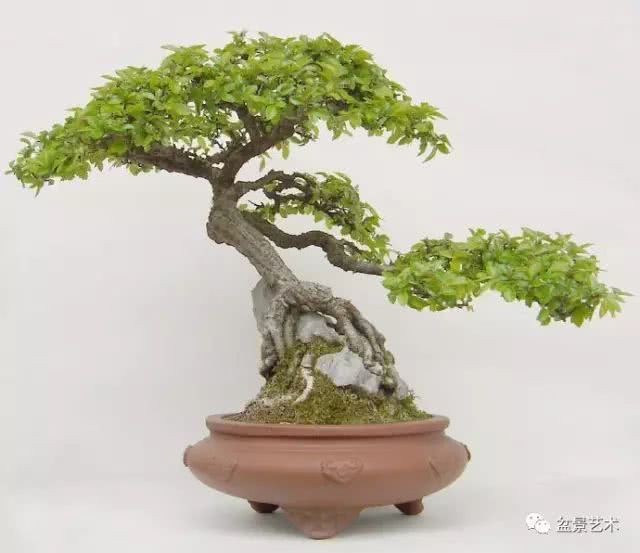
The most beautiful ornamental period for an old Chinese elm stump bonsai is when the new buds first emerge; the whole tree's new buds are like little sparkling emerald green jades adorning the branches, extremely beautiful. If it is a autumn elm or elm whose new leaves and tender branches are all red, then red beads fill the branches, offering a different kind of charm. In order to obtain the beauty of new buds and tender branches, after autumn begins, remove all the old leaves of the Chinese elm, water once with a nitrogen fertilizer solution, and persist in spraying water on the branches and trunk every morning and evening; after one week you can again enjoy the beauty of the new buds and tender branches.